Thomas A Platts-Mills, Behnam Keshavarz, Jeffrey M Wilson, Sheryl L Rifas-Shiman, Samuel M Ailsworth, Joanne E Sordillo, Lisa Workman, Martin Chapman, Jonas Lidholm, Emily Oken, Diane R Gold
{"title":"青少年早期哮喘的高风险与螨和猫过敏原特异性IgE和IgG4的数量差异有关:一种修改的Th2相关抗体反应","authors":"Thomas A Platts-Mills, Behnam Keshavarz, Jeffrey M Wilson, Sheryl L Rifas-Shiman, Samuel M Ailsworth, Joanne E Sordillo, Lisa Workman, Martin Chapman, Jonas Lidholm, Emily Oken, Diane R Gold","doi":"10.1016/j.ebiom.2024.105556","DOIUrl":null,"url":null,"abstract":"<p><strong>Background: </strong>Although proteins derived from cats are an important contributor to indoor allergen exposure in relation to asthma, it has been known for at least twenty years that some children who live in a house with a cat can become clinically tolerant to these animals. In 2001, we reported that children exposed to high levels of cat allergens made high levels of IgG4 antibodies to the cat allergen Fel d 1, and we coined the term \"a modified Th2 response\". However, this phenomenon is still poorly understood.</p><p><strong>Methods: </strong>We studied serum antibodies among 616 individuals in the Viva unselected birth cohort recruited at their early teen visit (mean age 13.1 SD 0.8). IgE and IgG4 antibodies were measured by ImmunoCAP to inhaled allergens as well as the best characterised component allergens of cat, Fel d 1, Fel d 2, Fel d 4, and Fel d 7, and the dust mite allergens Der p 1, Der p 2, Der p 10, and Der p 23.</p><p><strong>Findings: </strong>The results confirm that young teens living in a home with a cat make high levels of IgG4 specific for cat allergens, and that those antibodies, and specifically those to Fel d 1 are negatively associated with asthma. By contrast, the IgG4 responses to Fel d 4 and Fel d 7 are significantly lower and have no significant association with asthma. Perhaps more surprisingly, a similar effect is seen in relation to dust-mite allergens. Although the allergen Der p 1 is a major part of the IgE response to mite allergens, this protein also induced high prevalence and levels of IgG4 antibodies and has a less strong relationship to asthma than IgE to Der p 2 or Der p 23. Indeed, values of specific IgE to Der p 1 >3.5 IU/mL were not significantly related to asthma (OR 1.5 CI 0.8-2.8, p = 0.3, Chi<sup>2</sup> test). The prevalence and levels of specific IgG4 to these less abundant allergens are significantly lower for Der p 2 and almost absent for Der p 23.</p><p><strong>Interpretation: </strong>High exposure to specific allergens in household dust can enhance production of both sIgE and sIgG4 antibodies, while allergens where abundance is significantly lower in dust can induce sIgE with limited or no sIgG4. The result is that the less abundant allergens, i.e., Fel d 4, Fel d 7, Der p 2, and Der p 23, may have a significantly higher relevance to asthma than expected because they induce less sIgG4.</p><p><strong>Funding: </strong>This work was funded by R01-AI20565 (TPM) and support for the IgE and IgG4 assays provided by Phadia/Thermo Fisher Kalamazoo, Michigan. Project Viva is also supported by NIH R01HD034568 and R24ES.</p>","PeriodicalId":11494,"journal":{"name":"EBioMedicine","volume":"112 ","pages":"105556"},"PeriodicalIF":11.2000,"publicationDate":"2025-02-01","publicationTypes":"Journal Article","fieldsOfStudy":null,"isOpenAccess":false,"openAccessPdf":"https://www.ncbi.nlm.nih.gov/pmc/articles/PMC11840499/pdf/","citationCount":"0","resultStr":"{\"title\":\"High risk of asthma among early teens is associated with quantitative differences in mite and cat allergen specific IgE and IgG4: a modified Th2 related antibody response revisited.\",\"authors\":\"Thomas A Platts-Mills, Behnam Keshavarz, Jeffrey M Wilson, Sheryl L Rifas-Shiman, Samuel M Ailsworth, Joanne E Sordillo, Lisa Workman, Martin Chapman, Jonas Lidholm, Emily Oken, Diane R Gold\",\"doi\":\"10.1016/j.ebiom.2024.105556\",\"DOIUrl\":null,\"url\":null,\"abstract\":\"<p><strong>Background: </strong>Although proteins derived from cats are an important contributor to indoor allergen exposure in relation to asthma, it has been known for at least twenty years that some children who live in a house with a cat can become clinically tolerant to these animals. In 2001, we reported that children exposed to high levels of cat allergens made high levels of IgG4 antibodies to the cat allergen Fel d 1, and we coined the term \\\"a modified Th2 response\\\". However, this phenomenon is still poorly understood.</p><p><strong>Methods: </strong>We studied serum antibodies among 616 individuals in the Viva unselected birth cohort recruited at their early teen visit (mean age 13.1 SD 0.8). IgE and IgG4 antibodies were measured by ImmunoCAP to inhaled allergens as well as the best characterised component allergens of cat, Fel d 1, Fel d 2, Fel d 4, and Fel d 7, and the dust mite allergens Der p 1, Der p 2, Der p 10, and Der p 23.</p><p><strong>Findings: </strong>The results confirm that young teens living in a home with a cat make high levels of IgG4 specific for cat allergens, and that those antibodies, and specifically those to Fel d 1 are negatively associated with asthma. By contrast, the IgG4 responses to Fel d 4 and Fel d 7 are significantly lower and have no significant association with asthma. Perhaps more surprisingly, a similar effect is seen in relation to dust-mite allergens. Although the allergen Der p 1 is a major part of the IgE response to mite allergens, this protein also induced high prevalence and levels of IgG4 antibodies and has a less strong relationship to asthma than IgE to Der p 2 or Der p 23. Indeed, values of specific IgE to Der p 1 >3.5 IU/mL were not significantly related to asthma (OR 1.5 CI 0.8-2.8, p = 0.3, Chi<sup>2</sup> test). The prevalence and levels of specific IgG4 to these less abundant allergens are significantly lower for Der p 2 and almost absent for Der p 23.</p><p><strong>Interpretation: </strong>High exposure to specific allergens in household dust can enhance production of both sIgE and sIgG4 antibodies, while allergens where abundance is significantly lower in dust can induce sIgE with limited or no sIgG4. The result is that the less abundant allergens, i.e., Fel d 4, Fel d 7, Der p 2, and Der p 23, may have a significantly higher relevance to asthma than expected because they induce less sIgG4.</p><p><strong>Funding: </strong>This work was funded by R01-AI20565 (TPM) and support for the IgE and IgG4 assays provided by Phadia/Thermo Fisher Kalamazoo, Michigan. Project Viva is also supported by NIH R01HD034568 and R24ES.</p>\",\"PeriodicalId\":11494,\"journal\":{\"name\":\"EBioMedicine\",\"volume\":\"112 \",\"pages\":\"105556\"},\"PeriodicalIF\":11.2000,\"publicationDate\":\"2025-02-01\",\"publicationTypes\":\"Journal Article\",\"fieldsOfStudy\":null,\"isOpenAccess\":false,\"openAccessPdf\":\"https://www.ncbi.nlm.nih.gov/pmc/articles/PMC11840499/pdf/\",\"citationCount\":\"0\",\"resultStr\":null,\"platform\":\"Semanticscholar\",\"paperid\":null,\"PeriodicalName\":\"EBioMedicine\",\"FirstCategoryId\":\"3\",\"ListUrlMain\":\"https://doi.org/10.1016/j.ebiom.2024.105556\",\"RegionNum\":1,\"RegionCategory\":\"医学\",\"ArticlePicture\":[],\"TitleCN\":null,\"AbstractTextCN\":null,\"PMCID\":null,\"EPubDate\":\"\",\"PubModel\":\"\",\"JCR\":\"Q1\",\"JCRName\":\"MEDICINE, RESEARCH & EXPERIMENTAL\",\"Score\":null,\"Total\":0}","platform":"Semanticscholar","paperid":null,"PeriodicalName":"EBioMedicine","FirstCategoryId":"3","ListUrlMain":"https://doi.org/10.1016/j.ebiom.2024.105556","RegionNum":1,"RegionCategory":"医学","ArticlePicture":[],"TitleCN":null,"AbstractTextCN":null,"PMCID":null,"EPubDate":"","PubModel":"","JCR":"Q1","JCRName":"MEDICINE, RESEARCH & EXPERIMENTAL","Score":null,"Total":0}
引用次数: 0
摘要
背景:虽然来自猫的蛋白质是与哮喘相关的室内过敏原暴露的重要因素,但至少20年来人们已经知道,一些与猫住在一起的儿童在临床上可以对这些动物产生耐受性。2001年,我们报道了暴露于高水平猫过敏原的儿童产生高水平的猫过敏原Fel d1的IgG4抗体,我们创造了“修饰的Th2反应”这个术语。然而,人们对这一现象仍然知之甚少。方法:我们研究了在Viva未选择出生队列中招募的616人的血清抗体,这些人在青少年早期访问时(平均年龄13.1 SD 0.8)。采用ImmunoCAP检测对吸入性变应原的IgE和IgG4抗体,以及猫、Fel d1、Fel d2、Fel d1、Fel d1、Fel d1和Fel d1、尘螨变应原Der p1、Der p2、Der p10和Der p23最具特征的组成变应原。研究发现:研究结果证实,与猫一起生活的青少年体内的IgG4抗体水平较高,这些抗体,特别是针对Fel d1的抗体,与哮喘呈负相关。相比之下,IgG4对Fel d 4和Fel d 7的反应明显降低,与哮喘无显著相关性。也许更令人惊讶的是,尘螨过敏原也有类似的效果。虽然过敏原Der p1是IgE对螨过敏原反应的主要部分,但该蛋白也诱导IgG4抗体的高流行率和水平,并且与哮喘的关系不如Der p2或Der p23的IgE强。确实,特异性IgE值与哮喘无显著相关性(OR 1.5 CI 0.8 ~ 2.8, p = 0.3, Chi2检验)。对这些较少的过敏原的特异性IgG4的流行率和水平在Der p2中明显较低,而在Der p23中几乎不存在。解释:高暴露于家庭粉尘中的特定过敏原可以增强sIgE和sIgG4抗体的产生,而粉尘中丰度明显较低的过敏原可以诱导sIgE,但sIgG4有限或没有。结果表明,较少丰富的过敏原,即Fel d 4、Fel d 7、Der p2和Der p23,可能与哮喘的相关性比预期的要高,因为它们诱导的sIgG4较少。经费:本工作由R01-AI20565 (TPM)资助,IgE和IgG4检测由Phadia/Thermo Fisher Kalamazoo, Michigan提供支持。Viva项目也得到了NIH R01HD034568和R24ES的支持。
High risk of asthma among early teens is associated with quantitative differences in mite and cat allergen specific IgE and IgG4: a modified Th2 related antibody response revisited.
Background: Although proteins derived from cats are an important contributor to indoor allergen exposure in relation to asthma, it has been known for at least twenty years that some children who live in a house with a cat can become clinically tolerant to these animals. In 2001, we reported that children exposed to high levels of cat allergens made high levels of IgG4 antibodies to the cat allergen Fel d 1, and we coined the term "a modified Th2 response". However, this phenomenon is still poorly understood.
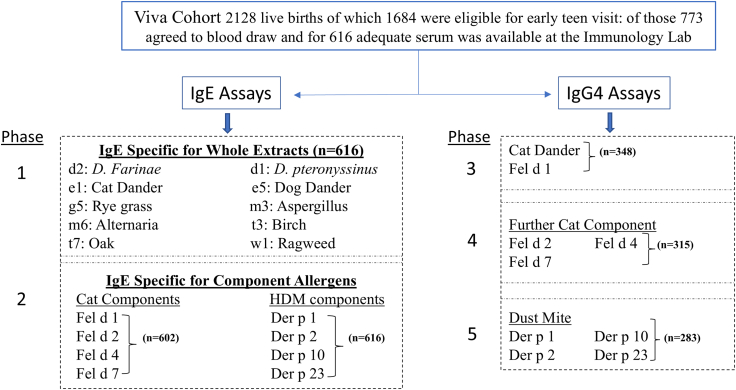
Methods: We studied serum antibodies among 616 individuals in the Viva unselected birth cohort recruited at their early teen visit (mean age 13.1 SD 0.8). IgE and IgG4 antibodies were measured by ImmunoCAP to inhaled allergens as well as the best characterised component allergens of cat, Fel d 1, Fel d 2, Fel d 4, and Fel d 7, and the dust mite allergens Der p 1, Der p 2, Der p 10, and Der p 23.
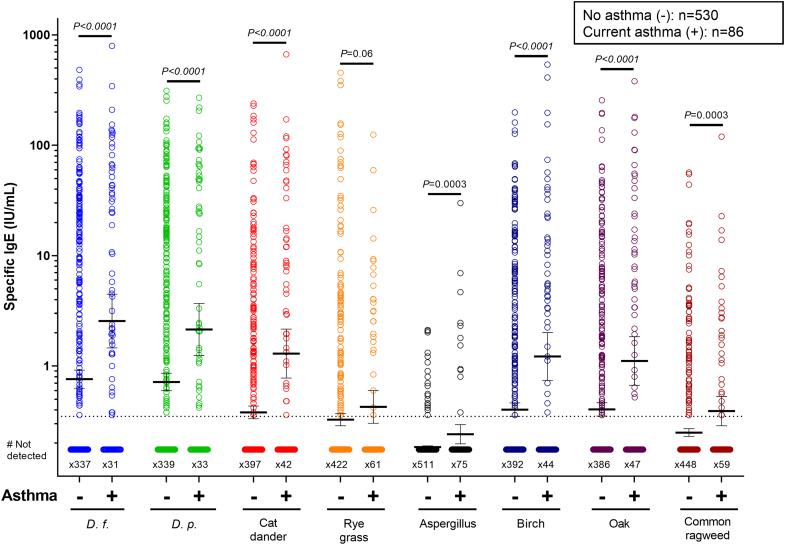
Findings: The results confirm that young teens living in a home with a cat make high levels of IgG4 specific for cat allergens, and that those antibodies, and specifically those to Fel d 1 are negatively associated with asthma. By contrast, the IgG4 responses to Fel d 4 and Fel d 7 are significantly lower and have no significant association with asthma. Perhaps more surprisingly, a similar effect is seen in relation to dust-mite allergens. Although the allergen Der p 1 is a major part of the IgE response to mite allergens, this protein also induced high prevalence and levels of IgG4 antibodies and has a less strong relationship to asthma than IgE to Der p 2 or Der p 23. Indeed, values of specific IgE to Der p 1 >3.5 IU/mL were not significantly related to asthma (OR 1.5 CI 0.8-2.8, p = 0.3, Chi2 test). The prevalence and levels of specific IgG4 to these less abundant allergens are significantly lower for Der p 2 and almost absent for Der p 23.
Interpretation: High exposure to specific allergens in household dust can enhance production of both sIgE and sIgG4 antibodies, while allergens where abundance is significantly lower in dust can induce sIgE with limited or no sIgG4. The result is that the less abundant allergens, i.e., Fel d 4, Fel d 7, Der p 2, and Der p 23, may have a significantly higher relevance to asthma than expected because they induce less sIgG4.
Funding: This work was funded by R01-AI20565 (TPM) and support for the IgE and IgG4 assays provided by Phadia/Thermo Fisher Kalamazoo, Michigan. Project Viva is also supported by NIH R01HD034568 and R24ES.
EBioMedicineBiochemistry, Genetics and Molecular Biology-General Biochemistry,Genetics and Molecular Biology
CiteScore
17.70
自引率
0.90%
发文量
579
审稿时长
5 weeks
期刊介绍:
eBioMedicine is a comprehensive biomedical research journal that covers a wide range of studies that are relevant to human health. Our focus is on original research that explores the fundamental factors influencing human health and disease, including the discovery of new therapeutic targets and treatments, the identification of biomarkers and diagnostic tools, and the investigation and modification of disease pathways and mechanisms. We welcome studies from any biomedical discipline that contribute to our understanding of disease and aim to improve human health.





 京公网安备 11010802042870号
京ICP备2023020795号-1
京公网安备 11010802042870号
京ICP备2023020795号-1

 分享
分享
 求助内容:
求助内容: 应助结果提醒方式:
 扫码关注我们
