Yao Yao, Jiawen Liu, Lei Li, Weiwei Chen, Zhaojun Meng, Jing Fu
{"title":"影响西藏儿童光学相干断层成像质量的因素。","authors":"Yao Yao, Jiawen Liu, Lei Li, Weiwei Chen, Zhaojun Meng, Jing Fu","doi":"10.3389/fmed.2025.1495527","DOIUrl":null,"url":null,"abstract":"<p><strong>Purpose: </strong>This study aim to investigate the clinical findings of subjects characteristics and image quality related factors in Tibetan children by optical coherence tomography (OCT) in epidemiological cohort study.</p><p><strong>Methods: </strong>Participants were 1,856 first-grade students (mean age = 6.82 ± 0.46 years) from seven selected elementary schools in Lhasa. Following comprehensive systemic and ophthalmic examinations, OCT scans were assessed by specialists with manual segmentation as needed.</p><p><strong>Results: </strong>A total of 1,698 students completed the examination protocol in this study (91.5%). After manual screening, 1,447 (78%) and 1,289 (70%) images could be analyzed in the macular and optic disc regions, respectively. Common image flaws were blinking or fixation error (70%+), poor focusing, and positioning errors. Among students who have completed OCT, a higher percentage of boys (<i>X</i> <sup>2</sup> = 8.48, <i>P</i> = 0.004) and suburban students (<i>X</i> <sup>2</sup> = 34.97, <i>P</i> < 0.001) with younger age (<i>t</i> = -2.20, <i>P</i> = 0.03), worse near vision (<i>t</i> = -3.95, <i>P</i> < 0.001), higher IOP (<i>t</i> = 2.38, <i>P</i> = 0.017) and higher heart rate (<i>t</i> = 3.15, <i>P</i> = 0.002) have unsatisfactory image quality in the macular region, almost same as the optic disc region. Students in suburban schools (OR = 1.74, <i>P</i> < 0.001) with lower near VA (OR = 6.64, <i>P</i> < 0.001) or boys (OR = 0.78, <i>P</i> = 0.03) were more likely to have worse image quality on OCT scans when corrected for ethnicity. Manual segmentation was more prevalent in the optic disc region, resulting in increased retinal thickness across most subregions.</p><p><strong>Conclusion: </strong>This study underscores the imperative for stringent image quality control in pediatric OCT assessments to ensure precise clinical outcomes.</p>","PeriodicalId":12488,"journal":{"name":"Frontiers in Medicine","volume":"12 ","pages":"1495527"},"PeriodicalIF":3.6000,"publicationDate":"2025-01-17","publicationTypes":"Journal Article","fieldsOfStudy":null,"isOpenAccess":false,"openAccessPdf":"https://www.ncbi.nlm.nih.gov/pmc/articles/PMC11782558/pdf/","citationCount":"0","resultStr":"{\"title\":\"Factors influencing image quality in Tibetan children by optical coherence tomography.\",\"authors\":\"Yao Yao, Jiawen Liu, Lei Li, Weiwei Chen, Zhaojun Meng, Jing Fu\",\"doi\":\"10.3389/fmed.2025.1495527\",\"DOIUrl\":null,\"url\":null,\"abstract\":\"<p><strong>Purpose: </strong>This study aim to investigate the clinical findings of subjects characteristics and image quality related factors in Tibetan children by optical coherence tomography (OCT) in epidemiological cohort study.</p><p><strong>Methods: </strong>Participants were 1,856 first-grade students (mean age = 6.82 ± 0.46 years) from seven selected elementary schools in Lhasa. Following comprehensive systemic and ophthalmic examinations, OCT scans were assessed by specialists with manual segmentation as needed.</p><p><strong>Results: </strong>A total of 1,698 students completed the examination protocol in this study (91.5%). After manual screening, 1,447 (78%) and 1,289 (70%) images could be analyzed in the macular and optic disc regions, respectively. Common image flaws were blinking or fixation error (70%+), poor focusing, and positioning errors. Among students who have completed OCT, a higher percentage of boys (<i>X</i> <sup>2</sup> = 8.48, <i>P</i> = 0.004) and suburban students (<i>X</i> <sup>2</sup> = 34.97, <i>P</i> < 0.001) with younger age (<i>t</i> = -2.20, <i>P</i> = 0.03), worse near vision (<i>t</i> = -3.95, <i>P</i> < 0.001), higher IOP (<i>t</i> = 2.38, <i>P</i> = 0.017) and higher heart rate (<i>t</i> = 3.15, <i>P</i> = 0.002) have unsatisfactory image quality in the macular region, almost same as the optic disc region. Students in suburban schools (OR = 1.74, <i>P</i> < 0.001) with lower near VA (OR = 6.64, <i>P</i> < 0.001) or boys (OR = 0.78, <i>P</i> = 0.03) were more likely to have worse image quality on OCT scans when corrected for ethnicity. Manual segmentation was more prevalent in the optic disc region, resulting in increased retinal thickness across most subregions.</p><p><strong>Conclusion: </strong>This study underscores the imperative for stringent image quality control in pediatric OCT assessments to ensure precise clinical outcomes.</p>\",\"PeriodicalId\":12488,\"journal\":{\"name\":\"Frontiers in Medicine\",\"volume\":\"12 \",\"pages\":\"1495527\"},\"PeriodicalIF\":3.6000,\"publicationDate\":\"2025-01-17\",\"publicationTypes\":\"Journal Article\",\"fieldsOfStudy\":null,\"isOpenAccess\":false,\"openAccessPdf\":\"https://www.ncbi.nlm.nih.gov/pmc/articles/PMC11782558/pdf/\",\"citationCount\":\"0\",\"resultStr\":null,\"platform\":\"Semanticscholar\",\"paperid\":null,\"PeriodicalName\":\"Frontiers in Medicine\",\"FirstCategoryId\":\"3\",\"ListUrlMain\":\"https://doi.org/10.3389/fmed.2025.1495527\",\"RegionNum\":3,\"RegionCategory\":\"医学\",\"ArticlePicture\":[],\"TitleCN\":null,\"AbstractTextCN\":null,\"PMCID\":null,\"EPubDate\":\"2025/1/1 0:00:00\",\"PubModel\":\"eCollection\",\"JCR\":\"Q1\",\"JCRName\":\"MEDICINE, GENERAL & INTERNAL\",\"Score\":null,\"Total\":0}","platform":"Semanticscholar","paperid":null,"PeriodicalName":"Frontiers in Medicine","FirstCategoryId":"3","ListUrlMain":"https://doi.org/10.3389/fmed.2025.1495527","RegionNum":3,"RegionCategory":"医学","ArticlePicture":[],"TitleCN":null,"AbstractTextCN":null,"PMCID":null,"EPubDate":"2025/1/1 0:00:00","PubModel":"eCollection","JCR":"Q1","JCRName":"MEDICINE, GENERAL & INTERNAL","Score":null,"Total":0}
引用次数: 0
摘要
目的:探讨流行病学队列研究中光学相干断层扫描(OCT)对藏族儿童被试特征及图像质量相关因素的临床表现。方法:选取拉萨市7所小学的1856名一年级学生(平均年龄= 6.82±0.46岁)作为研究对象。在全面的系统检查和眼科检查之后,由专家评估OCT扫描,并根据需要进行手动分割。结果:本研究共有1698名学生完成了检查方案,占91.5%。经人工筛选,黄斑区和视盘区分别可分析1447张(78%)和1289张(70%)图像。常见的图像缺陷为闪烁或注视误差(70%以上)、聚焦差、定位误差。在完成OCT的学生中,年龄较小(t = -2.20, P = 0.03)、近视力较差(t = -3.95, P < 0.001)、IOP较高(t = 2.38, P = 0.017)、心率较高(t = 3.15, P = 0.002)的男生(x2 = 8.48, P = 0.004)和郊区学生(x2 = 34.97, P < 0.001)的黄斑区图像质量不理想的比例较高,与视盘区几乎相同。在校正种族因素后,郊区学校的学生(OR = 1.74, P < 0.001),近VA较低(OR = 6.64, P < 0.001)或男孩(OR = 0.78, P = 0.03)的OCT扫描图像质量更差。手动分割是更普遍的视盘区域,导致增加视网膜厚度在大多数次区域。结论:本研究强调了在儿童OCT评估中严格的图像质量控制以确保准确的临床结果的必要性。
Factors influencing image quality in Tibetan children by optical coherence tomography.
Purpose: This study aim to investigate the clinical findings of subjects characteristics and image quality related factors in Tibetan children by optical coherence tomography (OCT) in epidemiological cohort study.
Methods: Participants were 1,856 first-grade students (mean age = 6.82 ± 0.46 years) from seven selected elementary schools in Lhasa. Following comprehensive systemic and ophthalmic examinations, OCT scans were assessed by specialists with manual segmentation as needed.
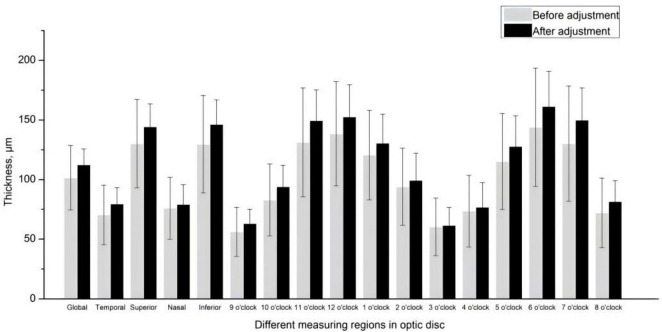
Results: A total of 1,698 students completed the examination protocol in this study (91.5%). After manual screening, 1,447 (78%) and 1,289 (70%) images could be analyzed in the macular and optic disc regions, respectively. Common image flaws were blinking or fixation error (70%+), poor focusing, and positioning errors. Among students who have completed OCT, a higher percentage of boys (X2 = 8.48, P = 0.004) and suburban students (X2 = 34.97, P < 0.001) with younger age (t = -2.20, P = 0.03), worse near vision (t = -3.95, P < 0.001), higher IOP (t = 2.38, P = 0.017) and higher heart rate (t = 3.15, P = 0.002) have unsatisfactory image quality in the macular region, almost same as the optic disc region. Students in suburban schools (OR = 1.74, P < 0.001) with lower near VA (OR = 6.64, P < 0.001) or boys (OR = 0.78, P = 0.03) were more likely to have worse image quality on OCT scans when corrected for ethnicity. Manual segmentation was more prevalent in the optic disc region, resulting in increased retinal thickness across most subregions.
Conclusion: This study underscores the imperative for stringent image quality control in pediatric OCT assessments to ensure precise clinical outcomes.
期刊介绍:
Frontiers in Medicine publishes rigorously peer-reviewed research linking basic research to clinical practice and patient care, as well as translating scientific advances into new therapies and diagnostic tools. Led by an outstanding Editorial Board of international experts, this multidisciplinary open-access journal is at the forefront of disseminating and communicating scientific knowledge and impactful discoveries to researchers, academics, clinicians and the public worldwide.
In addition to papers that provide a link between basic research and clinical practice, a particular emphasis is given to studies that are directly relevant to patient care. In this spirit, the journal publishes the latest research results and medical knowledge that facilitate the translation of scientific advances into new therapies or diagnostic tools. The full listing of the Specialty Sections represented by Frontiers in Medicine is as listed below. As well as the established medical disciplines, Frontiers in Medicine is launching new sections that together will facilitate
- the use of patient-reported outcomes under real world conditions
- the exploitation of big data and the use of novel information and communication tools in the assessment of new medicines
- the scientific bases for guidelines and decisions from regulatory authorities
- access to medicinal products and medical devices worldwide
- addressing the grand health challenges around the world







 京公网安备 11010802042870号
京ICP备2023020795号-1
京公网安备 11010802042870号
京ICP备2023020795号-1

 分享
分享
 求助内容:
求助内容: 应助结果提醒方式:
 扫码关注我们
