Per Aslak Myraunet, Atle Hole Saeterbakken, Vidar Andersen
{"title":"未经训练的成人超集与传统抗阻训练的急性情感反应、生理指标和训练量比较。","authors":"Per Aslak Myraunet, Atle Hole Saeterbakken, Vidar Andersen","doi":"10.3389/fspor.2025.1536747","DOIUrl":null,"url":null,"abstract":"<p><p>The aim of this study was to compare the perceptive responses, physiological measures, training volume and training duration comparing a superset vs. a traditional resistance training session in untrained adults. Thirty adults (29 ± 7 years, 1.72 ± 0.1 m, 77 ± 16 kg) performed one superset resistance training session and one traditional resistance training session in a randomized-crossover design. Both sessions consisted of eight exercises with two sets and a load of ∼10-repetition maximum. The outcomes included number of repetitions, training duration, blood lactate and heart rate in addition to rate of perceived exertion (RPE), rate of perceived discomfort (RPD), session displeasure/pleasure (sPDF) and exercise enjoyment (EES) which were recorded in the middle and post-exercise. Forty-eight hours after the last session the participants reported which session they would prefer as their regular routine if they had to choose. The main findings were that the superset session led to greater RPE compared to the traditional session (<i>p</i> = 0.012-0.16, <i>d</i> = 0.53-0.54). Further, there was a trend towards greater RPD after the superset session, although not reaching statistical significance (<i>p</i> = 0.092, <i>d</i> = 0.41). There were no differences for sPDF (<i>p</i> = 0.404) or EES (<i>p</i> = 0.829). Furthermore, the superset session demonstrated higher levels of blood lactate levels (18.3%. <i>p</i> < 0.001, <i>d</i> = 0.81) and average heart rate (7.8%, <i>p</i> < 0.001, <i>d</i> = 1.53) compared to the traditional session. The traditional session took 60% longer time (<i>p</i> < 0.001, <i>d</i> = 6.62), and had 4.6% more repetitions (<i>p</i> = 0.006, <i>d</i> = 0.54) compared to the superset session. Two out of three participants reported the superset session as their preferred regular training routine. In conclusion, the superset session led to a higher perceived effort and discomfort, higher metabolic stress, took less time, had a lower training volume and was more preferred compared to the traditional session in untrained adults.</p>","PeriodicalId":12716,"journal":{"name":"Frontiers in Sports and Active Living","volume":"7 ","pages":"1536747"},"PeriodicalIF":3.0000,"publicationDate":"2025-01-17","publicationTypes":"Journal Article","fieldsOfStudy":null,"isOpenAccess":false,"openAccessPdf":"https://www.ncbi.nlm.nih.gov/pmc/articles/PMC11782152/pdf/","citationCount":"0","resultStr":"{\"title\":\"A comparison of acute affective responses, physiological measures and training volume between superset and traditional resistance training in untrained adults.\",\"authors\":\"Per Aslak Myraunet, Atle Hole Saeterbakken, Vidar Andersen\",\"doi\":\"10.3389/fspor.2025.1536747\",\"DOIUrl\":null,\"url\":null,\"abstract\":\"<p><p>The aim of this study was to compare the perceptive responses, physiological measures, training volume and training duration comparing a superset vs. a traditional resistance training session in untrained adults. Thirty adults (29 ± 7 years, 1.72 ± 0.1 m, 77 ± 16 kg) performed one superset resistance training session and one traditional resistance training session in a randomized-crossover design. Both sessions consisted of eight exercises with two sets and a load of ∼10-repetition maximum. The outcomes included number of repetitions, training duration, blood lactate and heart rate in addition to rate of perceived exertion (RPE), rate of perceived discomfort (RPD), session displeasure/pleasure (sPDF) and exercise enjoyment (EES) which were recorded in the middle and post-exercise. Forty-eight hours after the last session the participants reported which session they would prefer as their regular routine if they had to choose. The main findings were that the superset session led to greater RPE compared to the traditional session (<i>p</i> = 0.012-0.16, <i>d</i> = 0.53-0.54). Further, there was a trend towards greater RPD after the superset session, although not reaching statistical significance (<i>p</i> = 0.092, <i>d</i> = 0.41). There were no differences for sPDF (<i>p</i> = 0.404) or EES (<i>p</i> = 0.829). Furthermore, the superset session demonstrated higher levels of blood lactate levels (18.3%. <i>p</i> < 0.001, <i>d</i> = 0.81) and average heart rate (7.8%, <i>p</i> < 0.001, <i>d</i> = 1.53) compared to the traditional session. The traditional session took 60% longer time (<i>p</i> < 0.001, <i>d</i> = 6.62), and had 4.6% more repetitions (<i>p</i> = 0.006, <i>d</i> = 0.54) compared to the superset session. Two out of three participants reported the superset session as their preferred regular training routine. In conclusion, the superset session led to a higher perceived effort and discomfort, higher metabolic stress, took less time, had a lower training volume and was more preferred compared to the traditional session in untrained adults.</p>\",\"PeriodicalId\":12716,\"journal\":{\"name\":\"Frontiers in Sports and Active Living\",\"volume\":\"7 \",\"pages\":\"1536747\"},\"PeriodicalIF\":3.0000,\"publicationDate\":\"2025-01-17\",\"publicationTypes\":\"Journal Article\",\"fieldsOfStudy\":null,\"isOpenAccess\":false,\"openAccessPdf\":\"https://www.ncbi.nlm.nih.gov/pmc/articles/PMC11782152/pdf/\",\"citationCount\":\"0\",\"resultStr\":null,\"platform\":\"Semanticscholar\",\"paperid\":null,\"PeriodicalName\":\"Frontiers in Sports and Active Living\",\"FirstCategoryId\":\"1085\",\"ListUrlMain\":\"https://doi.org/10.3389/fspor.2025.1536747\",\"RegionNum\":0,\"RegionCategory\":null,\"ArticlePicture\":[],\"TitleCN\":null,\"AbstractTextCN\":null,\"PMCID\":null,\"EPubDate\":\"2025/1/1 0:00:00\",\"PubModel\":\"eCollection\",\"JCR\":\"Q2\",\"JCRName\":\"SPORT SCIENCES\",\"Score\":null,\"Total\":0}","platform":"Semanticscholar","paperid":null,"PeriodicalName":"Frontiers in Sports and Active Living","FirstCategoryId":"1085","ListUrlMain":"https://doi.org/10.3389/fspor.2025.1536747","RegionNum":0,"RegionCategory":null,"ArticlePicture":[],"TitleCN":null,"AbstractTextCN":null,"PMCID":null,"EPubDate":"2025/1/1 0:00:00","PubModel":"eCollection","JCR":"Q2","JCRName":"SPORT SCIENCES","Score":null,"Total":0}
引用次数: 0
摘要
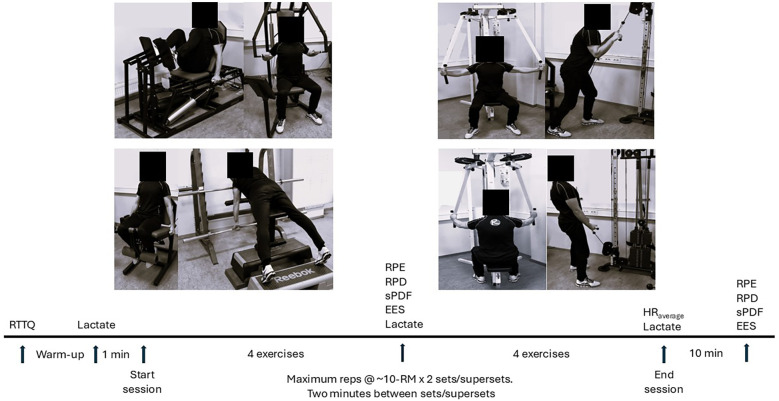
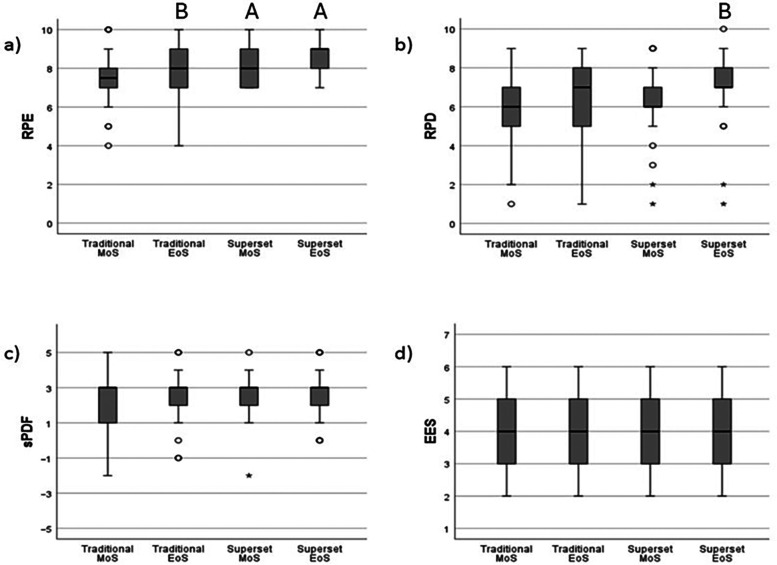
本研究的目的是比较超集和传统抗阻训练对未训练成人的感知反应、生理指标、训练量和训练时间的影响。30名成年人(29±7岁,1.72±0.1 m, 77±16 kg)进行了一次超集阻力训练和一次传统阻力训练,随机交叉设计。两次训练均由8个练习组成,每组2组,最多重复10次。结果包括重复次数、训练持续时间、血乳酸和心率,以及在运动中和运动后记录的感知用力率(RPE)、感知不适率(RPD)、运动不快/快乐(sPDF)和运动享受(EES)。在最后一次训练后48小时,参与者报告如果让他们选择,他们更喜欢哪一次训练作为他们的常规训练。主要发现是,与传统会话相比,超集会话导致更大的RPE (p = 0.012-0.16, d = 0.53-0.54)。此外,在超集会话之后,RPD有更大的趋势,尽管没有达到统计学意义(p = 0.092, d = 0.41)。sPDF (p = 0.404)和EES (p = 0.829)无差异。此外,超集组表现出更高的血乳酸水平(18.3%)。P d = 0.81)和平均心率(7.8%,P d = 1.53)。与超集会话相比,传统会话花费的时间长60% (p d = 6.62),重复次数多4.6% (p = 0.006, d = 0.54)。三分之二的参与者报告说,超集训练是他们首选的常规训练。总之,与未经训练的成年人的传统训练相比,超集训练导致更高的感知努力和不适,更高的代谢压力,更少的时间,更少的训练量,更受欢迎。
A comparison of acute affective responses, physiological measures and training volume between superset and traditional resistance training in untrained adults.
The aim of this study was to compare the perceptive responses, physiological measures, training volume and training duration comparing a superset vs. a traditional resistance training session in untrained adults. Thirty adults (29 ± 7 years, 1.72 ± 0.1 m, 77 ± 16 kg) performed one superset resistance training session and one traditional resistance training session in a randomized-crossover design. Both sessions consisted of eight exercises with two sets and a load of ∼10-repetition maximum. The outcomes included number of repetitions, training duration, blood lactate and heart rate in addition to rate of perceived exertion (RPE), rate of perceived discomfort (RPD), session displeasure/pleasure (sPDF) and exercise enjoyment (EES) which were recorded in the middle and post-exercise. Forty-eight hours after the last session the participants reported which session they would prefer as their regular routine if they had to choose. The main findings were that the superset session led to greater RPE compared to the traditional session (p = 0.012-0.16, d = 0.53-0.54). Further, there was a trend towards greater RPD after the superset session, although not reaching statistical significance (p = 0.092, d = 0.41). There were no differences for sPDF (p = 0.404) or EES (p = 0.829). Furthermore, the superset session demonstrated higher levels of blood lactate levels (18.3%. p < 0.001, d = 0.81) and average heart rate (7.8%, p < 0.001, d = 1.53) compared to the traditional session. The traditional session took 60% longer time (p < 0.001, d = 6.62), and had 4.6% more repetitions (p = 0.006, d = 0.54) compared to the superset session. Two out of three participants reported the superset session as their preferred regular training routine. In conclusion, the superset session led to a higher perceived effort and discomfort, higher metabolic stress, took less time, had a lower training volume and was more preferred compared to the traditional session in untrained adults.





 京公网安备 11010802042870号
京ICP备2023020795号-1
京公网安备 11010802042870号
京ICP备2023020795号-1

 分享
分享
 求助内容:
求助内容: 应助结果提醒方式:
 扫码关注我们
