{"title":"HMGA1是APC缺失驱动的结肠肿瘤发生的重要介质。","authors":"Yuxiang Wang, Mikayla Ybarra, Zhenghe Wang","doi":"10.1172/JCI187442","DOIUrl":null,"url":null,"abstract":"<p><p>Colorectal cancer is the second leading cause of cancer death in the United States. The adenomatous polyposis coli (APC) pathway plays a critical role in colorectal tumorigenesis, but the mechanism is not fully understood. In this issue of the JCI, Luo and colleagues used genetically engineered mouse models to show that high mobility group A (HMGA1) is a critical mediator in the development of colon tumors driven by the loss of the Apc gene. HMGA1 activated the transcription of Achaete-Scute Family BHLH Transcription Factor 2 (ASCL2), which regulated intestinal stemness and promoted colon tumorigenesis.</p>","PeriodicalId":15469,"journal":{"name":"Journal of Clinical Investigation","volume":"135 3","pages":""},"PeriodicalIF":13.6000,"publicationDate":"2025-02-03","publicationTypes":"Journal Article","fieldsOfStudy":null,"isOpenAccess":false,"openAccessPdf":"https://www.ncbi.nlm.nih.gov/pmc/articles/PMC11785912/pdf/","citationCount":"0","resultStr":"{\"title\":\"HMGA1 is a crucial mediator of colon tumorigenesis driven by the loss of APC.\",\"authors\":\"Yuxiang Wang, Mikayla Ybarra, Zhenghe Wang\",\"doi\":\"10.1172/JCI187442\",\"DOIUrl\":null,\"url\":null,\"abstract\":\"<p><p>Colorectal cancer is the second leading cause of cancer death in the United States. The adenomatous polyposis coli (APC) pathway plays a critical role in colorectal tumorigenesis, but the mechanism is not fully understood. In this issue of the JCI, Luo and colleagues used genetically engineered mouse models to show that high mobility group A (HMGA1) is a critical mediator in the development of colon tumors driven by the loss of the Apc gene. HMGA1 activated the transcription of Achaete-Scute Family BHLH Transcription Factor 2 (ASCL2), which regulated intestinal stemness and promoted colon tumorigenesis.</p>\",\"PeriodicalId\":15469,\"journal\":{\"name\":\"Journal of Clinical Investigation\",\"volume\":\"135 3\",\"pages\":\"\"},\"PeriodicalIF\":13.6000,\"publicationDate\":\"2025-02-03\",\"publicationTypes\":\"Journal Article\",\"fieldsOfStudy\":null,\"isOpenAccess\":false,\"openAccessPdf\":\"https://www.ncbi.nlm.nih.gov/pmc/articles/PMC11785912/pdf/\",\"citationCount\":\"0\",\"resultStr\":null,\"platform\":\"Semanticscholar\",\"paperid\":null,\"PeriodicalName\":\"Journal of Clinical Investigation\",\"FirstCategoryId\":\"3\",\"ListUrlMain\":\"https://doi.org/10.1172/JCI187442\",\"RegionNum\":1,\"RegionCategory\":\"医学\",\"ArticlePicture\":[],\"TitleCN\":null,\"AbstractTextCN\":null,\"PMCID\":null,\"EPubDate\":\"\",\"PubModel\":\"\",\"JCR\":\"Q1\",\"JCRName\":\"MEDICINE, RESEARCH & EXPERIMENTAL\",\"Score\":null,\"Total\":0}","platform":"Semanticscholar","paperid":null,"PeriodicalName":"Journal of Clinical Investigation","FirstCategoryId":"3","ListUrlMain":"https://doi.org/10.1172/JCI187442","RegionNum":1,"RegionCategory":"医学","ArticlePicture":[],"TitleCN":null,"AbstractTextCN":null,"PMCID":null,"EPubDate":"","PubModel":"","JCR":"Q1","JCRName":"MEDICINE, RESEARCH & EXPERIMENTAL","Score":null,"Total":0}
引用次数: 0
摘要
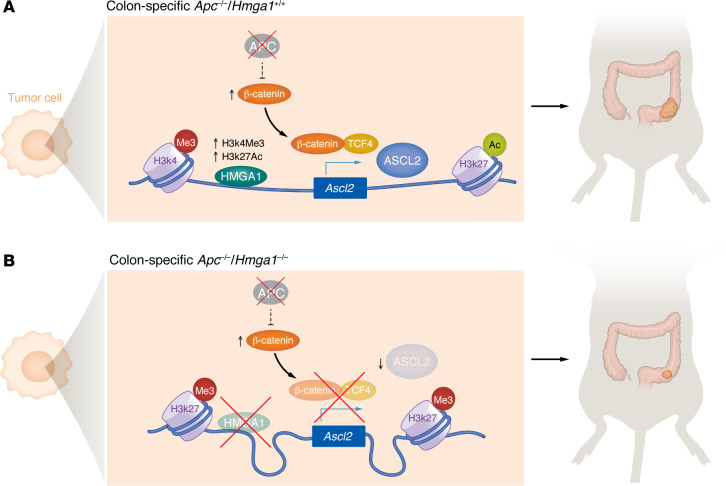
结直肠癌是美国癌症死亡的第二大原因。大肠腺瘤性息肉病(APC)通路在结直肠肿瘤发生中起关键作用,但其机制尚不完全清楚。在这一期的JCI中,Luo及其同事使用基因工程小鼠模型表明,高迁移率组A (HMGA1)是Apc基因缺失驱动的结肠肿瘤发展的关键介质。HMGA1激活achaet - sccute Family BHLH转录因子2 (ASCL2)的转录,调节肠干性,促进结肠肿瘤发生。
HMGA1 is a crucial mediator of colon tumorigenesis driven by the loss of APC.
Colorectal cancer is the second leading cause of cancer death in the United States. The adenomatous polyposis coli (APC) pathway plays a critical role in colorectal tumorigenesis, but the mechanism is not fully understood. In this issue of the JCI, Luo and colleagues used genetically engineered mouse models to show that high mobility group A (HMGA1) is a critical mediator in the development of colon tumors driven by the loss of the Apc gene. HMGA1 activated the transcription of Achaete-Scute Family BHLH Transcription Factor 2 (ASCL2), which regulated intestinal stemness and promoted colon tumorigenesis.
期刊介绍:
The Journal of Clinical Investigation, established in 1924 by the ASCI, is a prestigious publication that focuses on breakthroughs in basic and clinical biomedical science, with the goal of advancing the field of medicine. With an impressive Impact Factor of 15.9 in 2022, it is recognized as one of the leading journals in the "Medicine, Research & Experimental" category of the Web of Science.
The journal attracts a diverse readership from various medical disciplines and sectors. It publishes a wide range of research articles encompassing all biomedical specialties, including Autoimmunity, Gastroenterology, Immunology, Metabolism, Nephrology, Neuroscience, Oncology, Pulmonology, Vascular Biology, and many others.
The Editorial Board consists of esteemed academic editors who possess extensive expertise in their respective fields. They are actively involved in research, ensuring the journal's high standards of publication and scientific rigor.




 京公网安备 11010802042870号
京ICP备2023020795号-1
京公网安备 11010802042870号
京ICP备2023020795号-1

 分享
分享
 求助内容:
求助内容: 应助结果提醒方式:
 扫码关注我们
