Xiaojuan Li , Yiwei Cui , Chuxin Zhang , Weiyu Zang, Yuli Cheng, Chenyu Yang, Shujing Zhang, Xue Yu, Lin Gao
{"title":"秦归丸通过AMPK / PGC-1通路治疗PCOS卵母细胞异常发育。","authors":"Xiaojuan Li , Yiwei Cui , Chuxin Zhang , Weiyu Zang, Yuli Cheng, Chenyu Yang, Shujing Zhang, Xue Yu, Lin Gao","doi":"10.1016/j.jep.2025.119434","DOIUrl":null,"url":null,"abstract":"<div><h3>Objectives</h3><div>To investigate the therapeutic effects of <em>Qin Gui Wan</em> (QGW) and its disassembled functional drug groups, <em>Wenyang Zhuhuo</em> (WYZH) and <em>Xinwen Zhuyang</em> (XWZY), on letrozole-induced PCOS rats.</div></div><div><h3>Methods</h3><div>PCOS rat model was established by administering letrozole for 21 days. The rats were divided into control, PCOS, Diane-35, QGW, WYZH and XWZY groups. The changes of body weight, ovarian coefficient, estrous cycle and sex hormone levels were observed. The ovarian histological characteristics and ovulation were observed by HE staining. P450arom, SF-1, and AMPK/PGC-1ɑ pathway mRNA and protein expression were analyzed using qRT-PCR, WB, and IHC. The AMPK inhibitor Compound C (CC) was used to explore the treatment mechanism of QGW in granulosa cells. And UHPLC-MS/MS was used to performed chemical composition analysis.</div></div><div><h3>Results</h3><div>QGW, WYZH, and XWZY can correct the disordered estrous cycle of PCOS rats and improve the serum hormone status of rats to varying degrees. HE results indicated that QGW, WYZH, and XWZY improved ovarian polycystic changes and normalized ovulation. qRT-PCR, WB, and IHC results demonstrated that QGW, WYZH, and XWZY increased PGC-1α, SF-1, and P450arom mRNA and protein expression in the ovaries of PCOS rats. The level of AMPK mRNA in the ovaries of QGW and its disassembled prescriptions increased, while only WYZH and XWZY rats showed increased ovarian AMPK levels. CC attenuated the activation of AMPK, PGC-1α, SF-1, and P450arom mRNA by QGW.</div></div><div><h3>Conclusions</h3><div>This study demonstrates that QGW alleviates abnormal oocyte development in PCOS rats, possibly by enhancing P450arom expression via the AMPK/PGC-1α pathway, thus restoring normal androgen-estrogen balance and follicular development.</div></div>","PeriodicalId":15761,"journal":{"name":"Journal of ethnopharmacology","volume":"342 ","pages":"Article 119434"},"PeriodicalIF":5.4000,"publicationDate":"2025-02-27","publicationTypes":"Journal Article","fieldsOfStudy":null,"isOpenAccess":false,"openAccessPdf":"","citationCount":"0","resultStr":"{\"title\":\"Treatment of Qin Gui Wan (QGW) in PCOS abnormal oocytes development via AMPK/PGC-1ɑ pathway\",\"authors\":\"Xiaojuan Li , Yiwei Cui , Chuxin Zhang , Weiyu Zang, Yuli Cheng, Chenyu Yang, Shujing Zhang, Xue Yu, Lin Gao\",\"doi\":\"10.1016/j.jep.2025.119434\",\"DOIUrl\":null,\"url\":null,\"abstract\":\"<div><h3>Objectives</h3><div>To investigate the therapeutic effects of <em>Qin Gui Wan</em> (QGW) and its disassembled functional drug groups, <em>Wenyang Zhuhuo</em> (WYZH) and <em>Xinwen Zhuyang</em> (XWZY), on letrozole-induced PCOS rats.</div></div><div><h3>Methods</h3><div>PCOS rat model was established by administering letrozole for 21 days. The rats were divided into control, PCOS, Diane-35, QGW, WYZH and XWZY groups. The changes of body weight, ovarian coefficient, estrous cycle and sex hormone levels were observed. The ovarian histological characteristics and ovulation were observed by HE staining. P450arom, SF-1, and AMPK/PGC-1ɑ pathway mRNA and protein expression were analyzed using qRT-PCR, WB, and IHC. The AMPK inhibitor Compound C (CC) was used to explore the treatment mechanism of QGW in granulosa cells. And UHPLC-MS/MS was used to performed chemical composition analysis.</div></div><div><h3>Results</h3><div>QGW, WYZH, and XWZY can correct the disordered estrous cycle of PCOS rats and improve the serum hormone status of rats to varying degrees. HE results indicated that QGW, WYZH, and XWZY improved ovarian polycystic changes and normalized ovulation. qRT-PCR, WB, and IHC results demonstrated that QGW, WYZH, and XWZY increased PGC-1α, SF-1, and P450arom mRNA and protein expression in the ovaries of PCOS rats. The level of AMPK mRNA in the ovaries of QGW and its disassembled prescriptions increased, while only WYZH and XWZY rats showed increased ovarian AMPK levels. CC attenuated the activation of AMPK, PGC-1α, SF-1, and P450arom mRNA by QGW.</div></div><div><h3>Conclusions</h3><div>This study demonstrates that QGW alleviates abnormal oocyte development in PCOS rats, possibly by enhancing P450arom expression via the AMPK/PGC-1α pathway, thus restoring normal androgen-estrogen balance and follicular development.</div></div>\",\"PeriodicalId\":15761,\"journal\":{\"name\":\"Journal of ethnopharmacology\",\"volume\":\"342 \",\"pages\":\"Article 119434\"},\"PeriodicalIF\":5.4000,\"publicationDate\":\"2025-02-27\",\"publicationTypes\":\"Journal Article\",\"fieldsOfStudy\":null,\"isOpenAccess\":false,\"openAccessPdf\":\"\",\"citationCount\":\"0\",\"resultStr\":null,\"platform\":\"Semanticscholar\",\"paperid\":null,\"PeriodicalName\":\"Journal of ethnopharmacology\",\"FirstCategoryId\":\"3\",\"ListUrlMain\":\"https://www.sciencedirect.com/science/article/pii/S0378874125001175\",\"RegionNum\":2,\"RegionCategory\":\"医学\",\"ArticlePicture\":[],\"TitleCN\":null,\"AbstractTextCN\":null,\"PMCID\":null,\"EPubDate\":\"2025/1/31 0:00:00\",\"PubModel\":\"Epub\",\"JCR\":\"Q1\",\"JCRName\":\"CHEMISTRY, MEDICINAL\",\"Score\":null,\"Total\":0}","platform":"Semanticscholar","paperid":null,"PeriodicalName":"Journal of ethnopharmacology","FirstCategoryId":"3","ListUrlMain":"https://www.sciencedirect.com/science/article/pii/S0378874125001175","RegionNum":2,"RegionCategory":"医学","ArticlePicture":[],"TitleCN":null,"AbstractTextCN":null,"PMCID":null,"EPubDate":"2025/1/31 0:00:00","PubModel":"Epub","JCR":"Q1","JCRName":"CHEMISTRY, MEDICINAL","Score":null,"Total":0}
Treatment of Qin Gui Wan (QGW) in PCOS abnormal oocytes development via AMPK/PGC-1ɑ pathway
Objectives
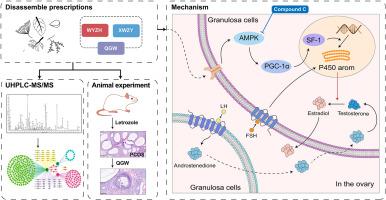
To investigate the therapeutic effects of Qin Gui Wan (QGW) and its disassembled functional drug groups, Wenyang Zhuhuo (WYZH) and Xinwen Zhuyang (XWZY), on letrozole-induced PCOS rats.
Methods
PCOS rat model was established by administering letrozole for 21 days. The rats were divided into control, PCOS, Diane-35, QGW, WYZH and XWZY groups. The changes of body weight, ovarian coefficient, estrous cycle and sex hormone levels were observed. The ovarian histological characteristics and ovulation were observed by HE staining. P450arom, SF-1, and AMPK/PGC-1ɑ pathway mRNA and protein expression were analyzed using qRT-PCR, WB, and IHC. The AMPK inhibitor Compound C (CC) was used to explore the treatment mechanism of QGW in granulosa cells. And UHPLC-MS/MS was used to performed chemical composition analysis.
Results
QGW, WYZH, and XWZY can correct the disordered estrous cycle of PCOS rats and improve the serum hormone status of rats to varying degrees. HE results indicated that QGW, WYZH, and XWZY improved ovarian polycystic changes and normalized ovulation. qRT-PCR, WB, and IHC results demonstrated that QGW, WYZH, and XWZY increased PGC-1α, SF-1, and P450arom mRNA and protein expression in the ovaries of PCOS rats. The level of AMPK mRNA in the ovaries of QGW and its disassembled prescriptions increased, while only WYZH and XWZY rats showed increased ovarian AMPK levels. CC attenuated the activation of AMPK, PGC-1α, SF-1, and P450arom mRNA by QGW.
Conclusions
This study demonstrates that QGW alleviates abnormal oocyte development in PCOS rats, possibly by enhancing P450arom expression via the AMPK/PGC-1α pathway, thus restoring normal androgen-estrogen balance and follicular development.
期刊介绍:
The Journal of Ethnopharmacology is dedicated to the exchange of information and understandings about people''s use of plants, fungi, animals, microorganisms and minerals and their biological and pharmacological effects based on the principles established through international conventions. Early people confronted with illness and disease, discovered a wealth of useful therapeutic agents in the plant and animal kingdoms. The empirical knowledge of these medicinal substances and their toxic potential was passed on by oral tradition and sometimes recorded in herbals and other texts on materia medica. Many valuable drugs of today (e.g., atropine, ephedrine, tubocurarine, digoxin, reserpine) came into use through the study of indigenous remedies. Chemists continue to use plant-derived drugs (e.g., morphine, taxol, physostigmine, quinidine, emetine) as prototypes in their attempts to develop more effective and less toxic medicinals.





 京公网安备 11010802042870号
京ICP备2023020795号-1
京公网安备 11010802042870号
京ICP备2023020795号-1

 分享
分享
 求助内容:
求助内容: 应助结果提醒方式:
 扫码关注我们
