Yılmaz Güvercin, Murat Yaylacı, Ayberk Dizdar, Mehmet Emin Özdemir, Sevil Ay, Ecren Uzun Yaylacı, Umitcan Karahasanoğlu, Hüseyin Uygun, Gökhan Peker
{"title":"股骨颈骨折手术中螺钉置换方案的生物力学分析及解决建议:有限元法。","authors":"Yılmaz Güvercin, Murat Yaylacı, Ayberk Dizdar, Mehmet Emin Özdemir, Sevil Ay, Ecren Uzun Yaylacı, Umitcan Karahasanoğlu, Hüseyin Uygun, Gökhan Peker","doi":"10.1111/os.14337","DOIUrl":null,"url":null,"abstract":"<p><strong>Objective: </strong>Despite several surgical options, there has yet to be a consensus on the best treatment for femoral neck fracture (FNF) due to higher complication rates compared to other bone fractures. This study aims to examine the possible consequences and solution suggestions of changing screws during surgery for various reasons in FNF surgical treatment from a biomechanical perspective.</p><p><strong>Method: </strong>FNF and treatment materials were analyzed biomechanically using a package program based on the finite element method (FEM). This study created a solid model with images of femur bone tomography. Dynamic hip screws (DHS), cannulated screws (CCS), and medial buttress plates (MBP) were obtained by making three-dimensional designs. The required elements for the models were assigned, and the material properties of the elements were defined. The solutions were obtained as crack distance and deformation results after defining the boundary conditions and applying the necessary loading.</p><p><strong>Results: </strong>The strain and crack distance values created by six models on the fracture line under different parameters were obtained, and the numerical results were evaluated. The DHS and CCS models produced the highest crack distance and deformation values when all screws were loose. The lowest values were obtained in the intact-85 model when all CCS were tight. When the results are evaluated, it is seen that the MBP has a decreasing effect on the results. Mechanical evaluation of six different options used in femoral neck fractures was performed. 85 mm CCS applied to our standard model gave the best results, while the use of 80 mm CCS in the same model showed promising results compared to other models. It is understood that CCS have the best stability even in loosening models with the medial support plate. Different models are from intact-85 mm DHS+1CS+MBP to DHS+1CS, which was worked with LSR+USR-2, according to decreasing stability.</p><p><strong>Conclusion: </strong>This study offers various biomechanical solutions to possible intraoperative problems in FNF treatment. The following results were obtained from the study data. When the CCS needs to be lengthened or replaced, it is appropriate to use the CCS with the MBP. A single anti-rotation screw is sufficient for lag screw extensions of the DHS plate, and the MBP may be a savior procedure in surgery.</p>","PeriodicalId":19566,"journal":{"name":"Orthopaedic Surgery","volume":"17 2","pages":"614-623"},"PeriodicalIF":2.1000,"publicationDate":"2025-02-01","publicationTypes":"Journal Article","fieldsOfStudy":null,"isOpenAccess":false,"openAccessPdf":"https://www.ncbi.nlm.nih.gov/pmc/articles/PMC11787977/pdf/","citationCount":"0","resultStr":"{\"title\":\"Biomechanical Analysis and Solution Suggestions of Screw Replacement Scenarios in Femoral Neck Fracture Surgeries: Finite Element Method.\",\"authors\":\"Yılmaz Güvercin, Murat Yaylacı, Ayberk Dizdar, Mehmet Emin Özdemir, Sevil Ay, Ecren Uzun Yaylacı, Umitcan Karahasanoğlu, Hüseyin Uygun, Gökhan Peker\",\"doi\":\"10.1111/os.14337\",\"DOIUrl\":null,\"url\":null,\"abstract\":\"<p><strong>Objective: </strong>Despite several surgical options, there has yet to be a consensus on the best treatment for femoral neck fracture (FNF) due to higher complication rates compared to other bone fractures. This study aims to examine the possible consequences and solution suggestions of changing screws during surgery for various reasons in FNF surgical treatment from a biomechanical perspective.</p><p><strong>Method: </strong>FNF and treatment materials were analyzed biomechanically using a package program based on the finite element method (FEM). This study created a solid model with images of femur bone tomography. Dynamic hip screws (DHS), cannulated screws (CCS), and medial buttress plates (MBP) were obtained by making three-dimensional designs. The required elements for the models were assigned, and the material properties of the elements were defined. The solutions were obtained as crack distance and deformation results after defining the boundary conditions and applying the necessary loading.</p><p><strong>Results: </strong>The strain and crack distance values created by six models on the fracture line under different parameters were obtained, and the numerical results were evaluated. The DHS and CCS models produced the highest crack distance and deformation values when all screws were loose. The lowest values were obtained in the intact-85 model when all CCS were tight. When the results are evaluated, it is seen that the MBP has a decreasing effect on the results. Mechanical evaluation of six different options used in femoral neck fractures was performed. 85 mm CCS applied to our standard model gave the best results, while the use of 80 mm CCS in the same model showed promising results compared to other models. It is understood that CCS have the best stability even in loosening models with the medial support plate. Different models are from intact-85 mm DHS+1CS+MBP to DHS+1CS, which was worked with LSR+USR-2, according to decreasing stability.</p><p><strong>Conclusion: </strong>This study offers various biomechanical solutions to possible intraoperative problems in FNF treatment. The following results were obtained from the study data. When the CCS needs to be lengthened or replaced, it is appropriate to use the CCS with the MBP. A single anti-rotation screw is sufficient for lag screw extensions of the DHS plate, and the MBP may be a savior procedure in surgery.</p>\",\"PeriodicalId\":19566,\"journal\":{\"name\":\"Orthopaedic Surgery\",\"volume\":\"17 2\",\"pages\":\"614-623\"},\"PeriodicalIF\":2.1000,\"publicationDate\":\"2025-02-01\",\"publicationTypes\":\"Journal Article\",\"fieldsOfStudy\":null,\"isOpenAccess\":false,\"openAccessPdf\":\"https://www.ncbi.nlm.nih.gov/pmc/articles/PMC11787977/pdf/\",\"citationCount\":\"0\",\"resultStr\":null,\"platform\":\"Semanticscholar\",\"paperid\":null,\"PeriodicalName\":\"Orthopaedic Surgery\",\"FirstCategoryId\":\"3\",\"ListUrlMain\":\"https://doi.org/10.1111/os.14337\",\"RegionNum\":2,\"RegionCategory\":\"医学\",\"ArticlePicture\":[],\"TitleCN\":null,\"AbstractTextCN\":null,\"PMCID\":null,\"EPubDate\":\"2025/1/6 0:00:00\",\"PubModel\":\"Epub\",\"JCR\":\"Q2\",\"JCRName\":\"ORTHOPEDICS\",\"Score\":null,\"Total\":0}","platform":"Semanticscholar","paperid":null,"PeriodicalName":"Orthopaedic Surgery","FirstCategoryId":"3","ListUrlMain":"https://doi.org/10.1111/os.14337","RegionNum":2,"RegionCategory":"医学","ArticlePicture":[],"TitleCN":null,"AbstractTextCN":null,"PMCID":null,"EPubDate":"2025/1/6 0:00:00","PubModel":"Epub","JCR":"Q2","JCRName":"ORTHOPEDICS","Score":null,"Total":0}
引用次数: 0
摘要
目的:尽管有几种手术选择,但由于股骨颈骨折(FNF)的并发症发生率高于其他骨折,因此尚未就其最佳治疗达成共识。本研究旨在从生物力学角度探讨FNF手术治疗中各种原因术中更换螺钉可能产生的后果及解决建议。方法:采用基于有限元法(FEM)的软件包程序对FNF和处理材料进行生物力学分析。本研究创建了一个具有股骨骨断层扫描图像的实体模型。通过三维设计获得动态髋螺钉(DHS)、空心螺钉(CCS)和内侧支撑板(MBP)。分配模型所需的元素,并定义元素的材料属性。在确定边界条件并施加必要的载荷后,得到裂纹距离和变形结果的解。结果:得到了不同参数下6种模型在断裂线上产生的应变和裂纹距离值,并对数值结果进行了评价。当所有螺钉松动时,DHS和CCS模型的裂纹距离和变形值最大。在完整-85模型中,当所有CCS都很紧时,其值最小。当对结果进行评估时,可以看到MBP对结果的影响是递减的。对股骨颈骨折的6种不同治疗方案进行力学评价。85毫米的CCS应用于我们的标准模型得到了最好的结果,而80毫米的CCS在同一模型中使用,与其他模型相比,效果很好。据了解,即使在有内侧支撑板的松动模型中,CCS也具有最好的稳定性。根据稳定性的降低,不同的型号从完整的85 mm DHS+1CS+MBP到与LSR+USR-2一起工作的DHS+1CS。结论:本研究为FNF治疗术中可能出现的问题提供了多种生物力学解决方案。从研究数据中得到以下结果:当需要延长或更换CCS时,可将CCS与MBP配合使用。单颗抗旋转螺钉足以用于DHS钢板的拉力螺钉扩展,MBP可能是手术中的救星。
Biomechanical Analysis and Solution Suggestions of Screw Replacement Scenarios in Femoral Neck Fracture Surgeries: Finite Element Method.
Objective: Despite several surgical options, there has yet to be a consensus on the best treatment for femoral neck fracture (FNF) due to higher complication rates compared to other bone fractures. This study aims to examine the possible consequences and solution suggestions of changing screws during surgery for various reasons in FNF surgical treatment from a biomechanical perspective.
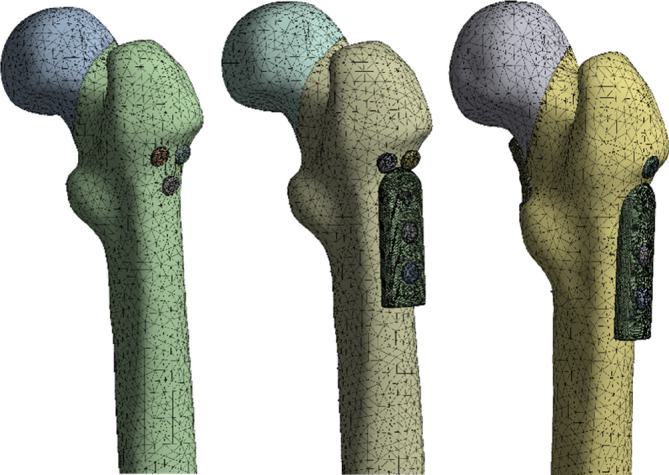
Method: FNF and treatment materials were analyzed biomechanically using a package program based on the finite element method (FEM). This study created a solid model with images of femur bone tomography. Dynamic hip screws (DHS), cannulated screws (CCS), and medial buttress plates (MBP) were obtained by making three-dimensional designs. The required elements for the models were assigned, and the material properties of the elements were defined. The solutions were obtained as crack distance and deformation results after defining the boundary conditions and applying the necessary loading.
Results: The strain and crack distance values created by six models on the fracture line under different parameters were obtained, and the numerical results were evaluated. The DHS and CCS models produced the highest crack distance and deformation values when all screws were loose. The lowest values were obtained in the intact-85 model when all CCS were tight. When the results are evaluated, it is seen that the MBP has a decreasing effect on the results. Mechanical evaluation of six different options used in femoral neck fractures was performed. 85 mm CCS applied to our standard model gave the best results, while the use of 80 mm CCS in the same model showed promising results compared to other models. It is understood that CCS have the best stability even in loosening models with the medial support plate. Different models are from intact-85 mm DHS+1CS+MBP to DHS+1CS, which was worked with LSR+USR-2, according to decreasing stability.
Conclusion: This study offers various biomechanical solutions to possible intraoperative problems in FNF treatment. The following results were obtained from the study data. When the CCS needs to be lengthened or replaced, it is appropriate to use the CCS with the MBP. A single anti-rotation screw is sufficient for lag screw extensions of the DHS plate, and the MBP may be a savior procedure in surgery.
期刊介绍:
Orthopaedic Surgery (OS) is the official journal of the Chinese Orthopaedic Association, focusing on all aspects of orthopaedic technique and surgery.
The journal publishes peer-reviewed articles in the following categories: Original Articles, Clinical Articles, Review Articles, Guidelines, Editorials, Commentaries, Surgical Techniques, Case Reports and Meeting Reports.






 京公网安备 11010802042870号
京ICP备2023020795号-1
京公网安备 11010802042870号
京ICP备2023020795号-1

 分享
分享
 求助内容:
求助内容: 应助结果提醒方式:
 扫码关注我们
