Giulia Galteri MSc, Sara Montanari PhD, Giacomo Dozza BSc, Marco Palanca PhD, Luca Cristofolini PhD
{"title":"短肱骨柄在全肩关节置换术中不影响初始假体的稳定性。","authors":"Giulia Galteri MSc, Sara Montanari PhD, Giacomo Dozza BSc, Marco Palanca PhD, Luca Cristofolini PhD","doi":"10.1016/j.jseint.2024.09.021","DOIUrl":null,"url":null,"abstract":"<div><h3>Background</h3><div>The trend of the modern humeral components in total shoulder arthroplasty is toward shorter and shorter humeral stems. However, the question remains whether short uncemented stems can provide the same implant stability as long stems. This study aimed to evaluate and compare the torsional primary stability and the pull-out extraction force of both a long and a short version of the same stem.</div></div><div><h3>Materials and methods</h3><div>Ten humeral components (five long stems and five short stems) were press-fitted into ten synthetic composite humeri. A torsional load was applied to generate the most critical loading condition. The specimens were loaded with 100 cycles between 2 Nm and 10 Nm, at 1 Hz. A 3D Digital Image Correlation system was used to measure the relative displacement between the prosthesis and the host bone during the test. After completing the torsional test, the pull-out force was measured. Differences between the long and short stem on the biomechanical parameters (permanent migrations, inducible micromotion, and extraction force) were tested with the nonparametric Mann-Whitney test (<em>P</em> < .05).</div></div><div><h3>Results</h3><div>The main rotational inducible micromotion was around the craniocaudal axis. No significant differences were found between the rotational permanent migrations of the long and short stem around the craniocaudal (<em>P</em> = .421), anteroposterior (<em>P</em> = .841), and mediolateral axes (<em>P</em> = .452). No significant differences were found between the rotational inducible micromotions of the long and short stem around the craniocaudal (<em>P</em> = .222), anteroposterior (<em>P</em> = .420), and mediolateral axes (<em>P</em> = .655). No significant differences were found between the permanent translations of the long and short stem along the craniocaudal (<em>P</em> = .341), anteroposterior (<em>P</em> = .420), and mediolateral (<em>P</em> = .429) directions. No significant differences were found between the translations of the long and short stem in terms of inducible translation in the craniocaudal (<em>P</em> = .547), anteroposterior (<em>P</em> = .999), and mediolateral axes (<em>P</em> = .285). Similar extraction force (<em>P</em> = .35) was found.</div></div><div><h3>Discussion and Conclusion</h3><div>No statistically significant difference was found between the long-stem and short-stem implants. These results show that short uncemented stems can provide adequate primary mechanical stability. As the long-stem version of this stem is already clinically used, the present findings suggest that the short version can be reasonably expected to deliver similar outcomes in terms of implant stability.</div></div>","PeriodicalId":34444,"journal":{"name":"JSES International","volume":"9 1","pages":"Pages 212-218"},"PeriodicalIF":2.0000,"publicationDate":"2025-01-01","publicationTypes":"Journal Article","fieldsOfStudy":null,"isOpenAccess":false,"openAccessPdf":"https://www.ncbi.nlm.nih.gov/pmc/articles/PMC11784511/pdf/","citationCount":"0","resultStr":"{\"title\":\"Short humeral stem in total shoulder arthroplasty does not jeopardize primary implant stability\",\"authors\":\"Giulia Galteri MSc, Sara Montanari PhD, Giacomo Dozza BSc, Marco Palanca PhD, Luca Cristofolini PhD\",\"doi\":\"10.1016/j.jseint.2024.09.021\",\"DOIUrl\":null,\"url\":null,\"abstract\":\"<div><h3>Background</h3><div>The trend of the modern humeral components in total shoulder arthroplasty is toward shorter and shorter humeral stems. However, the question remains whether short uncemented stems can provide the same implant stability as long stems. This study aimed to evaluate and compare the torsional primary stability and the pull-out extraction force of both a long and a short version of the same stem.</div></div><div><h3>Materials and methods</h3><div>Ten humeral components (five long stems and five short stems) were press-fitted into ten synthetic composite humeri. A torsional load was applied to generate the most critical loading condition. The specimens were loaded with 100 cycles between 2 Nm and 10 Nm, at 1 Hz. A 3D Digital Image Correlation system was used to measure the relative displacement between the prosthesis and the host bone during the test. After completing the torsional test, the pull-out force was measured. Differences between the long and short stem on the biomechanical parameters (permanent migrations, inducible micromotion, and extraction force) were tested with the nonparametric Mann-Whitney test (<em>P</em> < .05).</div></div><div><h3>Results</h3><div>The main rotational inducible micromotion was around the craniocaudal axis. No significant differences were found between the rotational permanent migrations of the long and short stem around the craniocaudal (<em>P</em> = .421), anteroposterior (<em>P</em> = .841), and mediolateral axes (<em>P</em> = .452). No significant differences were found between the rotational inducible micromotions of the long and short stem around the craniocaudal (<em>P</em> = .222), anteroposterior (<em>P</em> = .420), and mediolateral axes (<em>P</em> = .655). No significant differences were found between the permanent translations of the long and short stem along the craniocaudal (<em>P</em> = .341), anteroposterior (<em>P</em> = .420), and mediolateral (<em>P</em> = .429) directions. No significant differences were found between the translations of the long and short stem in terms of inducible translation in the craniocaudal (<em>P</em> = .547), anteroposterior (<em>P</em> = .999), and mediolateral axes (<em>P</em> = .285). Similar extraction force (<em>P</em> = .35) was found.</div></div><div><h3>Discussion and Conclusion</h3><div>No statistically significant difference was found between the long-stem and short-stem implants. These results show that short uncemented stems can provide adequate primary mechanical stability. As the long-stem version of this stem is already clinically used, the present findings suggest that the short version can be reasonably expected to deliver similar outcomes in terms of implant stability.</div></div>\",\"PeriodicalId\":34444,\"journal\":{\"name\":\"JSES International\",\"volume\":\"9 1\",\"pages\":\"Pages 212-218\"},\"PeriodicalIF\":2.0000,\"publicationDate\":\"2025-01-01\",\"publicationTypes\":\"Journal Article\",\"fieldsOfStudy\":null,\"isOpenAccess\":false,\"openAccessPdf\":\"https://www.ncbi.nlm.nih.gov/pmc/articles/PMC11784511/pdf/\",\"citationCount\":\"0\",\"resultStr\":null,\"platform\":\"Semanticscholar\",\"paperid\":null,\"PeriodicalName\":\"JSES International\",\"FirstCategoryId\":\"1085\",\"ListUrlMain\":\"https://www.sciencedirect.com/science/article/pii/S2666638324004183\",\"RegionNum\":0,\"RegionCategory\":null,\"ArticlePicture\":[],\"TitleCN\":null,\"AbstractTextCN\":null,\"PMCID\":null,\"EPubDate\":\"2024/10/3 0:00:00\",\"PubModel\":\"Epub\",\"JCR\":\"Q2\",\"JCRName\":\"Medicine\",\"Score\":null,\"Total\":0}","platform":"Semanticscholar","paperid":null,"PeriodicalName":"JSES International","FirstCategoryId":"1085","ListUrlMain":"https://www.sciencedirect.com/science/article/pii/S2666638324004183","RegionNum":0,"RegionCategory":null,"ArticlePicture":[],"TitleCN":null,"AbstractTextCN":null,"PMCID":null,"EPubDate":"2024/10/3 0:00:00","PubModel":"Epub","JCR":"Q2","JCRName":"Medicine","Score":null,"Total":0}
Short humeral stem in total shoulder arthroplasty does not jeopardize primary implant stability
Background
The trend of the modern humeral components in total shoulder arthroplasty is toward shorter and shorter humeral stems. However, the question remains whether short uncemented stems can provide the same implant stability as long stems. This study aimed to evaluate and compare the torsional primary stability and the pull-out extraction force of both a long and a short version of the same stem.
Materials and methods
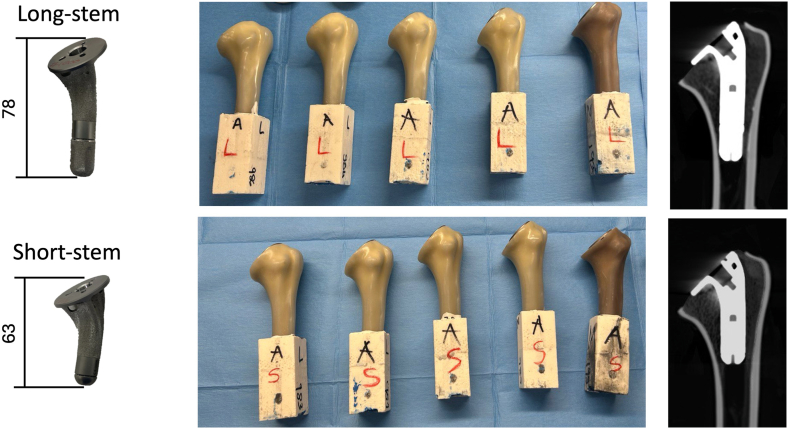
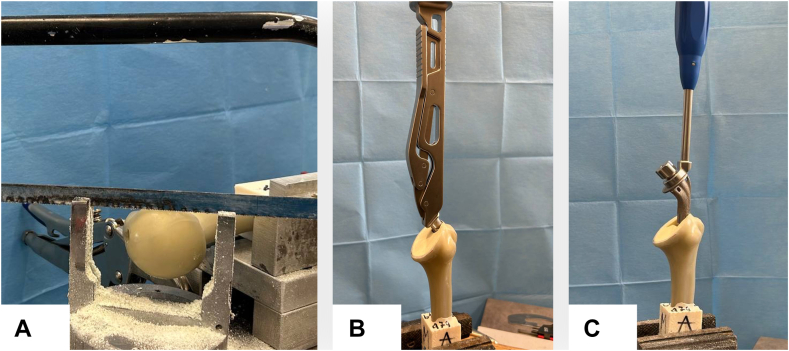
Ten humeral components (five long stems and five short stems) were press-fitted into ten synthetic composite humeri. A torsional load was applied to generate the most critical loading condition. The specimens were loaded with 100 cycles between 2 Nm and 10 Nm, at 1 Hz. A 3D Digital Image Correlation system was used to measure the relative displacement between the prosthesis and the host bone during the test. After completing the torsional test, the pull-out force was measured. Differences between the long and short stem on the biomechanical parameters (permanent migrations, inducible micromotion, and extraction force) were tested with the nonparametric Mann-Whitney test (P < .05).
Results
The main rotational inducible micromotion was around the craniocaudal axis. No significant differences were found between the rotational permanent migrations of the long and short stem around the craniocaudal (P = .421), anteroposterior (P = .841), and mediolateral axes (P = .452). No significant differences were found between the rotational inducible micromotions of the long and short stem around the craniocaudal (P = .222), anteroposterior (P = .420), and mediolateral axes (P = .655). No significant differences were found between the permanent translations of the long and short stem along the craniocaudal (P = .341), anteroposterior (P = .420), and mediolateral (P = .429) directions. No significant differences were found between the translations of the long and short stem in terms of inducible translation in the craniocaudal (P = .547), anteroposterior (P = .999), and mediolateral axes (P = .285). Similar extraction force (P = .35) was found.
Discussion and Conclusion
No statistically significant difference was found between the long-stem and short-stem implants. These results show that short uncemented stems can provide adequate primary mechanical stability. As the long-stem version of this stem is already clinically used, the present findings suggest that the short version can be reasonably expected to deliver similar outcomes in terms of implant stability.





 京公网安备 11010802042870号
京ICP备2023020795号-1
京公网安备 11010802042870号
京ICP备2023020795号-1

 分享
分享
 求助内容:
求助内容: 应助结果提醒方式:
 扫码关注我们
