Sebastian Oenning MD , Clara de Castillo , Elena Jacob MD , Arne Riegel MD , Philipp A. Michel MD , Jens Wermers MSc , Michael J. Raschke MD , J. Christoph Katthagen MD
{"title":"肩关节前凸和变形对前肩稳定性的临床影响。","authors":"Sebastian Oenning MD , Clara de Castillo , Elena Jacob MD , Arne Riegel MD , Philipp A. Michel MD , Jens Wermers MSc , Michael J. Raschke MD , J. Christoph Katthagen MD","doi":"10.1016/j.jseint.2024.09.029","DOIUrl":null,"url":null,"abstract":"<div><h3>Background</h3><div>In recent biomechanical studies, the importance of glenoid concavity and version for anterior shoulder stability has been highlighted. With this study, we aimed to assess their clinical relevance as stabilizing factors. We hypothesized that low glenoid concavity and low retroversion are associated with anterior glenohumeral instability.</div></div><div><h3>Methods</h3><div>In this single-center, retrospective case-control study, computed tomography scans of n = 34 patients following acute anteroinferior glenohumeral dislocation between 2015 and 2021 were included. Patients with glenoid fractures and pre-existing glenohumeral pathologies were excluded. In the control group, n = 68 polytrauma patients referred to our level-I-trauma center were included, who showed neither acute nor chronic glenohumeral pathologies. Both groups were matched age- and gender-specifically in a 2:1 ratio. Glenoid concavity was measured according to the bony shoulder stability ratio (BSSR) in anterior-posterior (AP) and superior-inferior (SI) direction. Version was measured by the glenoid vault method.</div></div><div><h3>Results</h3><div>The instability cohort presented with a lower BSSR (SI) compared to the control group (49.8% vs. 56.9%, <em>P</em> = .001). The BSSR (AP) did not differ significantly (30.2% vs. 33.7%, <em>P</em> = .163). A higher retroversion was seen in the instability cohort (−13.1° vs. −11.4°; <em>P</em> = .041). Subgroup analyses showed higher BSSR (SI) in ≥60-year-old patients compared to ≤30-year-old patients. BSSR (AP) and glenoid version did neither differ age- nor gender-specifically.</div></div><div><h3>Conclusion</h3><div>Glenoid concavity is a relevant factor for anterior shoulder stability in the clinical setting. In contrast to recent biomechanical studies, glenoid version appears to have only limited clinical impact on anterior stability. Regarding the individual treatment of anterior glenohumeral instability, glenoid concavity should be focused on as an essential bony stabilizing factor.</div></div>","PeriodicalId":34444,"journal":{"name":"JSES International","volume":"9 1","pages":"Pages 62-69"},"PeriodicalIF":0.0000,"publicationDate":"2025-01-01","publicationTypes":"Journal Article","fieldsOfStudy":null,"isOpenAccess":false,"openAccessPdf":"https://www.ncbi.nlm.nih.gov/pmc/articles/PMC11784467/pdf/","citationCount":"0","resultStr":"{\"title\":\"The clinical impact of glenoid concavity and version on anterior shoulder stability\",\"authors\":\"Sebastian Oenning MD , Clara de Castillo , Elena Jacob MD , Arne Riegel MD , Philipp A. Michel MD , Jens Wermers MSc , Michael J. Raschke MD , J. Christoph Katthagen MD\",\"doi\":\"10.1016/j.jseint.2024.09.029\",\"DOIUrl\":null,\"url\":null,\"abstract\":\"<div><h3>Background</h3><div>In recent biomechanical studies, the importance of glenoid concavity and version for anterior shoulder stability has been highlighted. With this study, we aimed to assess their clinical relevance as stabilizing factors. We hypothesized that low glenoid concavity and low retroversion are associated with anterior glenohumeral instability.</div></div><div><h3>Methods</h3><div>In this single-center, retrospective case-control study, computed tomography scans of n = 34 patients following acute anteroinferior glenohumeral dislocation between 2015 and 2021 were included. Patients with glenoid fractures and pre-existing glenohumeral pathologies were excluded. In the control group, n = 68 polytrauma patients referred to our level-I-trauma center were included, who showed neither acute nor chronic glenohumeral pathologies. Both groups were matched age- and gender-specifically in a 2:1 ratio. Glenoid concavity was measured according to the bony shoulder stability ratio (BSSR) in anterior-posterior (AP) and superior-inferior (SI) direction. Version was measured by the glenoid vault method.</div></div><div><h3>Results</h3><div>The instability cohort presented with a lower BSSR (SI) compared to the control group (49.8% vs. 56.9%, <em>P</em> = .001). The BSSR (AP) did not differ significantly (30.2% vs. 33.7%, <em>P</em> = .163). A higher retroversion was seen in the instability cohort (−13.1° vs. −11.4°; <em>P</em> = .041). Subgroup analyses showed higher BSSR (SI) in ≥60-year-old patients compared to ≤30-year-old patients. BSSR (AP) and glenoid version did neither differ age- nor gender-specifically.</div></div><div><h3>Conclusion</h3><div>Glenoid concavity is a relevant factor for anterior shoulder stability in the clinical setting. In contrast to recent biomechanical studies, glenoid version appears to have only limited clinical impact on anterior stability. Regarding the individual treatment of anterior glenohumeral instability, glenoid concavity should be focused on as an essential bony stabilizing factor.</div></div>\",\"PeriodicalId\":34444,\"journal\":{\"name\":\"JSES International\",\"volume\":\"9 1\",\"pages\":\"Pages 62-69\"},\"PeriodicalIF\":0.0000,\"publicationDate\":\"2025-01-01\",\"publicationTypes\":\"Journal Article\",\"fieldsOfStudy\":null,\"isOpenAccess\":false,\"openAccessPdf\":\"https://www.ncbi.nlm.nih.gov/pmc/articles/PMC11784467/pdf/\",\"citationCount\":\"0\",\"resultStr\":null,\"platform\":\"Semanticscholar\",\"paperid\":null,\"PeriodicalName\":\"JSES International\",\"FirstCategoryId\":\"1085\",\"ListUrlMain\":\"https://www.sciencedirect.com/science/article/pii/S2666638324004407\",\"RegionNum\":0,\"RegionCategory\":null,\"ArticlePicture\":[],\"TitleCN\":null,\"AbstractTextCN\":null,\"PMCID\":null,\"EPubDate\":\"2024/11/2 0:00:00\",\"PubModel\":\"Epub\",\"JCR\":\"Q2\",\"JCRName\":\"Medicine\",\"Score\":null,\"Total\":0}","platform":"Semanticscholar","paperid":null,"PeriodicalName":"JSES International","FirstCategoryId":"1085","ListUrlMain":"https://www.sciencedirect.com/science/article/pii/S2666638324004407","RegionNum":0,"RegionCategory":null,"ArticlePicture":[],"TitleCN":null,"AbstractTextCN":null,"PMCID":null,"EPubDate":"2024/11/2 0:00:00","PubModel":"Epub","JCR":"Q2","JCRName":"Medicine","Score":null,"Total":0}
引用次数: 0
摘要
背景:在最近的生物力学研究中,突出了肩关节前凸和弯曲对肩关节稳定性的重要性。通过这项研究,我们旨在评估它们作为稳定因素的临床相关性。我们假设低盂内凹和低盂内翻与盂肱前侧不稳定有关。方法:在这项单中心回顾性病例对照研究中,纳入了2015年至2021年间n = 34例急性前下盂肱脱位患者的计算机断层扫描。排除有肩胛骨折和已有肩关节病变的患者。在对照组中,我们的i级创伤中心纳入了n = 68例多发创伤患者,他们既没有出现急性也没有出现慢性肩关节病变。两组按年龄和性别按2:1的比例进行匹配。根据前后(AP)和上下(SI)方向骨肩稳定比(BSSR)测量关节盂凹陷度。通过关节盂拱顶法测量关节屈曲度。结果:与对照组相比,不稳定组的BSSR (SI)较低(49.8%比56.9%,P = .001)。BSSR (AP)差异无统计学意义(30.2% vs. 33.7%, P = 0.163)。在不稳定组中观察到更高的逆行度(-13.1°vs -11.4°;P = .041)。亚组分析显示,≥60岁患者的BSSR (SI)高于≤30岁患者。BSSR (AP)和关节盂版本没有年龄和性别差异。结论:关节盂凹度是影响肩关节前稳定性的一个重要因素。与最近的生物力学研究相反,关节盂内翻对前路稳定性的临床影响似乎有限。对于肱骨前关节不稳的个体化治疗,应将盂内凹作为重要的骨稳定因素加以重视。
The clinical impact of glenoid concavity and version on anterior shoulder stability
Background
In recent biomechanical studies, the importance of glenoid concavity and version for anterior shoulder stability has been highlighted. With this study, we aimed to assess their clinical relevance as stabilizing factors. We hypothesized that low glenoid concavity and low retroversion are associated with anterior glenohumeral instability.
Methods
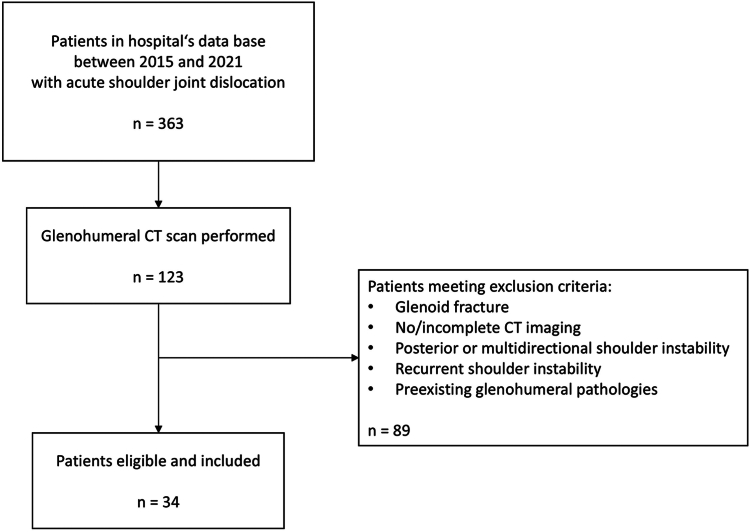
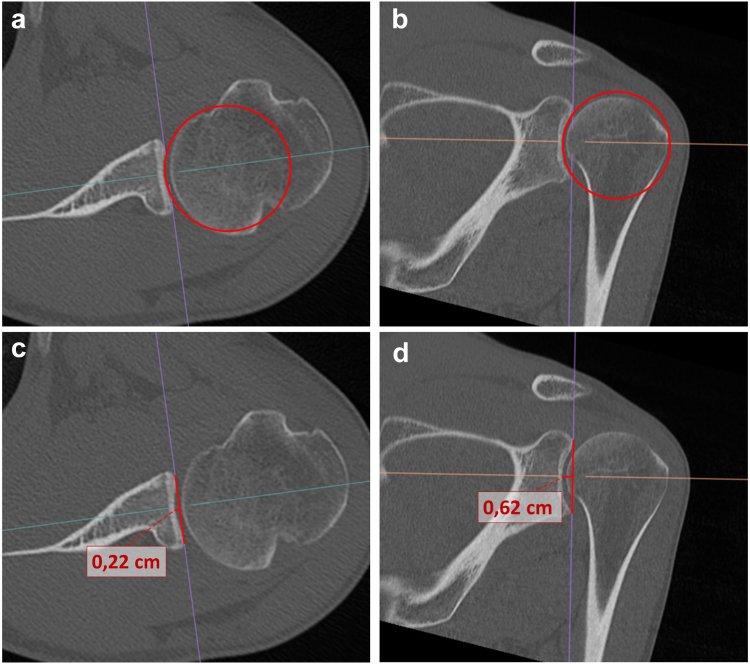
In this single-center, retrospective case-control study, computed tomography scans of n = 34 patients following acute anteroinferior glenohumeral dislocation between 2015 and 2021 were included. Patients with glenoid fractures and pre-existing glenohumeral pathologies were excluded. In the control group, n = 68 polytrauma patients referred to our level-I-trauma center were included, who showed neither acute nor chronic glenohumeral pathologies. Both groups were matched age- and gender-specifically in a 2:1 ratio. Glenoid concavity was measured according to the bony shoulder stability ratio (BSSR) in anterior-posterior (AP) and superior-inferior (SI) direction. Version was measured by the glenoid vault method.
Results
The instability cohort presented with a lower BSSR (SI) compared to the control group (49.8% vs. 56.9%, P = .001). The BSSR (AP) did not differ significantly (30.2% vs. 33.7%, P = .163). A higher retroversion was seen in the instability cohort (−13.1° vs. −11.4°; P = .041). Subgroup analyses showed higher BSSR (SI) in ≥60-year-old patients compared to ≤30-year-old patients. BSSR (AP) and glenoid version did neither differ age- nor gender-specifically.
Conclusion
Glenoid concavity is a relevant factor for anterior shoulder stability in the clinical setting. In contrast to recent biomechanical studies, glenoid version appears to have only limited clinical impact on anterior stability. Regarding the individual treatment of anterior glenohumeral instability, glenoid concavity should be focused on as an essential bony stabilizing factor.





 京公网安备 11010802042870号
京ICP备2023020795号-1
京公网安备 11010802042870号
京ICP备2023020795号-1

 分享
分享
 求助内容:
求助内容: 应助结果提醒方式:
 扫码关注我们
