{"title":"扭转柄张力带技术在肱骨近端骨折逆行全肩关节置换术中,无论采用垂直缝合,均可获得较高的结节愈合率。","authors":"Kazumasa Takayama MD, Hiromu Ito MD, PhD","doi":"10.1016/j.jseint.2024.08.186","DOIUrl":null,"url":null,"abstract":"<div><h3>Background</h3><div>The importance of tuberosity healing in reverse total shoulder arthroplasty for proximal humeral fractures (PHFs) has been recognized. The turned stem tension band (TSTB) technique has been applied to tuberosity repair, and high bone healing and low reduction loss rates have been reported. Vertical sutures were added to the original method to reinforce fixation. We hypothesized that vertical sutures would be unnecessary in case the supraspinatus tendon was resected. This study aimed to compare the TSTB technique with or without vertical suturing for PHFs and evaluate the rates of tuberosity healing and reduction loss.</div></div><div><h3>Methods</h3><div>Thirty five patients (vertical suture group: 18 cases and nonvertical suture group: 17 cases) underwent reverse total shoulder arthroplasty for complex PHFs using the TSTB technique. We evaluated the postoperative range of motion, the American Shoulder and Elbow Surgeons score, tuberosity healing rates, and reduction loss.</div></div><div><h3>Results</h3><div>The vertical and nonvertical suture groups showed no significant difference in flexion (119 ± 33° vs. 124 ± 23°, <em>P</em> = .95), abduction (116 ± 35° vs. 115 ± 27°, <em>P</em> = .78), external rotation (27 ± 12° vs. 21 ± 8°, <em>P</em> = .16), internal rotation (6 ± 4° lumbar 3 level vs. 6 ± 4°, lumbar 3 level <em>P</em> = .87), the American Shoulder and Elbow Surgeons (77.3 ± 10.7 vs. 81.6 ± 6.3, <em>P</em> = .59), Numerical Rating Scale scores (1.2 ± 0.9 vs. 0.8 ± 0.9, <em>P</em> = .13), and tuberosity reduction loss (<em>P</em> = .34). The tuberosity healing rate in both groups was 100%.</div></div><div><h3>Conclusion</h3><div>The TSTB technique for PHFs provided high tuberosity healing and low reduction loss rates regardless of vertical sutures.</div></div>","PeriodicalId":34444,"journal":{"name":"JSES International","volume":"9 1","pages":"Pages 155-162"},"PeriodicalIF":2.0000,"publicationDate":"2025-01-01","publicationTypes":"Journal Article","fieldsOfStudy":null,"isOpenAccess":false,"openAccessPdf":"https://www.ncbi.nlm.nih.gov/pmc/articles/PMC11784290/pdf/","citationCount":"0","resultStr":"{\"title\":\"Turned stem tension band technique in reverse total shoulder arthroplasty for proximal humeral fracture can achieve high tuberosity healing rates regardless of the vertical sutures\",\"authors\":\"Kazumasa Takayama MD, Hiromu Ito MD, PhD\",\"doi\":\"10.1016/j.jseint.2024.08.186\",\"DOIUrl\":null,\"url\":null,\"abstract\":\"<div><h3>Background</h3><div>The importance of tuberosity healing in reverse total shoulder arthroplasty for proximal humeral fractures (PHFs) has been recognized. The turned stem tension band (TSTB) technique has been applied to tuberosity repair, and high bone healing and low reduction loss rates have been reported. Vertical sutures were added to the original method to reinforce fixation. We hypothesized that vertical sutures would be unnecessary in case the supraspinatus tendon was resected. This study aimed to compare the TSTB technique with or without vertical suturing for PHFs and evaluate the rates of tuberosity healing and reduction loss.</div></div><div><h3>Methods</h3><div>Thirty five patients (vertical suture group: 18 cases and nonvertical suture group: 17 cases) underwent reverse total shoulder arthroplasty for complex PHFs using the TSTB technique. We evaluated the postoperative range of motion, the American Shoulder and Elbow Surgeons score, tuberosity healing rates, and reduction loss.</div></div><div><h3>Results</h3><div>The vertical and nonvertical suture groups showed no significant difference in flexion (119 ± 33° vs. 124 ± 23°, <em>P</em> = .95), abduction (116 ± 35° vs. 115 ± 27°, <em>P</em> = .78), external rotation (27 ± 12° vs. 21 ± 8°, <em>P</em> = .16), internal rotation (6 ± 4° lumbar 3 level vs. 6 ± 4°, lumbar 3 level <em>P</em> = .87), the American Shoulder and Elbow Surgeons (77.3 ± 10.7 vs. 81.6 ± 6.3, <em>P</em> = .59), Numerical Rating Scale scores (1.2 ± 0.9 vs. 0.8 ± 0.9, <em>P</em> = .13), and tuberosity reduction loss (<em>P</em> = .34). The tuberosity healing rate in both groups was 100%.</div></div><div><h3>Conclusion</h3><div>The TSTB technique for PHFs provided high tuberosity healing and low reduction loss rates regardless of vertical sutures.</div></div>\",\"PeriodicalId\":34444,\"journal\":{\"name\":\"JSES International\",\"volume\":\"9 1\",\"pages\":\"Pages 155-162\"},\"PeriodicalIF\":2.0000,\"publicationDate\":\"2025-01-01\",\"publicationTypes\":\"Journal Article\",\"fieldsOfStudy\":null,\"isOpenAccess\":false,\"openAccessPdf\":\"https://www.ncbi.nlm.nih.gov/pmc/articles/PMC11784290/pdf/\",\"citationCount\":\"0\",\"resultStr\":null,\"platform\":\"Semanticscholar\",\"paperid\":null,\"PeriodicalName\":\"JSES International\",\"FirstCategoryId\":\"1085\",\"ListUrlMain\":\"https://www.sciencedirect.com/science/article/pii/S2666638324003785\",\"RegionNum\":0,\"RegionCategory\":null,\"ArticlePicture\":[],\"TitleCN\":null,\"AbstractTextCN\":null,\"PMCID\":null,\"EPubDate\":\"2024/8/30 0:00:00\",\"PubModel\":\"Epub\",\"JCR\":\"Q2\",\"JCRName\":\"Medicine\",\"Score\":null,\"Total\":0}","platform":"Semanticscholar","paperid":null,"PeriodicalName":"JSES International","FirstCategoryId":"1085","ListUrlMain":"https://www.sciencedirect.com/science/article/pii/S2666638324003785","RegionNum":0,"RegionCategory":null,"ArticlePicture":[],"TitleCN":null,"AbstractTextCN":null,"PMCID":null,"EPubDate":"2024/8/30 0:00:00","PubModel":"Epub","JCR":"Q2","JCRName":"Medicine","Score":null,"Total":0}
Turned stem tension band technique in reverse total shoulder arthroplasty for proximal humeral fracture can achieve high tuberosity healing rates regardless of the vertical sutures
Background
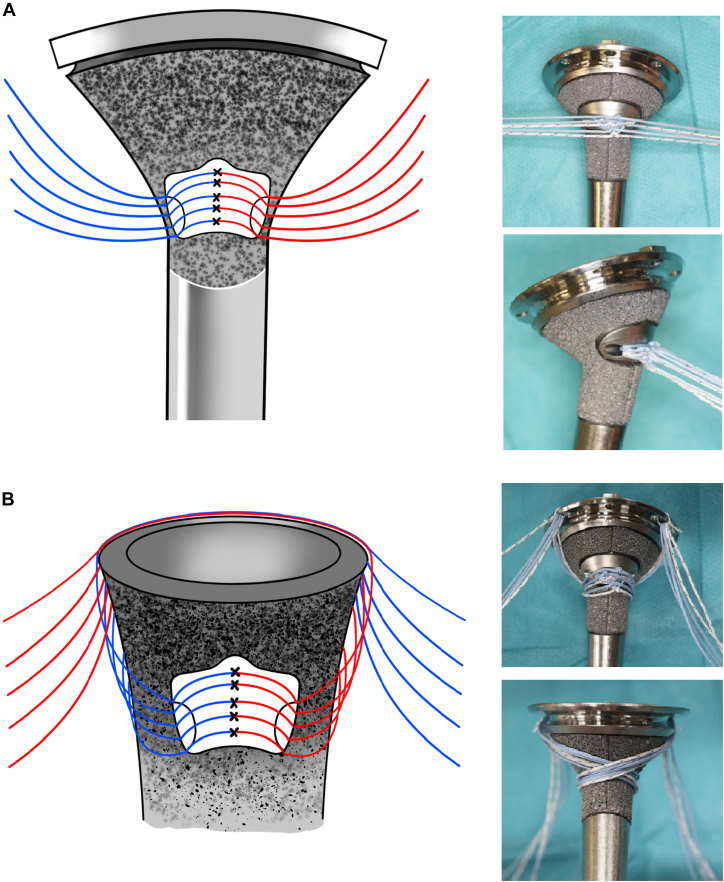
The importance of tuberosity healing in reverse total shoulder arthroplasty for proximal humeral fractures (PHFs) has been recognized. The turned stem tension band (TSTB) technique has been applied to tuberosity repair, and high bone healing and low reduction loss rates have been reported. Vertical sutures were added to the original method to reinforce fixation. We hypothesized that vertical sutures would be unnecessary in case the supraspinatus tendon was resected. This study aimed to compare the TSTB technique with or without vertical suturing for PHFs and evaluate the rates of tuberosity healing and reduction loss.
Methods
Thirty five patients (vertical suture group: 18 cases and nonvertical suture group: 17 cases) underwent reverse total shoulder arthroplasty for complex PHFs using the TSTB technique. We evaluated the postoperative range of motion, the American Shoulder and Elbow Surgeons score, tuberosity healing rates, and reduction loss.
Results
The vertical and nonvertical suture groups showed no significant difference in flexion (119 ± 33° vs. 124 ± 23°, P = .95), abduction (116 ± 35° vs. 115 ± 27°, P = .78), external rotation (27 ± 12° vs. 21 ± 8°, P = .16), internal rotation (6 ± 4° lumbar 3 level vs. 6 ± 4°, lumbar 3 level P = .87), the American Shoulder and Elbow Surgeons (77.3 ± 10.7 vs. 81.6 ± 6.3, P = .59), Numerical Rating Scale scores (1.2 ± 0.9 vs. 0.8 ± 0.9, P = .13), and tuberosity reduction loss (P = .34). The tuberosity healing rate in both groups was 100%.
Conclusion
The TSTB technique for PHFs provided high tuberosity healing and low reduction loss rates regardless of vertical sutures.






 京公网安备 11010802042870号
京ICP备2023020795号-1
京公网安备 11010802042870号
京ICP备2023020795号-1

 分享
分享
 求助内容:
求助内容: 应助结果提醒方式:
 扫码关注我们
