{"title":"导航诊断不确定性甲状腺结节:细胞学和组织学在嗜瘤性和罕见模式病变中的关键作用。","authors":"Jaiden Townsend, Miguel Perez-Machado","doi":"10.1111/cyt.13473","DOIUrl":null,"url":null,"abstract":"<p>Thyroid nodules are prevalent in clinical practice with a prevalence of up to 60%, the majority are benign with a risk of malignancy being 7%–15% [<span>1, 2</span>]. Fine-needle aspiration (FNA) cytology is a cornerstone in the evaluation of thyroid nodules, allowing for an early, minimally invasive assessment [<span>3</span>]. FNA provide an economic and accurate diagnosis of nodular thyroid disease [<span>4</span>]. This approach has significantly advanced the diagnostic process for thyroid nodules.</p><p>Despite this utility, FNA cytology has limitations, particularly in the evaluation of indeterminate thyroid nodules. The Bethesda (2023) terminology provides a standardised international framework for categorising FNA results into six categories. (i) non-diagnostic, (ii) benign, (iii) atypia of undetermined significance, (iv) follicular neoplasm, (v) suspicious for malignancy and (vi) malignant [<span>5</span>]. These categories guide clinical management, with nodules classified as Bethesda III and above often warranting further consideration for surgical intervention.</p><p>Although FNA is a valuable diagnostic tool, it has limitations in distinguishing pathologies with overlapping cytological features. This is particularly difficult in those nodules with indeterminate morphological cytological features. It may fail to differentiate between benign and malignant lesions, particularly when critical features such as capsular or vascular invasion cannot be assessed cytologically. In such cases, histological evaluation is essential, as it provides a detailed examination of architectural features, including tissue invasion, which is crucial for definitive diagnosis. By complementing cytology, histology offers a more comprehensive assessment, facilitating accurate classification of thyroid nodules and informing appropriate clinical management.</p><p>Oncocytic cells are specialised cells characterised by an unusually high number of mitochondria, which gives them a distinctive granular, eosinophilic (pinkish) and often intensely staining cytoplasm. These cells can occur in various tissues and are frequently associated with both benign and malignant tumours, especially in organs like the thyroid, salivary glands, kidneys and adrenal glands. The term ‘oncocytic’ is derived from the Greek word <i>onkos</i>, meaning ‘mass’ or ‘bulk’, reflecting the swollen or enlarged appearance of these cells due to their high mitochondrial content.</p><p>This report details the final diagnosis of a patient with an FNA in which oncyotoid cells were present with a diagnosis of a category IV-subtype oncocytic details a case of underscoring the importance of distinguishing cytological features and the use of histology to avoiding misclassification.</p><p>A 52-year-old male presented with a history of Hashimoto's thyroiditis presented with a 10 mm nodule in the right lobe of the thyroid. Ultrasound of the right lobe showed a U3 nodule. The patient underwent an FNA. Cytology used a 5 mL aspiration was taken and a diagnosis of Thy3F (RCPath UK terminology) equivalent to Category IV-subtype oncocytic suspicious of follicular neoplasia was made. The direct smear showed a monotonous population of follicular epithelial cells—single and forming a small aggregate—these cells show oncocytic features in the form of abundant dense cytoplasm with relatively uniform nuclei, presenting as oncocytic cells.</p><p>Cellular direct smears and Posie cellular cytospin preparation show large polygonal cells with abundant, granular, cytoplasm and enlarged nuclei, in loose groups with predominance of micro-follicles. Some cells show a prominent nucleolus. Nuclear grooves and nuclear inclusions are not identified, and there no evidence of dysplasia were noticed. There are occasional mixed inflammatory cells and a little colloid in the background.</p><p>Subsequently, the case was presented in a multi-disciplinary team (MDT) meeting where the decision of a right hemithyroidectomy was reached. A specimen of right hemithyroidectomy, comprising the right lobe and part of the isthmus the cut surface revealed a grey-white diffused lesion that almost displaced the entire parenchyma.</p><p>Despite the utility of FNA cytology, histological examination remains the gold standard for the definitive diagnosis of thyroid lesions. In cases, where cytology is indeterminate or suggestive of follicular neoplasms, surgical excision followed by histological examination becomes crucial. Oncocytic cells, also referred to as oncocytic thyroid carcinoma, are a distinct variant of follicular cells characterised by their abundant, granular, eosinophilic cytoplasm, and hyperchromatic nuclei. These cells are commonly associated with both benign (oncocytic adenomas) and malignant (oncocytic carcinoma) neoplasms. While the presence of oncocytic cells can suggest a particular subtype of follicular neoplasm, abundant cytoplasm is not exclusive to oncocytic cells. This distinction is critical, as misidentifying a trabecular adenoma as an oncocytic lesion could lead to unnecessary concern or overtreatment [<span>6</span>].</p><p>Trabecular adenomas, though rare, can present a diagnostic challenge as cytological features may mimic those of more concerning oncocytic neoplasms. These adenomas exhibit follicular epithelial cells with abundant cytoplasm, a feature that can mimic oncocytic cells. Histologically, trabecular adenomas display a distinctive architectural pattern, with elongated cells organised in interconnecting trabeculae, which are encapsulated and benign [<span>7</span>]. However, it is important to note that oncocytic lesions, including those with trabecular architecture, may carry a slightly higher risk of malignancy compared to non-oncocytic adenomas, as oncocytic features are associated with follicular carcinomas in some cases. Accurate differentiation between benign and malignant oncolytic lesions relies on thorough histological and molecular evaluation.</p><p>One rare variant of follicular adenomas are trabecular thyroid adenomas characterised by their unique histological architecture, with cells arranged in a trabecular pattern. These adenomas are typically encapsulated, with a benign clinical course. The cytological features of trabecular adenomas can overlap with other follicular-patterned lesions, including oncocytic neoplasms, which complicates preoperative diagnosis. Histologically, trabecular adenomas exhibit elongated cells arranged in interconnecting trabeculae, often surrounded by a fibrous capsule. This architectural feature distinguishes them from oncocytic neoplasms, which tend to have a more diffuse growth pattern [<span>8</span>].</p><p>In conclusion, this case emphasises the importance of considering trabecular adenoma in the differential diagnosis of thyroid nodules, particularly in cases where FNA reveals follicular epithelial cells with abundant cytoplasm. Although these features may raise suspicion for oncocytic neoplasms, trabecular adenomas have distinct histological characteristics that set them apart. A thorough histological evaluation is essential for guiding a definitive diagnosis and ensuring appropriate clinical management. The case reinforces the need for a multidisciplinary approach, involving pathologists, endocrinologists, and surgeons, in the management of thyroid nodules to achieve optimal patient outcomes.</p><p><b>Jaiden Townsend:</b> data collection, writing the manuscript. <b>Miguel Perez-Machado:</b> reviewing the manuscript.</p><p>The authors declare no conflicts of interest.</p>","PeriodicalId":55187,"journal":{"name":"Cytopathology","volume":"36 3","pages":"278-280"},"PeriodicalIF":1.1000,"publicationDate":"2025-02-03","publicationTypes":"Journal Article","fieldsOfStudy":null,"isOpenAccess":false,"openAccessPdf":"https://onlinelibrary.wiley.com/doi/epdf/10.1111/cyt.13473","citationCount":"0","resultStr":"{\"title\":\"Navigating Diagnostic Uncertainty in Thyroid Nodules: The Critical Role of Cytology and Histology in Oncocytic and Rare Patterned Lesions\",\"authors\":\"Jaiden Townsend, Miguel Perez-Machado\",\"doi\":\"10.1111/cyt.13473\",\"DOIUrl\":null,\"url\":null,\"abstract\":\"<p>Thyroid nodules are prevalent in clinical practice with a prevalence of up to 60%, the majority are benign with a risk of malignancy being 7%–15% [<span>1, 2</span>]. Fine-needle aspiration (FNA) cytology is a cornerstone in the evaluation of thyroid nodules, allowing for an early, minimally invasive assessment [<span>3</span>]. FNA provide an economic and accurate diagnosis of nodular thyroid disease [<span>4</span>]. This approach has significantly advanced the diagnostic process for thyroid nodules.</p><p>Despite this utility, FNA cytology has limitations, particularly in the evaluation of indeterminate thyroid nodules. The Bethesda (2023) terminology provides a standardised international framework for categorising FNA results into six categories. (i) non-diagnostic, (ii) benign, (iii) atypia of undetermined significance, (iv) follicular neoplasm, (v) suspicious for malignancy and (vi) malignant [<span>5</span>]. These categories guide clinical management, with nodules classified as Bethesda III and above often warranting further consideration for surgical intervention.</p><p>Although FNA is a valuable diagnostic tool, it has limitations in distinguishing pathologies with overlapping cytological features. This is particularly difficult in those nodules with indeterminate morphological cytological features. It may fail to differentiate between benign and malignant lesions, particularly when critical features such as capsular or vascular invasion cannot be assessed cytologically. In such cases, histological evaluation is essential, as it provides a detailed examination of architectural features, including tissue invasion, which is crucial for definitive diagnosis. By complementing cytology, histology offers a more comprehensive assessment, facilitating accurate classification of thyroid nodules and informing appropriate clinical management.</p><p>Oncocytic cells are specialised cells characterised by an unusually high number of mitochondria, which gives them a distinctive granular, eosinophilic (pinkish) and often intensely staining cytoplasm. These cells can occur in various tissues and are frequently associated with both benign and malignant tumours, especially in organs like the thyroid, salivary glands, kidneys and adrenal glands. The term ‘oncocytic’ is derived from the Greek word <i>onkos</i>, meaning ‘mass’ or ‘bulk’, reflecting the swollen or enlarged appearance of these cells due to their high mitochondrial content.</p><p>This report details the final diagnosis of a patient with an FNA in which oncyotoid cells were present with a diagnosis of a category IV-subtype oncocytic details a case of underscoring the importance of distinguishing cytological features and the use of histology to avoiding misclassification.</p><p>A 52-year-old male presented with a history of Hashimoto's thyroiditis presented with a 10 mm nodule in the right lobe of the thyroid. Ultrasound of the right lobe showed a U3 nodule. The patient underwent an FNA. Cytology used a 5 mL aspiration was taken and a diagnosis of Thy3F (RCPath UK terminology) equivalent to Category IV-subtype oncocytic suspicious of follicular neoplasia was made. The direct smear showed a monotonous population of follicular epithelial cells—single and forming a small aggregate—these cells show oncocytic features in the form of abundant dense cytoplasm with relatively uniform nuclei, presenting as oncocytic cells.</p><p>Cellular direct smears and Posie cellular cytospin preparation show large polygonal cells with abundant, granular, cytoplasm and enlarged nuclei, in loose groups with predominance of micro-follicles. Some cells show a prominent nucleolus. Nuclear grooves and nuclear inclusions are not identified, and there no evidence of dysplasia were noticed. There are occasional mixed inflammatory cells and a little colloid in the background.</p><p>Subsequently, the case was presented in a multi-disciplinary team (MDT) meeting where the decision of a right hemithyroidectomy was reached. A specimen of right hemithyroidectomy, comprising the right lobe and part of the isthmus the cut surface revealed a grey-white diffused lesion that almost displaced the entire parenchyma.</p><p>Despite the utility of FNA cytology, histological examination remains the gold standard for the definitive diagnosis of thyroid lesions. In cases, where cytology is indeterminate or suggestive of follicular neoplasms, surgical excision followed by histological examination becomes crucial. Oncocytic cells, also referred to as oncocytic thyroid carcinoma, are a distinct variant of follicular cells characterised by their abundant, granular, eosinophilic cytoplasm, and hyperchromatic nuclei. These cells are commonly associated with both benign (oncocytic adenomas) and malignant (oncocytic carcinoma) neoplasms. While the presence of oncocytic cells can suggest a particular subtype of follicular neoplasm, abundant cytoplasm is not exclusive to oncocytic cells. This distinction is critical, as misidentifying a trabecular adenoma as an oncocytic lesion could lead to unnecessary concern or overtreatment [<span>6</span>].</p><p>Trabecular adenomas, though rare, can present a diagnostic challenge as cytological features may mimic those of more concerning oncocytic neoplasms. These adenomas exhibit follicular epithelial cells with abundant cytoplasm, a feature that can mimic oncocytic cells. Histologically, trabecular adenomas display a distinctive architectural pattern, with elongated cells organised in interconnecting trabeculae, which are encapsulated and benign [<span>7</span>]. However, it is important to note that oncocytic lesions, including those with trabecular architecture, may carry a slightly higher risk of malignancy compared to non-oncocytic adenomas, as oncocytic features are associated with follicular carcinomas in some cases. Accurate differentiation between benign and malignant oncolytic lesions relies on thorough histological and molecular evaluation.</p><p>One rare variant of follicular adenomas are trabecular thyroid adenomas characterised by their unique histological architecture, with cells arranged in a trabecular pattern. These adenomas are typically encapsulated, with a benign clinical course. The cytological features of trabecular adenomas can overlap with other follicular-patterned lesions, including oncocytic neoplasms, which complicates preoperative diagnosis. Histologically, trabecular adenomas exhibit elongated cells arranged in interconnecting trabeculae, often surrounded by a fibrous capsule. This architectural feature distinguishes them from oncocytic neoplasms, which tend to have a more diffuse growth pattern [<span>8</span>].</p><p>In conclusion, this case emphasises the importance of considering trabecular adenoma in the differential diagnosis of thyroid nodules, particularly in cases where FNA reveals follicular epithelial cells with abundant cytoplasm. Although these features may raise suspicion for oncocytic neoplasms, trabecular adenomas have distinct histological characteristics that set them apart. A thorough histological evaluation is essential for guiding a definitive diagnosis and ensuring appropriate clinical management. The case reinforces the need for a multidisciplinary approach, involving pathologists, endocrinologists, and surgeons, in the management of thyroid nodules to achieve optimal patient outcomes.</p><p><b>Jaiden Townsend:</b> data collection, writing the manuscript. <b>Miguel Perez-Machado:</b> reviewing the manuscript.</p><p>The authors declare no conflicts of interest.</p>\",\"PeriodicalId\":55187,\"journal\":{\"name\":\"Cytopathology\",\"volume\":\"36 3\",\"pages\":\"278-280\"},\"PeriodicalIF\":1.1000,\"publicationDate\":\"2025-02-03\",\"publicationTypes\":\"Journal Article\",\"fieldsOfStudy\":null,\"isOpenAccess\":false,\"openAccessPdf\":\"https://onlinelibrary.wiley.com/doi/epdf/10.1111/cyt.13473\",\"citationCount\":\"0\",\"resultStr\":null,\"platform\":\"Semanticscholar\",\"paperid\":null,\"PeriodicalName\":\"Cytopathology\",\"FirstCategoryId\":\"3\",\"ListUrlMain\":\"https://onlinelibrary.wiley.com/doi/10.1111/cyt.13473\",\"RegionNum\":4,\"RegionCategory\":\"医学\",\"ArticlePicture\":[],\"TitleCN\":null,\"AbstractTextCN\":null,\"PMCID\":null,\"EPubDate\":\"\",\"PubModel\":\"\",\"JCR\":\"Q4\",\"JCRName\":\"CELL BIOLOGY\",\"Score\":null,\"Total\":0}","platform":"Semanticscholar","paperid":null,"PeriodicalName":"Cytopathology","FirstCategoryId":"3","ListUrlMain":"https://onlinelibrary.wiley.com/doi/10.1111/cyt.13473","RegionNum":4,"RegionCategory":"医学","ArticlePicture":[],"TitleCN":null,"AbstractTextCN":null,"PMCID":null,"EPubDate":"","PubModel":"","JCR":"Q4","JCRName":"CELL BIOLOGY","Score":null,"Total":0}
Navigating Diagnostic Uncertainty in Thyroid Nodules: The Critical Role of Cytology and Histology in Oncocytic and Rare Patterned Lesions
Thyroid nodules are prevalent in clinical practice with a prevalence of up to 60%, the majority are benign with a risk of malignancy being 7%–15% [1, 2]. Fine-needle aspiration (FNA) cytology is a cornerstone in the evaluation of thyroid nodules, allowing for an early, minimally invasive assessment [3]. FNA provide an economic and accurate diagnosis of nodular thyroid disease [4]. This approach has significantly advanced the diagnostic process for thyroid nodules.
Despite this utility, FNA cytology has limitations, particularly in the evaluation of indeterminate thyroid nodules. The Bethesda (2023) terminology provides a standardised international framework for categorising FNA results into six categories. (i) non-diagnostic, (ii) benign, (iii) atypia of undetermined significance, (iv) follicular neoplasm, (v) suspicious for malignancy and (vi) malignant [5]. These categories guide clinical management, with nodules classified as Bethesda III and above often warranting further consideration for surgical intervention.
Although FNA is a valuable diagnostic tool, it has limitations in distinguishing pathologies with overlapping cytological features. This is particularly difficult in those nodules with indeterminate morphological cytological features. It may fail to differentiate between benign and malignant lesions, particularly when critical features such as capsular or vascular invasion cannot be assessed cytologically. In such cases, histological evaluation is essential, as it provides a detailed examination of architectural features, including tissue invasion, which is crucial for definitive diagnosis. By complementing cytology, histology offers a more comprehensive assessment, facilitating accurate classification of thyroid nodules and informing appropriate clinical management.
Oncocytic cells are specialised cells characterised by an unusually high number of mitochondria, which gives them a distinctive granular, eosinophilic (pinkish) and often intensely staining cytoplasm. These cells can occur in various tissues and are frequently associated with both benign and malignant tumours, especially in organs like the thyroid, salivary glands, kidneys and adrenal glands. The term ‘oncocytic’ is derived from the Greek word onkos, meaning ‘mass’ or ‘bulk’, reflecting the swollen or enlarged appearance of these cells due to their high mitochondrial content.
This report details the final diagnosis of a patient with an FNA in which oncyotoid cells were present with a diagnosis of a category IV-subtype oncocytic details a case of underscoring the importance of distinguishing cytological features and the use of histology to avoiding misclassification.
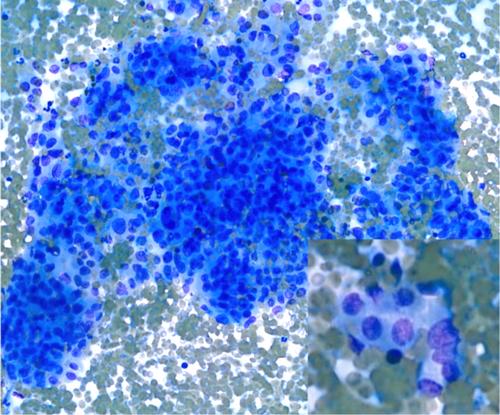
A 52-year-old male presented with a history of Hashimoto's thyroiditis presented with a 10 mm nodule in the right lobe of the thyroid. Ultrasound of the right lobe showed a U3 nodule. The patient underwent an FNA. Cytology used a 5 mL aspiration was taken and a diagnosis of Thy3F (RCPath UK terminology) equivalent to Category IV-subtype oncocytic suspicious of follicular neoplasia was made. The direct smear showed a monotonous population of follicular epithelial cells—single and forming a small aggregate—these cells show oncocytic features in the form of abundant dense cytoplasm with relatively uniform nuclei, presenting as oncocytic cells.
Cellular direct smears and Posie cellular cytospin preparation show large polygonal cells with abundant, granular, cytoplasm and enlarged nuclei, in loose groups with predominance of micro-follicles. Some cells show a prominent nucleolus. Nuclear grooves and nuclear inclusions are not identified, and there no evidence of dysplasia were noticed. There are occasional mixed inflammatory cells and a little colloid in the background.
Subsequently, the case was presented in a multi-disciplinary team (MDT) meeting where the decision of a right hemithyroidectomy was reached. A specimen of right hemithyroidectomy, comprising the right lobe and part of the isthmus the cut surface revealed a grey-white diffused lesion that almost displaced the entire parenchyma.
Despite the utility of FNA cytology, histological examination remains the gold standard for the definitive diagnosis of thyroid lesions. In cases, where cytology is indeterminate or suggestive of follicular neoplasms, surgical excision followed by histological examination becomes crucial. Oncocytic cells, also referred to as oncocytic thyroid carcinoma, are a distinct variant of follicular cells characterised by their abundant, granular, eosinophilic cytoplasm, and hyperchromatic nuclei. These cells are commonly associated with both benign (oncocytic adenomas) and malignant (oncocytic carcinoma) neoplasms. While the presence of oncocytic cells can suggest a particular subtype of follicular neoplasm, abundant cytoplasm is not exclusive to oncocytic cells. This distinction is critical, as misidentifying a trabecular adenoma as an oncocytic lesion could lead to unnecessary concern or overtreatment [6].
Trabecular adenomas, though rare, can present a diagnostic challenge as cytological features may mimic those of more concerning oncocytic neoplasms. These adenomas exhibit follicular epithelial cells with abundant cytoplasm, a feature that can mimic oncocytic cells. Histologically, trabecular adenomas display a distinctive architectural pattern, with elongated cells organised in interconnecting trabeculae, which are encapsulated and benign [7]. However, it is important to note that oncocytic lesions, including those with trabecular architecture, may carry a slightly higher risk of malignancy compared to non-oncocytic adenomas, as oncocytic features are associated with follicular carcinomas in some cases. Accurate differentiation between benign and malignant oncolytic lesions relies on thorough histological and molecular evaluation.
One rare variant of follicular adenomas are trabecular thyroid adenomas characterised by their unique histological architecture, with cells arranged in a trabecular pattern. These adenomas are typically encapsulated, with a benign clinical course. The cytological features of trabecular adenomas can overlap with other follicular-patterned lesions, including oncocytic neoplasms, which complicates preoperative diagnosis. Histologically, trabecular adenomas exhibit elongated cells arranged in interconnecting trabeculae, often surrounded by a fibrous capsule. This architectural feature distinguishes them from oncocytic neoplasms, which tend to have a more diffuse growth pattern [8].
In conclusion, this case emphasises the importance of considering trabecular adenoma in the differential diagnosis of thyroid nodules, particularly in cases where FNA reveals follicular epithelial cells with abundant cytoplasm. Although these features may raise suspicion for oncocytic neoplasms, trabecular adenomas have distinct histological characteristics that set them apart. A thorough histological evaluation is essential for guiding a definitive diagnosis and ensuring appropriate clinical management. The case reinforces the need for a multidisciplinary approach, involving pathologists, endocrinologists, and surgeons, in the management of thyroid nodules to achieve optimal patient outcomes.
Jaiden Townsend: data collection, writing the manuscript. Miguel Perez-Machado: reviewing the manuscript.
期刊介绍:
The aim of Cytopathology is to publish articles relating to those aspects of cytology which will increase our knowledge and understanding of the aetiology, diagnosis and management of human disease. It contains original articles and critical reviews on all aspects of clinical cytology in its broadest sense, including: gynaecological and non-gynaecological cytology; fine needle aspiration and screening strategy.
Cytopathology welcomes papers and articles on: ultrastructural, histochemical and immunocytochemical studies of the cell; quantitative cytology and DNA hybridization as applied to cytological material.





 京公网安备 11010802042870号
京ICP备2023020795号-1
京公网安备 11010802042870号
京ICP备2023020795号-1

 分享
分享
 求助内容:
求助内容: 应助结果提醒方式:
 扫码关注我们
