Bhavya Papudeshi, Michael J Roach, Vijini Mallawaarachchi, George Bouras, Susanna R Grigson, Sarah K Giles, Clarice M Harker, Abbey L K Hutton, Anita Tarasenko, Laura K Inglis, Alejandro A Vega, Cole Souza, Lance Boling, Hamza Hajama, Ana Georgina Cobián Güemes, Anca M Segall, Elizabeth A Dinsdale, Robert A Edwards
{"title":"Sphae:从测序数据中预测噬菌体治疗候选药物的自动化工具包。","authors":"Bhavya Papudeshi, Michael J Roach, Vijini Mallawaarachchi, George Bouras, Susanna R Grigson, Sarah K Giles, Clarice M Harker, Abbey L K Hutton, Anita Tarasenko, Laura K Inglis, Alejandro A Vega, Cole Souza, Lance Boling, Hamza Hajama, Ana Georgina Cobián Güemes, Anca M Segall, Elizabeth A Dinsdale, Robert A Edwards","doi":"10.1093/bioadv/vbaf004","DOIUrl":null,"url":null,"abstract":"<p><strong>Motivation: </strong>Phage therapy offers a viable alternative for bacterial infections amid rising antimicrobial resistance. Its success relies on selecting safe and effective phage candidates that require comprehensive genomic screening to identify potential risks. However, this process is often labor intensive and time-consuming, hindering rapid clinical deployment.</p><p><strong>Results: </strong>We developed Sphae, an automated bioinformatics pipeline designed to streamline the therapeutic potential of a phage in under 10 minutes. Using Snakemake workflow manager, Sphae integrates tools for quality control, assembly, genome assessment, and annotation tailored specifically for phage biology. Sphae automates the detection of key genomic markers, including virulence factors, antimicrobial resistance genes, and lysogeny indicators such as integrase, recombinase, and transposase, which could preclude therapeutic use. Among the 65 phage sequences analyzed, 28 showed therapeutic potential, 8 failed due to low sequencing depth, 22 contained prophage or virulent markers, and 23 had multiple phage genomes. This workflow produces a report to assess phage safety and therapy suitability quickly. Sphae is scalable and portable, facilitating efficient deployment across most high-performance computing and cloud platforms, accelerating the genomic evaluation process.</p><p><strong>Availability and implementation: </strong>Sphae source code is freely available at https://github.com/linsalrob/sphae, with installation supported on Conda, PyPi, Docker containers.</p>","PeriodicalId":72368,"journal":{"name":"Bioinformatics advances","volume":"5 1","pages":"vbaf004"},"PeriodicalIF":2.8000,"publicationDate":"2025-01-17","publicationTypes":"Journal Article","fieldsOfStudy":null,"isOpenAccess":false,"openAccessPdf":"https://www.ncbi.nlm.nih.gov/pmc/articles/PMC11783317/pdf/","citationCount":"0","resultStr":"{\"title\":\"Sphae: an automated toolkit for predicting phage therapy candidates from sequencing data.\",\"authors\":\"Bhavya Papudeshi, Michael J Roach, Vijini Mallawaarachchi, George Bouras, Susanna R Grigson, Sarah K Giles, Clarice M Harker, Abbey L K Hutton, Anita Tarasenko, Laura K Inglis, Alejandro A Vega, Cole Souza, Lance Boling, Hamza Hajama, Ana Georgina Cobián Güemes, Anca M Segall, Elizabeth A Dinsdale, Robert A Edwards\",\"doi\":\"10.1093/bioadv/vbaf004\",\"DOIUrl\":null,\"url\":null,\"abstract\":\"<p><strong>Motivation: </strong>Phage therapy offers a viable alternative for bacterial infections amid rising antimicrobial resistance. Its success relies on selecting safe and effective phage candidates that require comprehensive genomic screening to identify potential risks. However, this process is often labor intensive and time-consuming, hindering rapid clinical deployment.</p><p><strong>Results: </strong>We developed Sphae, an automated bioinformatics pipeline designed to streamline the therapeutic potential of a phage in under 10 minutes. Using Snakemake workflow manager, Sphae integrates tools for quality control, assembly, genome assessment, and annotation tailored specifically for phage biology. Sphae automates the detection of key genomic markers, including virulence factors, antimicrobial resistance genes, and lysogeny indicators such as integrase, recombinase, and transposase, which could preclude therapeutic use. Among the 65 phage sequences analyzed, 28 showed therapeutic potential, 8 failed due to low sequencing depth, 22 contained prophage or virulent markers, and 23 had multiple phage genomes. This workflow produces a report to assess phage safety and therapy suitability quickly. Sphae is scalable and portable, facilitating efficient deployment across most high-performance computing and cloud platforms, accelerating the genomic evaluation process.</p><p><strong>Availability and implementation: </strong>Sphae source code is freely available at https://github.com/linsalrob/sphae, with installation supported on Conda, PyPi, Docker containers.</p>\",\"PeriodicalId\":72368,\"journal\":{\"name\":\"Bioinformatics advances\",\"volume\":\"5 1\",\"pages\":\"vbaf004\"},\"PeriodicalIF\":2.8000,\"publicationDate\":\"2025-01-17\",\"publicationTypes\":\"Journal Article\",\"fieldsOfStudy\":null,\"isOpenAccess\":false,\"openAccessPdf\":\"https://www.ncbi.nlm.nih.gov/pmc/articles/PMC11783317/pdf/\",\"citationCount\":\"0\",\"resultStr\":null,\"platform\":\"Semanticscholar\",\"paperid\":null,\"PeriodicalName\":\"Bioinformatics advances\",\"FirstCategoryId\":\"1085\",\"ListUrlMain\":\"https://doi.org/10.1093/bioadv/vbaf004\",\"RegionNum\":0,\"RegionCategory\":null,\"ArticlePicture\":[],\"TitleCN\":null,\"AbstractTextCN\":null,\"PMCID\":null,\"EPubDate\":\"2025/1/1 0:00:00\",\"PubModel\":\"eCollection\",\"JCR\":\"Q2\",\"JCRName\":\"MATHEMATICAL & COMPUTATIONAL BIOLOGY\",\"Score\":null,\"Total\":0}","platform":"Semanticscholar","paperid":null,"PeriodicalName":"Bioinformatics advances","FirstCategoryId":"1085","ListUrlMain":"https://doi.org/10.1093/bioadv/vbaf004","RegionNum":0,"RegionCategory":null,"ArticlePicture":[],"TitleCN":null,"AbstractTextCN":null,"PMCID":null,"EPubDate":"2025/1/1 0:00:00","PubModel":"eCollection","JCR":"Q2","JCRName":"MATHEMATICAL & COMPUTATIONAL BIOLOGY","Score":null,"Total":0}
Sphae: an automated toolkit for predicting phage therapy candidates from sequencing data.
Motivation: Phage therapy offers a viable alternative for bacterial infections amid rising antimicrobial resistance. Its success relies on selecting safe and effective phage candidates that require comprehensive genomic screening to identify potential risks. However, this process is often labor intensive and time-consuming, hindering rapid clinical deployment.
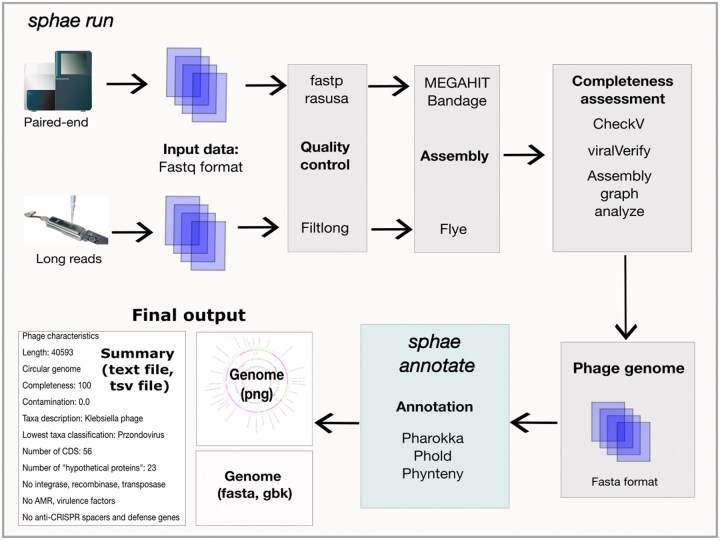
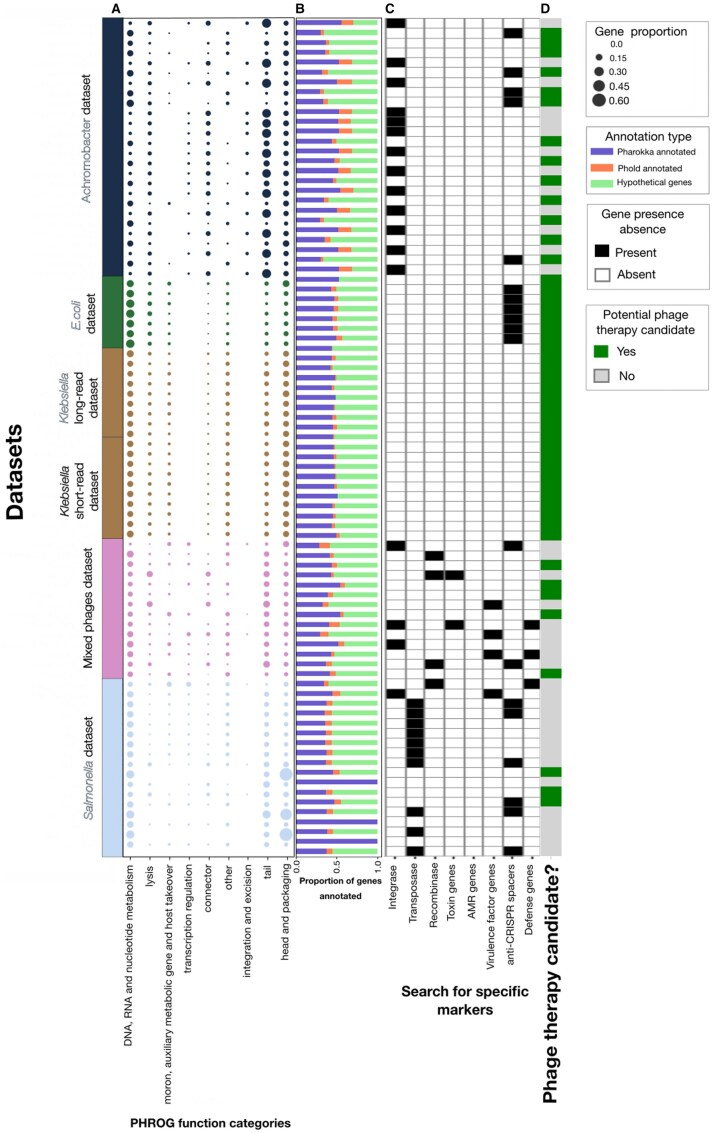
Results: We developed Sphae, an automated bioinformatics pipeline designed to streamline the therapeutic potential of a phage in under 10 minutes. Using Snakemake workflow manager, Sphae integrates tools for quality control, assembly, genome assessment, and annotation tailored specifically for phage biology. Sphae automates the detection of key genomic markers, including virulence factors, antimicrobial resistance genes, and lysogeny indicators such as integrase, recombinase, and transposase, which could preclude therapeutic use. Among the 65 phage sequences analyzed, 28 showed therapeutic potential, 8 failed due to low sequencing depth, 22 contained prophage or virulent markers, and 23 had multiple phage genomes. This workflow produces a report to assess phage safety and therapy suitability quickly. Sphae is scalable and portable, facilitating efficient deployment across most high-performance computing and cloud platforms, accelerating the genomic evaluation process.
Availability and implementation: Sphae source code is freely available at https://github.com/linsalrob/sphae, with installation supported on Conda, PyPi, Docker containers.




 京公网安备 11010802042870号
京ICP备2023020795号-1
京公网安备 11010802042870号
京ICP备2023020795号-1

 分享
分享

 求助内容:
求助内容: 应助结果提醒方式:
 扫码关注我们
