Qinsheng Hu, Chengcheng Wu, Ling Wang, Dan Cao, Junchao Wang, Yangrui Du, Miao Liu and Kaijun Li
{"title":"具有抗菌和抗炎作用的多功能金属酚纳米颗粒用于骨髓炎的治疗。","authors":"Qinsheng Hu, Chengcheng Wu, Ling Wang, Dan Cao, Junchao Wang, Yangrui Du, Miao Liu and Kaijun Li","doi":"10.1039/D4TB02649G","DOIUrl":null,"url":null,"abstract":"<p >Osteomyelitis is a serious inflammatory disease mostly caused by bacterial infections. It is necessary to simultaneously eradicate bacterial cells and inhibit inflammation in treating osteomyelitis. Herein, we design an innovative zinc ion (Zn<small><sup>2+</sup></small>)-based nano delivery system for the management of osteomyelitis. Taking advantage of the coordination self-assembly of Zn<small><sup>2+</sup></small>, quercetin (QU), and ε-poly-<small>L</small>-lysine (EPL), Zn<small><sup>2+</sup></small>-containing nanoparticles (denoted as ZQE NPs) are prepared. ZQE NPs are spherical nanoparticles with amorphous structures. They are stable in the physiological neutral environment but can be dissociated in an acidic microenvironment of infection sites. Since Zn<small><sup>2+</sup></small> is encapsulated into ZQE NPs by coordination interaction, the deactivation of Zn<small><sup>2+</sup></small> by proteins can be effectively avoided. Therefore, ZQE NPs can maintain excellent bactericidal activity in a protein-rich environment, while dissociative Zn<small><sup>2+</sup></small> doesn’t exhibit obvious bactericidal ability. Meanwhile, ZQE NPs are highly effective at scavenging intracellular reactive oxygen species (ROS) and inhibiting pro-inflammatory cytokines, due to the strong anti-inflammatory effects of QU and Zn<small><sup>2+</sup></small>. The <em>in vivo</em> therapeutic efficacy of ZQE NPs is assessed using a rat model of methicillin-resistant <em>Staphylococcus aureus</em> (MRSA)-induced osteomyelitis. Results demonstrate that ZQE NPs effectively eradicate bacterial cells and reduce inflammation <em>in vivo</em>, thereby promoting osteogenesis and recovery of osteomyelitis.</p>","PeriodicalId":83,"journal":{"name":"Journal of Materials Chemistry B","volume":" 9","pages":" 3067-3079"},"PeriodicalIF":6.2000,"publicationDate":"2025-01-29","publicationTypes":"Journal Article","fieldsOfStudy":null,"isOpenAccess":false,"openAccessPdf":"","citationCount":"0","resultStr":"{\"title\":\"Multifunctional metal–phenolic nanoparticles with antibacterial and anti-inflammatory effects for osteomyelitis management\",\"authors\":\"Qinsheng Hu, Chengcheng Wu, Ling Wang, Dan Cao, Junchao Wang, Yangrui Du, Miao Liu and Kaijun Li\",\"doi\":\"10.1039/D4TB02649G\",\"DOIUrl\":null,\"url\":null,\"abstract\":\"<p >Osteomyelitis is a serious inflammatory disease mostly caused by bacterial infections. It is necessary to simultaneously eradicate bacterial cells and inhibit inflammation in treating osteomyelitis. Herein, we design an innovative zinc ion (Zn<small><sup>2+</sup></small>)-based nano delivery system for the management of osteomyelitis. Taking advantage of the coordination self-assembly of Zn<small><sup>2+</sup></small>, quercetin (QU), and ε-poly-<small>L</small>-lysine (EPL), Zn<small><sup>2+</sup></small>-containing nanoparticles (denoted as ZQE NPs) are prepared. ZQE NPs are spherical nanoparticles with amorphous structures. They are stable in the physiological neutral environment but can be dissociated in an acidic microenvironment of infection sites. Since Zn<small><sup>2+</sup></small> is encapsulated into ZQE NPs by coordination interaction, the deactivation of Zn<small><sup>2+</sup></small> by proteins can be effectively avoided. Therefore, ZQE NPs can maintain excellent bactericidal activity in a protein-rich environment, while dissociative Zn<small><sup>2+</sup></small> doesn’t exhibit obvious bactericidal ability. Meanwhile, ZQE NPs are highly effective at scavenging intracellular reactive oxygen species (ROS) and inhibiting pro-inflammatory cytokines, due to the strong anti-inflammatory effects of QU and Zn<small><sup>2+</sup></small>. The <em>in vivo</em> therapeutic efficacy of ZQE NPs is assessed using a rat model of methicillin-resistant <em>Staphylococcus aureus</em> (MRSA)-induced osteomyelitis. Results demonstrate that ZQE NPs effectively eradicate bacterial cells and reduce inflammation <em>in vivo</em>, thereby promoting osteogenesis and recovery of osteomyelitis.</p>\",\"PeriodicalId\":83,\"journal\":{\"name\":\"Journal of Materials Chemistry B\",\"volume\":\" 9\",\"pages\":\" 3067-3079\"},\"PeriodicalIF\":6.2000,\"publicationDate\":\"2025-01-29\",\"publicationTypes\":\"Journal Article\",\"fieldsOfStudy\":null,\"isOpenAccess\":false,\"openAccessPdf\":\"\",\"citationCount\":\"0\",\"resultStr\":null,\"platform\":\"Semanticscholar\",\"paperid\":null,\"PeriodicalName\":\"Journal of Materials Chemistry B\",\"FirstCategoryId\":\"1\",\"ListUrlMain\":\"https://pubs.rsc.org/en/content/articlelanding/2025/tb/d4tb02649g\",\"RegionNum\":3,\"RegionCategory\":\"医学\",\"ArticlePicture\":[],\"TitleCN\":null,\"AbstractTextCN\":null,\"PMCID\":null,\"EPubDate\":\"\",\"PubModel\":\"\",\"JCR\":\"Q1\",\"JCRName\":\"MATERIALS SCIENCE, BIOMATERIALS\",\"Score\":null,\"Total\":0}","platform":"Semanticscholar","paperid":null,"PeriodicalName":"Journal of Materials Chemistry B","FirstCategoryId":"1","ListUrlMain":"https://pubs.rsc.org/en/content/articlelanding/2025/tb/d4tb02649g","RegionNum":3,"RegionCategory":"医学","ArticlePicture":[],"TitleCN":null,"AbstractTextCN":null,"PMCID":null,"EPubDate":"","PubModel":"","JCR":"Q1","JCRName":"MATERIALS SCIENCE, BIOMATERIALS","Score":null,"Total":0}
Multifunctional metal–phenolic nanoparticles with antibacterial and anti-inflammatory effects for osteomyelitis management
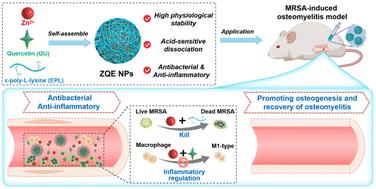
Osteomyelitis is a serious inflammatory disease mostly caused by bacterial infections. It is necessary to simultaneously eradicate bacterial cells and inhibit inflammation in treating osteomyelitis. Herein, we design an innovative zinc ion (Zn2+)-based nano delivery system for the management of osteomyelitis. Taking advantage of the coordination self-assembly of Zn2+, quercetin (QU), and ε-poly-L-lysine (EPL), Zn2+-containing nanoparticles (denoted as ZQE NPs) are prepared. ZQE NPs are spherical nanoparticles with amorphous structures. They are stable in the physiological neutral environment but can be dissociated in an acidic microenvironment of infection sites. Since Zn2+ is encapsulated into ZQE NPs by coordination interaction, the deactivation of Zn2+ by proteins can be effectively avoided. Therefore, ZQE NPs can maintain excellent bactericidal activity in a protein-rich environment, while dissociative Zn2+ doesn’t exhibit obvious bactericidal ability. Meanwhile, ZQE NPs are highly effective at scavenging intracellular reactive oxygen species (ROS) and inhibiting pro-inflammatory cytokines, due to the strong anti-inflammatory effects of QU and Zn2+. The in vivo therapeutic efficacy of ZQE NPs is assessed using a rat model of methicillin-resistant Staphylococcus aureus (MRSA)-induced osteomyelitis. Results demonstrate that ZQE NPs effectively eradicate bacterial cells and reduce inflammation in vivo, thereby promoting osteogenesis and recovery of osteomyelitis.
期刊介绍:
Journal of Materials Chemistry A, B & C cover high quality studies across all fields of materials chemistry. The journals focus on those theoretical or experimental studies that report new understanding, applications, properties and synthesis of materials. Journal of Materials Chemistry A, B & C are separated by the intended application of the material studied. Broadly, applications in energy and sustainability are of interest to Journal of Materials Chemistry A, applications in biology and medicine are of interest to Journal of Materials Chemistry B, and applications in optical, magnetic and electronic devices are of interest to Journal of Materials Chemistry C.Journal of Materials Chemistry B is a Transformative Journal and Plan S compliant. Example topic areas within the scope of Journal of Materials Chemistry B are listed below. This list is neither exhaustive nor exclusive:
Antifouling coatings
Biocompatible materials
Bioelectronics
Bioimaging
Biomimetics
Biomineralisation
Bionics
Biosensors
Diagnostics
Drug delivery
Gene delivery
Immunobiology
Nanomedicine
Regenerative medicine & Tissue engineering
Scaffolds
Soft robotics
Stem cells
Therapeutic devices




 京公网安备 11010802042870号
京ICP备2023020795号-1
京公网安备 11010802042870号
京ICP备2023020795号-1

 分享
分享
 求助内容:
求助内容: 应助结果提醒方式:
 扫码关注我们
