Andressa A. Bertolazzo, Mark J. Meijerink, Eli Martinez, Henry Chan, Carlos Chu-Jon, Ilke Arslan, Subramanian K.R.S. Sankaranarayanan, Valeria Molinero
{"title":"结合实验和模拟揭示一维沸石的各向异性生长机制和界面","authors":"Andressa A. Bertolazzo, Mark J. Meijerink, Eli Martinez, Henry Chan, Carlos Chu-Jon, Ilke Arslan, Subramanian K.R.S. Sankaranarayanan, Valeria Molinero","doi":"10.1021/acs.chemmater.4c03293","DOIUrl":null,"url":null,"abstract":"Zeolites are nanoporous crystalline materials critical for diverse industrial applications, yet their growth mechanisms are poorly understood. This study presents a novel integrated framework combining experimental synthesis, high-resolution imaging, coarse-grained molecular dynamics simulations, and computer vision to uncover the mechanisms of growth of SSZ-24, a 1D channel zeolite. We demonstrate how synthesis conditions, such as temperature and reactant concentration, govern crystal anisotropy and surface roughness with growth dynamics differing markedly by crystallographic orientation. Along the channels, growth involves minimal energy barriers and rapid nucleation, resulting in rough surfaces. In contrast, growth perpendicular to the channels requires cooperative molecular organization and is highly sensitive to thermodynamic and kinetic conditions, yielding smooth anisotropic surfaces under low driving forces. By simulating transmission electron microscopy (TEM) images, we bridge molecular-scale simulations with experimental observations, identifying distinct growth mechanisms along different crystal planes. This work offers molecular-level insights into zeolite crystallization, advancing the rational design of nanoporous materials. The integration of cross-disciplinary methodologies establishes a transformative framework for optimizing zeolite synthesis, with implications for broader classes of materials.","PeriodicalId":33,"journal":{"name":"Chemistry of Materials","volume":"39 1","pages":""},"PeriodicalIF":7.1000,"publicationDate":"2025-02-04","publicationTypes":"Journal Article","fieldsOfStudy":null,"isOpenAccess":false,"openAccessPdf":"","citationCount":"0","resultStr":"{\"title\":\"Integrating Experiments and Simulations to Reveal Anisotropic Growth Mechanisms and Interfaces of a One-Dimensional Zeolite\",\"authors\":\"Andressa A. Bertolazzo, Mark J. Meijerink, Eli Martinez, Henry Chan, Carlos Chu-Jon, Ilke Arslan, Subramanian K.R.S. Sankaranarayanan, Valeria Molinero\",\"doi\":\"10.1021/acs.chemmater.4c03293\",\"DOIUrl\":null,\"url\":null,\"abstract\":\"Zeolites are nanoporous crystalline materials critical for diverse industrial applications, yet their growth mechanisms are poorly understood. This study presents a novel integrated framework combining experimental synthesis, high-resolution imaging, coarse-grained molecular dynamics simulations, and computer vision to uncover the mechanisms of growth of SSZ-24, a 1D channel zeolite. We demonstrate how synthesis conditions, such as temperature and reactant concentration, govern crystal anisotropy and surface roughness with growth dynamics differing markedly by crystallographic orientation. Along the channels, growth involves minimal energy barriers and rapid nucleation, resulting in rough surfaces. In contrast, growth perpendicular to the channels requires cooperative molecular organization and is highly sensitive to thermodynamic and kinetic conditions, yielding smooth anisotropic surfaces under low driving forces. By simulating transmission electron microscopy (TEM) images, we bridge molecular-scale simulations with experimental observations, identifying distinct growth mechanisms along different crystal planes. This work offers molecular-level insights into zeolite crystallization, advancing the rational design of nanoporous materials. The integration of cross-disciplinary methodologies establishes a transformative framework for optimizing zeolite synthesis, with implications for broader classes of materials.\",\"PeriodicalId\":33,\"journal\":{\"name\":\"Chemistry of Materials\",\"volume\":\"39 1\",\"pages\":\"\"},\"PeriodicalIF\":7.1000,\"publicationDate\":\"2025-02-04\",\"publicationTypes\":\"Journal Article\",\"fieldsOfStudy\":null,\"isOpenAccess\":false,\"openAccessPdf\":\"\",\"citationCount\":\"0\",\"resultStr\":null,\"platform\":\"Semanticscholar\",\"paperid\":null,\"PeriodicalName\":\"Chemistry of Materials\",\"FirstCategoryId\":\"88\",\"ListUrlMain\":\"https://doi.org/10.1021/acs.chemmater.4c03293\",\"RegionNum\":2,\"RegionCategory\":\"材料科学\",\"ArticlePicture\":[],\"TitleCN\":null,\"AbstractTextCN\":null,\"PMCID\":null,\"EPubDate\":\"\",\"PubModel\":\"\",\"JCR\":\"Q2\",\"JCRName\":\"CHEMISTRY, PHYSICAL\",\"Score\":null,\"Total\":0}","platform":"Semanticscholar","paperid":null,"PeriodicalName":"Chemistry of Materials","FirstCategoryId":"88","ListUrlMain":"https://doi.org/10.1021/acs.chemmater.4c03293","RegionNum":2,"RegionCategory":"材料科学","ArticlePicture":[],"TitleCN":null,"AbstractTextCN":null,"PMCID":null,"EPubDate":"","PubModel":"","JCR":"Q2","JCRName":"CHEMISTRY, PHYSICAL","Score":null,"Total":0}
Integrating Experiments and Simulations to Reveal Anisotropic Growth Mechanisms and Interfaces of a One-Dimensional Zeolite
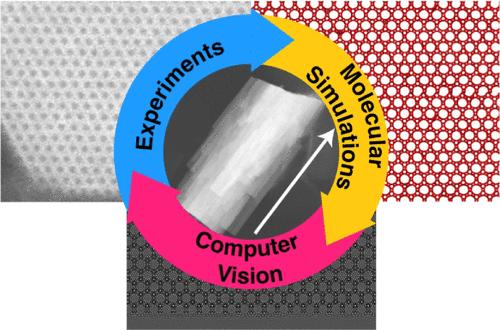
Zeolites are nanoporous crystalline materials critical for diverse industrial applications, yet their growth mechanisms are poorly understood. This study presents a novel integrated framework combining experimental synthesis, high-resolution imaging, coarse-grained molecular dynamics simulations, and computer vision to uncover the mechanisms of growth of SSZ-24, a 1D channel zeolite. We demonstrate how synthesis conditions, such as temperature and reactant concentration, govern crystal anisotropy and surface roughness with growth dynamics differing markedly by crystallographic orientation. Along the channels, growth involves minimal energy barriers and rapid nucleation, resulting in rough surfaces. In contrast, growth perpendicular to the channels requires cooperative molecular organization and is highly sensitive to thermodynamic and kinetic conditions, yielding smooth anisotropic surfaces under low driving forces. By simulating transmission electron microscopy (TEM) images, we bridge molecular-scale simulations with experimental observations, identifying distinct growth mechanisms along different crystal planes. This work offers molecular-level insights into zeolite crystallization, advancing the rational design of nanoporous materials. The integration of cross-disciplinary methodologies establishes a transformative framework for optimizing zeolite synthesis, with implications for broader classes of materials.
期刊介绍:
The journal Chemistry of Materials focuses on publishing original research at the intersection of materials science and chemistry. The studies published in the journal involve chemistry as a prominent component and explore topics such as the design, synthesis, characterization, processing, understanding, and application of functional or potentially functional materials. The journal covers various areas of interest, including inorganic and organic solid-state chemistry, nanomaterials, biomaterials, thin films and polymers, and composite/hybrid materials. The journal particularly seeks papers that highlight the creation or development of innovative materials with novel optical, electrical, magnetic, catalytic, or mechanical properties. It is essential that manuscripts on these topics have a primary focus on the chemistry of materials and represent a significant advancement compared to prior research. Before external reviews are sought, submitted manuscripts undergo a review process by a minimum of two editors to ensure their appropriateness for the journal and the presence of sufficient evidence of a significant advance that will be of broad interest to the materials chemistry community.




 京公网安备 11010802042870号
京ICP备2023020795号-1
京公网安备 11010802042870号
京ICP备2023020795号-1

 分享
分享
 求助内容:
求助内容: 应助结果提醒方式:
 扫码关注我们
