Dustin A. Carlson , John E. Pandolfino , Rena Yadlapati , Marcelo F. Vela , Stuart J. Spechler , Felice H. Schnoll-Sussman , Kristle Lynch , Adriana Lazarescu , Abraham Khan , Philip Katz , Anand S. Jain , C. Prakash Gyawali , Milli Gupta , Jose M. Garza , Ronnie Fass , John O. Clarke , Reena V. Chokshi , Joan Chen , Karthik Ravi , Walter W. Chan , Vani J.A. Konda
{"title":"执行和解释食道运动障碍FLIP全测量法的标准化方法:达拉斯共识","authors":"Dustin A. Carlson , John E. Pandolfino , Rena Yadlapati , Marcelo F. Vela , Stuart J. Spechler , Felice H. Schnoll-Sussman , Kristle Lynch , Adriana Lazarescu , Abraham Khan , Philip Katz , Anand S. Jain , C. Prakash Gyawali , Milli Gupta , Jose M. Garza , Ronnie Fass , John O. Clarke , Reena V. Chokshi , Joan Chen , Karthik Ravi , Walter W. Chan , Vani J.A. Konda","doi":"10.1053/j.gastro.2025.01.234","DOIUrl":null,"url":null,"abstract":"<div><h3>Background & Aims</h3><div>Functional lumen imaging probe (FLIP) panometry provides assessment of the esophagogastric junction opening and esophageal body contractile activity during an endoscopic procedure and is increasingly being incorporated into comprehensive esophageal motility assessments. The aim of this study was to provide a standardized approach and vocabulary to the procedure and interpretation and update the motility classification scheme.</div></div><div><h3>Methods</h3><div>A working group of 19 FLIP panometry experts convened in a modified Delphi consensus process to produce and assess statements on the FLIP panometry procedure and interpretation. Three rounds of voting were conducted on an agreement scale of 1–9 for appropriateness, followed by face-to-face discussions and an opportunity for revisions of statements. The “percent agreement” was the proportion of votes with score ≥7 indicating level of agreement on appropriateness.</div></div><div><h3>Results</h3><div>A total of 40 statements were selected for final inclusion in the Dallas Consensus, including FLIP panometry protocol, interpretation of esophagogastric junction opening and contractile response, and motility classification scheme. Key statements included: “FLIP panometry should be interpreted in the context of the clinical presentation, the accompanying EGD [esophagogastroduodenoscopy] findings and other relevant complementary testing” (median response 9.0; 100% agreement). “A major motor disorder is unlikely in the setting of a ‘normal’ FLIP panometry classification” (median response 9.0; 94% agreement). “Diminished or absent contractile response with reduced esophageal opening (ie, nonspastic obstruction) supports the diagnosis of a disorder of EGJ [esophagogastric junction] outflow” (median response 8.5; 94% agreement).</div></div><div><h3>Conclusions</h3><div>The standardized approach for performance and interpretation of the Dallas Consensus can facilitate use of FLIP panometry in broad clinical settings.</div></div>","PeriodicalId":12590,"journal":{"name":"Gastroenterology","volume":"168 6","pages":"Pages 1114-1127.e5"},"PeriodicalIF":25.1000,"publicationDate":"2025-06-01","publicationTypes":"Journal Article","fieldsOfStudy":null,"isOpenAccess":false,"openAccessPdf":"","citationCount":"0","resultStr":"{\"title\":\"A Standardized Approach to Performing and Interpreting Functional Lumen Imaging Probe Panometry for Esophageal Motility Disorders: The Dallas Consensus\",\"authors\":\"Dustin A. Carlson , John E. Pandolfino , Rena Yadlapati , Marcelo F. Vela , Stuart J. Spechler , Felice H. Schnoll-Sussman , Kristle Lynch , Adriana Lazarescu , Abraham Khan , Philip Katz , Anand S. Jain , C. Prakash Gyawali , Milli Gupta , Jose M. Garza , Ronnie Fass , John O. Clarke , Reena V. Chokshi , Joan Chen , Karthik Ravi , Walter W. Chan , Vani J.A. Konda\",\"doi\":\"10.1053/j.gastro.2025.01.234\",\"DOIUrl\":null,\"url\":null,\"abstract\":\"<div><h3>Background & Aims</h3><div>Functional lumen imaging probe (FLIP) panometry provides assessment of the esophagogastric junction opening and esophageal body contractile activity during an endoscopic procedure and is increasingly being incorporated into comprehensive esophageal motility assessments. The aim of this study was to provide a standardized approach and vocabulary to the procedure and interpretation and update the motility classification scheme.</div></div><div><h3>Methods</h3><div>A working group of 19 FLIP panometry experts convened in a modified Delphi consensus process to produce and assess statements on the FLIP panometry procedure and interpretation. Three rounds of voting were conducted on an agreement scale of 1–9 for appropriateness, followed by face-to-face discussions and an opportunity for revisions of statements. The “percent agreement” was the proportion of votes with score ≥7 indicating level of agreement on appropriateness.</div></div><div><h3>Results</h3><div>A total of 40 statements were selected for final inclusion in the Dallas Consensus, including FLIP panometry protocol, interpretation of esophagogastric junction opening and contractile response, and motility classification scheme. Key statements included: “FLIP panometry should be interpreted in the context of the clinical presentation, the accompanying EGD [esophagogastroduodenoscopy] findings and other relevant complementary testing” (median response 9.0; 100% agreement). “A major motor disorder is unlikely in the setting of a ‘normal’ FLIP panometry classification” (median response 9.0; 94% agreement). “Diminished or absent contractile response with reduced esophageal opening (ie, nonspastic obstruction) supports the diagnosis of a disorder of EGJ [esophagogastric junction] outflow” (median response 8.5; 94% agreement).</div></div><div><h3>Conclusions</h3><div>The standardized approach for performance and interpretation of the Dallas Consensus can facilitate use of FLIP panometry in broad clinical settings.</div></div>\",\"PeriodicalId\":12590,\"journal\":{\"name\":\"Gastroenterology\",\"volume\":\"168 6\",\"pages\":\"Pages 1114-1127.e5\"},\"PeriodicalIF\":25.1000,\"publicationDate\":\"2025-06-01\",\"publicationTypes\":\"Journal Article\",\"fieldsOfStudy\":null,\"isOpenAccess\":false,\"openAccessPdf\":\"\",\"citationCount\":\"0\",\"resultStr\":null,\"platform\":\"Semanticscholar\",\"paperid\":null,\"PeriodicalName\":\"Gastroenterology\",\"FirstCategoryId\":\"3\",\"ListUrlMain\":\"https://www.sciencedirect.com/science/article/pii/S0016508525003415\",\"RegionNum\":1,\"RegionCategory\":\"医学\",\"ArticlePicture\":[],\"TitleCN\":null,\"AbstractTextCN\":null,\"PMCID\":null,\"EPubDate\":\"2025/2/4 0:00:00\",\"PubModel\":\"Epub\",\"JCR\":\"Q1\",\"JCRName\":\"GASTROENTEROLOGY & HEPATOLOGY\",\"Score\":null,\"Total\":0}","platform":"Semanticscholar","paperid":null,"PeriodicalName":"Gastroenterology","FirstCategoryId":"3","ListUrlMain":"https://www.sciencedirect.com/science/article/pii/S0016508525003415","RegionNum":1,"RegionCategory":"医学","ArticlePicture":[],"TitleCN":null,"AbstractTextCN":null,"PMCID":null,"EPubDate":"2025/2/4 0:00:00","PubModel":"Epub","JCR":"Q1","JCRName":"GASTROENTEROLOGY & HEPATOLOGY","Score":null,"Total":0}
A Standardized Approach to Performing and Interpreting Functional Lumen Imaging Probe Panometry for Esophageal Motility Disorders: The Dallas Consensus
Background & Aims
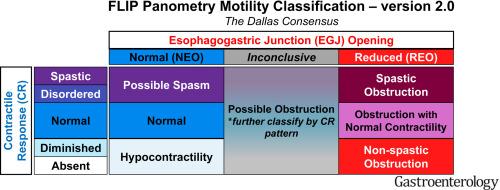
Functional lumen imaging probe (FLIP) panometry provides assessment of the esophagogastric junction opening and esophageal body contractile activity during an endoscopic procedure and is increasingly being incorporated into comprehensive esophageal motility assessments. The aim of this study was to provide a standardized approach and vocabulary to the procedure and interpretation and update the motility classification scheme.
Methods
A working group of 19 FLIP panometry experts convened in a modified Delphi consensus process to produce and assess statements on the FLIP panometry procedure and interpretation. Three rounds of voting were conducted on an agreement scale of 1–9 for appropriateness, followed by face-to-face discussions and an opportunity for revisions of statements. The “percent agreement” was the proportion of votes with score ≥7 indicating level of agreement on appropriateness.
Results
A total of 40 statements were selected for final inclusion in the Dallas Consensus, including FLIP panometry protocol, interpretation of esophagogastric junction opening and contractile response, and motility classification scheme. Key statements included: “FLIP panometry should be interpreted in the context of the clinical presentation, the accompanying EGD [esophagogastroduodenoscopy] findings and other relevant complementary testing” (median response 9.0; 100% agreement). “A major motor disorder is unlikely in the setting of a ‘normal’ FLIP panometry classification” (median response 9.0; 94% agreement). “Diminished or absent contractile response with reduced esophageal opening (ie, nonspastic obstruction) supports the diagnosis of a disorder of EGJ [esophagogastric junction] outflow” (median response 8.5; 94% agreement).
Conclusions
The standardized approach for performance and interpretation of the Dallas Consensus can facilitate use of FLIP panometry in broad clinical settings.
期刊介绍:
Gastroenterology is the most prominent journal in the field of gastrointestinal disease. It is the flagship journal of the American Gastroenterological Association and delivers authoritative coverage of clinical, translational, and basic studies of all aspects of the digestive system, including the liver and pancreas, as well as nutrition.
Some regular features of Gastroenterology include original research studies by leading authorities, comprehensive reviews and perspectives on important topics in adult and pediatric gastroenterology and hepatology. The journal also includes features such as editorials, correspondence, and commentaries, as well as special sections like "Mentoring, Education and Training Corner," "Diversity, Equity and Inclusion in GI," "Gastro Digest," "Gastro Curbside Consult," and "Gastro Grand Rounds."
Gastroenterology also provides digital media materials such as videos and "GI Rapid Reel" animations. It is abstracted and indexed in various databases including Scopus, Biological Abstracts, Current Contents, Embase, Nutrition Abstracts, Chemical Abstracts, Current Awareness in Biological Sciences, PubMed/Medline, and the Science Citation Index.




 京公网安备 11010802042870号
京ICP备2023020795号-1
京公网安备 11010802042870号
京ICP备2023020795号-1

 分享
分享
 求助内容:
求助内容: 应助结果提醒方式:
 扫码关注我们
