Haritha Valiyaveettil Padi, Shebin Sulaiman, Navya Nanattil and Binitha N. Narayanan*,
{"title":"用于柔性电子和储能应用的室温固化油墨配方的氨基边功能化n掺杂多孔石墨烯的简便制备","authors":"Haritha Valiyaveettil Padi, Shebin Sulaiman, Navya Nanattil and Binitha N. Narayanan*, ","doi":"10.1021/acsaem.4c02301","DOIUrl":null,"url":null,"abstract":"<p >Flexible conducting wires are highly relevant nowadays due to their possible integration into various electronic gadgets, where energy storage devices are also needed. Here a material composed of N-doped holey graphene with aromatic primary amine groups at the edges (N-doped holey graphene amine) takes the dual role of conducting wire and electrode for supercapacitors. A facile ball-milling of graphite with the N-containing milling agent 1-naphthylamine followed by high-temperature treatment led to the formation of N-doped holey graphene as evident from the material characterization using transmission electron microscopy, X-ray photoelectron spectroscopy, X-ray diffraction, field emission scanning electron microscopy, Fourier transform infrared spectroscopy, Raman spectroscopy, <sup>13</sup>C NMR spectroscopy, atomic force microscopy and elemental analysis. In addition to pyridinic, pyrolytic, and graphitic N, the NMR spectrum and XPS confirm the presence of -NH<sub>2</sub> attached to aromatic carbon. The graphene inks prepared at different temperatures including room temperature displayed variable conductivity suitable for the required applications; the sample treated at 250 °C was also used as an electrode material for supercapacitors. An areal capacitance of 12.33 mF/cm<sup>2</sup> at a current density of 0.06 mA/cm<sup>2</sup> is displayed by the graphene ink supercapacitor device together with an energy density of 1.71 μWh/cm<sup>2</sup>. A power density of 500 μW/cm<sup>2</sup> at a current density of 1 mA/cm<sup>2</sup> is displayed, and at 0.5 mA/cm<sup>2</sup>, the device retained 100% of its capacitance after 5000 continuous charge–discharge cycles.</p>","PeriodicalId":4,"journal":{"name":"ACS Applied Energy Materials","volume":"8 2","pages":"838–852 838–852"},"PeriodicalIF":5.5000,"publicationDate":"2025-01-11","publicationTypes":"Journal Article","fieldsOfStudy":null,"isOpenAccess":false,"openAccessPdf":"","citationCount":"0","resultStr":"{\"title\":\"Facile Preparation of Amino Edge Functionalized N-doped Holey Graphene for Room Temperature Curable Ink Formulation Suitable for Flexible Electronics and Energy Storage Applications\",\"authors\":\"Haritha Valiyaveettil Padi, Shebin Sulaiman, Navya Nanattil and Binitha N. Narayanan*, \",\"doi\":\"10.1021/acsaem.4c02301\",\"DOIUrl\":null,\"url\":null,\"abstract\":\"<p >Flexible conducting wires are highly relevant nowadays due to their possible integration into various electronic gadgets, where energy storage devices are also needed. Here a material composed of N-doped holey graphene with aromatic primary amine groups at the edges (N-doped holey graphene amine) takes the dual role of conducting wire and electrode for supercapacitors. A facile ball-milling of graphite with the N-containing milling agent 1-naphthylamine followed by high-temperature treatment led to the formation of N-doped holey graphene as evident from the material characterization using transmission electron microscopy, X-ray photoelectron spectroscopy, X-ray diffraction, field emission scanning electron microscopy, Fourier transform infrared spectroscopy, Raman spectroscopy, <sup>13</sup>C NMR spectroscopy, atomic force microscopy and elemental analysis. In addition to pyridinic, pyrolytic, and graphitic N, the NMR spectrum and XPS confirm the presence of -NH<sub>2</sub> attached to aromatic carbon. The graphene inks prepared at different temperatures including room temperature displayed variable conductivity suitable for the required applications; the sample treated at 250 °C was also used as an electrode material for supercapacitors. An areal capacitance of 12.33 mF/cm<sup>2</sup> at a current density of 0.06 mA/cm<sup>2</sup> is displayed by the graphene ink supercapacitor device together with an energy density of 1.71 μWh/cm<sup>2</sup>. A power density of 500 μW/cm<sup>2</sup> at a current density of 1 mA/cm<sup>2</sup> is displayed, and at 0.5 mA/cm<sup>2</sup>, the device retained 100% of its capacitance after 5000 continuous charge–discharge cycles.</p>\",\"PeriodicalId\":4,\"journal\":{\"name\":\"ACS Applied Energy Materials\",\"volume\":\"8 2\",\"pages\":\"838–852 838–852\"},\"PeriodicalIF\":5.5000,\"publicationDate\":\"2025-01-11\",\"publicationTypes\":\"Journal Article\",\"fieldsOfStudy\":null,\"isOpenAccess\":false,\"openAccessPdf\":\"\",\"citationCount\":\"0\",\"resultStr\":null,\"platform\":\"Semanticscholar\",\"paperid\":null,\"PeriodicalName\":\"ACS Applied Energy Materials\",\"FirstCategoryId\":\"88\",\"ListUrlMain\":\"https://pubs.acs.org/doi/10.1021/acsaem.4c02301\",\"RegionNum\":3,\"RegionCategory\":\"材料科学\",\"ArticlePicture\":[],\"TitleCN\":null,\"AbstractTextCN\":null,\"PMCID\":null,\"EPubDate\":\"\",\"PubModel\":\"\",\"JCR\":\"Q2\",\"JCRName\":\"CHEMISTRY, PHYSICAL\",\"Score\":null,\"Total\":0}","platform":"Semanticscholar","paperid":null,"PeriodicalName":"ACS Applied Energy Materials","FirstCategoryId":"88","ListUrlMain":"https://pubs.acs.org/doi/10.1021/acsaem.4c02301","RegionNum":3,"RegionCategory":"材料科学","ArticlePicture":[],"TitleCN":null,"AbstractTextCN":null,"PMCID":null,"EPubDate":"","PubModel":"","JCR":"Q2","JCRName":"CHEMISTRY, PHYSICAL","Score":null,"Total":0}
Facile Preparation of Amino Edge Functionalized N-doped Holey Graphene for Room Temperature Curable Ink Formulation Suitable for Flexible Electronics and Energy Storage Applications
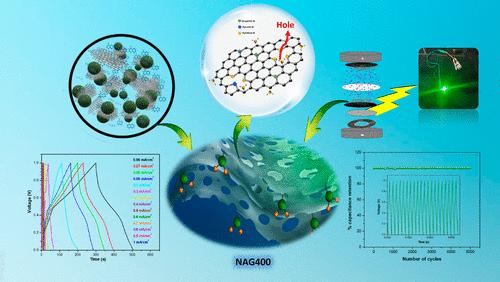
Flexible conducting wires are highly relevant nowadays due to their possible integration into various electronic gadgets, where energy storage devices are also needed. Here a material composed of N-doped holey graphene with aromatic primary amine groups at the edges (N-doped holey graphene amine) takes the dual role of conducting wire and electrode for supercapacitors. A facile ball-milling of graphite with the N-containing milling agent 1-naphthylamine followed by high-temperature treatment led to the formation of N-doped holey graphene as evident from the material characterization using transmission electron microscopy, X-ray photoelectron spectroscopy, X-ray diffraction, field emission scanning electron microscopy, Fourier transform infrared spectroscopy, Raman spectroscopy, 13C NMR spectroscopy, atomic force microscopy and elemental analysis. In addition to pyridinic, pyrolytic, and graphitic N, the NMR spectrum and XPS confirm the presence of -NH2 attached to aromatic carbon. The graphene inks prepared at different temperatures including room temperature displayed variable conductivity suitable for the required applications; the sample treated at 250 °C was also used as an electrode material for supercapacitors. An areal capacitance of 12.33 mF/cm2 at a current density of 0.06 mA/cm2 is displayed by the graphene ink supercapacitor device together with an energy density of 1.71 μWh/cm2. A power density of 500 μW/cm2 at a current density of 1 mA/cm2 is displayed, and at 0.5 mA/cm2, the device retained 100% of its capacitance after 5000 continuous charge–discharge cycles.
期刊介绍:
ACS Applied Energy Materials is an interdisciplinary journal publishing original research covering all aspects of materials, engineering, chemistry, physics and biology relevant to energy conversion and storage. The journal is devoted to reports of new and original experimental and theoretical research of an applied nature that integrate knowledge in the areas of materials, engineering, physics, bioscience, and chemistry into important energy applications.




 京公网安备 11010802042870号
京ICP备2023020795号-1
京公网安备 11010802042870号
京ICP备2023020795号-1

 分享
分享
 求助内容:
求助内容: 应助结果提醒方式:
 扫码关注我们
