{"title":"表面活性剂驱动的铜表面界面工程用于增强电化学CO2还原","authors":"Aarthi Pandiarajan , Gurusamy Hemalatha , Babu Mahalakshmi , Subbiah Ravichandran","doi":"10.1016/j.jelechem.2024.118883","DOIUrl":null,"url":null,"abstract":"<div><div>Achieving carbon neutrality necessitates innovative strategies, such as CO<sub>2</sub>-driven conversion technologies, to convert carbon dioxide into useful chemicals and fuels. An initiative of surfactant-driven interfacial engineering holds promises for transforming copper catalysts in electrochemical CO<sub>2</sub> reduction. This work demonstrates tailoring the surface contact using surfactant and its impact on reaction behaviour as a proof-of-concept. Herein we exploit a surfactant-directed interface via electrodeposition techniques with a treatment of CTAB (cetyltrimethylammonium bromide) to enhance the hydrophobicity of the copper surfaces. This modification strategy resulted in notable enhancements in electrocatalytic kinetics and a reduced onset potential, thereby facilitating more efficient initiation of CO<sub>2</sub> reduction reactions. However, a remarkable improvement has been observed in Faradaic efficiency (FE) which rose from 40% with unmodified copper electrodes to 71% with CTAB-modified electrodes. This enhancement represents improved selectivity for the CO<sub>2</sub> reduction reaction and significant improvements in formate synthesis. Furthermore, the copper surface treated with CTAB displayed outstanding stability, retaining a high level of FE over 12 h. These findings show that surfactant-driven interface engineering has the potential to revolutionise copper surfaces and improve the stability and efficiency of electrochemical CO<sub>2</sub> reduction technologies.</div></div>","PeriodicalId":355,"journal":{"name":"Journal of Electroanalytical Chemistry","volume":"978 ","pages":"Article 118883"},"PeriodicalIF":4.1000,"publicationDate":"2025-02-01","publicationTypes":"Journal Article","fieldsOfStudy":null,"isOpenAccess":false,"openAccessPdf":"","citationCount":"0","resultStr":"{\"title\":\"Surfactant-driven interfacial engineering of copper surfaces for enhanced electrochemical CO2 reduction\",\"authors\":\"Aarthi Pandiarajan , Gurusamy Hemalatha , Babu Mahalakshmi , Subbiah Ravichandran\",\"doi\":\"10.1016/j.jelechem.2024.118883\",\"DOIUrl\":null,\"url\":null,\"abstract\":\"<div><div>Achieving carbon neutrality necessitates innovative strategies, such as CO<sub>2</sub>-driven conversion technologies, to convert carbon dioxide into useful chemicals and fuels. An initiative of surfactant-driven interfacial engineering holds promises for transforming copper catalysts in electrochemical CO<sub>2</sub> reduction. This work demonstrates tailoring the surface contact using surfactant and its impact on reaction behaviour as a proof-of-concept. Herein we exploit a surfactant-directed interface via electrodeposition techniques with a treatment of CTAB (cetyltrimethylammonium bromide) to enhance the hydrophobicity of the copper surfaces. This modification strategy resulted in notable enhancements in electrocatalytic kinetics and a reduced onset potential, thereby facilitating more efficient initiation of CO<sub>2</sub> reduction reactions. However, a remarkable improvement has been observed in Faradaic efficiency (FE) which rose from 40% with unmodified copper electrodes to 71% with CTAB-modified electrodes. This enhancement represents improved selectivity for the CO<sub>2</sub> reduction reaction and significant improvements in formate synthesis. Furthermore, the copper surface treated with CTAB displayed outstanding stability, retaining a high level of FE over 12 h. These findings show that surfactant-driven interface engineering has the potential to revolutionise copper surfaces and improve the stability and efficiency of electrochemical CO<sub>2</sub> reduction technologies.</div></div>\",\"PeriodicalId\":355,\"journal\":{\"name\":\"Journal of Electroanalytical Chemistry\",\"volume\":\"978 \",\"pages\":\"Article 118883\"},\"PeriodicalIF\":4.1000,\"publicationDate\":\"2025-02-01\",\"publicationTypes\":\"Journal Article\",\"fieldsOfStudy\":null,\"isOpenAccess\":false,\"openAccessPdf\":\"\",\"citationCount\":\"0\",\"resultStr\":null,\"platform\":\"Semanticscholar\",\"paperid\":null,\"PeriodicalName\":\"Journal of Electroanalytical Chemistry\",\"FirstCategoryId\":\"92\",\"ListUrlMain\":\"https://www.sciencedirect.com/science/article/pii/S1572665724008622\",\"RegionNum\":3,\"RegionCategory\":\"化学\",\"ArticlePicture\":[],\"TitleCN\":null,\"AbstractTextCN\":null,\"PMCID\":null,\"EPubDate\":\"2024/12/16 0:00:00\",\"PubModel\":\"Epub\",\"JCR\":\"Q1\",\"JCRName\":\"CHEMISTRY, ANALYTICAL\",\"Score\":null,\"Total\":0}","platform":"Semanticscholar","paperid":null,"PeriodicalName":"Journal of Electroanalytical Chemistry","FirstCategoryId":"92","ListUrlMain":"https://www.sciencedirect.com/science/article/pii/S1572665724008622","RegionNum":3,"RegionCategory":"化学","ArticlePicture":[],"TitleCN":null,"AbstractTextCN":null,"PMCID":null,"EPubDate":"2024/12/16 0:00:00","PubModel":"Epub","JCR":"Q1","JCRName":"CHEMISTRY, ANALYTICAL","Score":null,"Total":0}
Surfactant-driven interfacial engineering of copper surfaces for enhanced electrochemical CO2 reduction
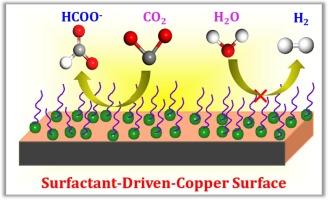
Achieving carbon neutrality necessitates innovative strategies, such as CO2-driven conversion technologies, to convert carbon dioxide into useful chemicals and fuels. An initiative of surfactant-driven interfacial engineering holds promises for transforming copper catalysts in electrochemical CO2 reduction. This work demonstrates tailoring the surface contact using surfactant and its impact on reaction behaviour as a proof-of-concept. Herein we exploit a surfactant-directed interface via electrodeposition techniques with a treatment of CTAB (cetyltrimethylammonium bromide) to enhance the hydrophobicity of the copper surfaces. This modification strategy resulted in notable enhancements in electrocatalytic kinetics and a reduced onset potential, thereby facilitating more efficient initiation of CO2 reduction reactions. However, a remarkable improvement has been observed in Faradaic efficiency (FE) which rose from 40% with unmodified copper electrodes to 71% with CTAB-modified electrodes. This enhancement represents improved selectivity for the CO2 reduction reaction and significant improvements in formate synthesis. Furthermore, the copper surface treated with CTAB displayed outstanding stability, retaining a high level of FE over 12 h. These findings show that surfactant-driven interface engineering has the potential to revolutionise copper surfaces and improve the stability and efficiency of electrochemical CO2 reduction technologies.
期刊介绍:
The Journal of Electroanalytical Chemistry is the foremost international journal devoted to the interdisciplinary subject of electrochemistry in all its aspects, theoretical as well as applied.
Electrochemistry is a wide ranging area that is in a state of continuous evolution. Rather than compiling a long list of topics covered by the Journal, the editors would like to draw particular attention to the key issues of novelty, topicality and quality. Papers should present new and interesting electrochemical science in a way that is accessible to the reader. The presentation and discussion should be at a level that is consistent with the international status of the Journal. Reports describing the application of well-established techniques to problems that are essentially technical will not be accepted. Similarly, papers that report observations but fail to provide adequate interpretation will be rejected by the Editors. Papers dealing with technical electrochemistry should be submitted to other specialist journals unless the authors can show that their work provides substantially new insights into electrochemical processes.




 京公网安备 11010802042870号
京ICP备2023020795号-1
京公网安备 11010802042870号
京ICP备2023020795号-1

 分享
分享
 求助内容:
求助内容: 应助结果提醒方式:
 扫码关注我们
