Jeong-Woo Sun , Temesgen Tadeyos Zate , Woo-Jin Choi , Geon-Ju Lee , Yoon Sang Jeong , Sang-Goo Lee , Jong Eun Ryu , Wook Jo
{"title":"高温交流极化抑制PMN-PT单晶相变诱导退极化","authors":"Jeong-Woo Sun , Temesgen Tadeyos Zate , Woo-Jin Choi , Geon-Ju Lee , Yoon Sang Jeong , Sang-Goo Lee , Jong Eun Ryu , Wook Jo","doi":"10.1016/j.scriptamat.2024.116519","DOIUrl":null,"url":null,"abstract":"<div><div>Alternating current (AC) poling has been found to be more effective in optimizing the performance of [001]-oriented rhombohedral relaxor-PbTiO<sub>3</sub> single crystals. However, these materials undergo ferroelectric phase transformations, during which structural changes result in loss of polarization and property degradation. In this study, we focus on a strategy to mitigate phase transformation-induced depolarization in Pb(Mg<sub>1/3</sub>Nb<sub>2/3</sub>)O<sub>3</sub>-PbTiO<sub>3</sub> (PMN-PT) single crystals through high-temperature AC poling. Our results reveal that thermal depolarization is significantly reduced when AC poling is conducted at high temperature near the rhombohedral-to-tetragonal transformation temperature compared to the room-temperature poling. Furthermore, <em>in-situ</em> X-ray diffraction and Raman spectroscopy demonstrates that high-temperature AC poling can achieve a metastable phase and suppress symmetry changes during the ferroelectric phase transformation, contributing to reduced property degradation in the materials. Our findings highlight the potential of a novel domain engineering technique to enhance structural stability and mitigate depolarization in PMN-PT single crystals.</div></div>","PeriodicalId":423,"journal":{"name":"Scripta Materialia","volume":"258 ","pages":"Article 116519"},"PeriodicalIF":5.6000,"publicationDate":"2025-03-15","publicationTypes":"Journal Article","fieldsOfStudy":null,"isOpenAccess":false,"openAccessPdf":"","citationCount":"0","resultStr":"{\"title\":\"Suppressing phase transformation-induced depolarization in PMN-PT single crystals through high-temperature AC poling\",\"authors\":\"Jeong-Woo Sun , Temesgen Tadeyos Zate , Woo-Jin Choi , Geon-Ju Lee , Yoon Sang Jeong , Sang-Goo Lee , Jong Eun Ryu , Wook Jo\",\"doi\":\"10.1016/j.scriptamat.2024.116519\",\"DOIUrl\":null,\"url\":null,\"abstract\":\"<div><div>Alternating current (AC) poling has been found to be more effective in optimizing the performance of [001]-oriented rhombohedral relaxor-PbTiO<sub>3</sub> single crystals. However, these materials undergo ferroelectric phase transformations, during which structural changes result in loss of polarization and property degradation. In this study, we focus on a strategy to mitigate phase transformation-induced depolarization in Pb(Mg<sub>1/3</sub>Nb<sub>2/3</sub>)O<sub>3</sub>-PbTiO<sub>3</sub> (PMN-PT) single crystals through high-temperature AC poling. Our results reveal that thermal depolarization is significantly reduced when AC poling is conducted at high temperature near the rhombohedral-to-tetragonal transformation temperature compared to the room-temperature poling. Furthermore, <em>in-situ</em> X-ray diffraction and Raman spectroscopy demonstrates that high-temperature AC poling can achieve a metastable phase and suppress symmetry changes during the ferroelectric phase transformation, contributing to reduced property degradation in the materials. Our findings highlight the potential of a novel domain engineering technique to enhance structural stability and mitigate depolarization in PMN-PT single crystals.</div></div>\",\"PeriodicalId\":423,\"journal\":{\"name\":\"Scripta Materialia\",\"volume\":\"258 \",\"pages\":\"Article 116519\"},\"PeriodicalIF\":5.6000,\"publicationDate\":\"2025-03-15\",\"publicationTypes\":\"Journal Article\",\"fieldsOfStudy\":null,\"isOpenAccess\":false,\"openAccessPdf\":\"\",\"citationCount\":\"0\",\"resultStr\":null,\"platform\":\"Semanticscholar\",\"paperid\":null,\"PeriodicalName\":\"Scripta Materialia\",\"FirstCategoryId\":\"88\",\"ListUrlMain\":\"https://www.sciencedirect.com/science/article/pii/S1359646224005529\",\"RegionNum\":2,\"RegionCategory\":\"材料科学\",\"ArticlePicture\":[],\"TitleCN\":null,\"AbstractTextCN\":null,\"PMCID\":null,\"EPubDate\":\"2024/12/25 0:00:00\",\"PubModel\":\"Epub\",\"JCR\":\"Q2\",\"JCRName\":\"MATERIALS SCIENCE, MULTIDISCIPLINARY\",\"Score\":null,\"Total\":0}","platform":"Semanticscholar","paperid":null,"PeriodicalName":"Scripta Materialia","FirstCategoryId":"88","ListUrlMain":"https://www.sciencedirect.com/science/article/pii/S1359646224005529","RegionNum":2,"RegionCategory":"材料科学","ArticlePicture":[],"TitleCN":null,"AbstractTextCN":null,"PMCID":null,"EPubDate":"2024/12/25 0:00:00","PubModel":"Epub","JCR":"Q2","JCRName":"MATERIALS SCIENCE, MULTIDISCIPLINARY","Score":null,"Total":0}
Suppressing phase transformation-induced depolarization in PMN-PT single crystals through high-temperature AC poling
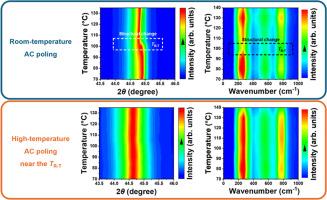
Alternating current (AC) poling has been found to be more effective in optimizing the performance of [001]-oriented rhombohedral relaxor-PbTiO3 single crystals. However, these materials undergo ferroelectric phase transformations, during which structural changes result in loss of polarization and property degradation. In this study, we focus on a strategy to mitigate phase transformation-induced depolarization in Pb(Mg1/3Nb2/3)O3-PbTiO3 (PMN-PT) single crystals through high-temperature AC poling. Our results reveal that thermal depolarization is significantly reduced when AC poling is conducted at high temperature near the rhombohedral-to-tetragonal transformation temperature compared to the room-temperature poling. Furthermore, in-situ X-ray diffraction and Raman spectroscopy demonstrates that high-temperature AC poling can achieve a metastable phase and suppress symmetry changes during the ferroelectric phase transformation, contributing to reduced property degradation in the materials. Our findings highlight the potential of a novel domain engineering technique to enhance structural stability and mitigate depolarization in PMN-PT single crystals.
期刊介绍:
Scripta Materialia is a LETTERS journal of Acta Materialia, providing a forum for the rapid publication of short communications on the relationship between the structure and the properties of inorganic materials. The emphasis is on originality rather than incremental research. Short reports on the development of materials with novel or substantially improved properties are also welcomed. Emphasis is on either the functional or mechanical behavior of metals, ceramics and semiconductors at all length scales.




 京公网安备 11010802042870号
京ICP备2023020795号-1
京公网安备 11010802042870号
京ICP备2023020795号-1

 分享
分享
 求助内容:
求助内容: 应助结果提醒方式:
 扫码关注我们
