{"title":"经济衰退指标对全球金融市场的影响:QVAR分析","authors":"Emre Bulut , Cumali Marangoz","doi":"10.1016/j.irfa.2025.103966","DOIUrl":null,"url":null,"abstract":"<div><div>This paper attempts to examine the impact of the connection and spillover effects between nine major stock exchange indices (namely, the US, the UK, China, Canada, Switzerland, Germany, India, Japan, and Hong Kong) and two economic recession indicators, specifically the SRRI and GRI, by employing the quantile vector autoregression (QVAR) method from May 1992 to December 1993. In a globally connected world, it is essential to comprehend the transmission and magnitude of shocks among financial markets and to understand spillover effects. To the best of our knowledge, this study is the first to comprehensively analyze the impact of the SAHM Rule Recession (SRRI) and GDP-Based Recession (GRI) Indices on the US stock index and its subsequent influence on worldwide financial markets. The findings demonstrate that economic recession indices significantly affect stock indices, especially in countries with close economic ties, such as China, Hong Kong, and India. In addition, the GRI implies the forward-looking nature of stock markets. Moreover, the US and UK are the major transmitters of recessionary shocks, indicating their crucial role in the global economic network.</div></div>","PeriodicalId":48226,"journal":{"name":"International Review of Financial Analysis","volume":"99 ","pages":"Article 103966"},"PeriodicalIF":10.2000,"publicationDate":"2025-03-01","publicationTypes":"Journal Article","fieldsOfStudy":null,"isOpenAccess":false,"openAccessPdf":"","citationCount":"0","resultStr":"{\"title\":\"Exploring the impact of economic recession indicators on global financial markets: A QVAR analysis\",\"authors\":\"Emre Bulut , Cumali Marangoz\",\"doi\":\"10.1016/j.irfa.2025.103966\",\"DOIUrl\":null,\"url\":null,\"abstract\":\"<div><div>This paper attempts to examine the impact of the connection and spillover effects between nine major stock exchange indices (namely, the US, the UK, China, Canada, Switzerland, Germany, India, Japan, and Hong Kong) and two economic recession indicators, specifically the SRRI and GRI, by employing the quantile vector autoregression (QVAR) method from May 1992 to December 1993. In a globally connected world, it is essential to comprehend the transmission and magnitude of shocks among financial markets and to understand spillover effects. To the best of our knowledge, this study is the first to comprehensively analyze the impact of the SAHM Rule Recession (SRRI) and GDP-Based Recession (GRI) Indices on the US stock index and its subsequent influence on worldwide financial markets. The findings demonstrate that economic recession indices significantly affect stock indices, especially in countries with close economic ties, such as China, Hong Kong, and India. In addition, the GRI implies the forward-looking nature of stock markets. Moreover, the US and UK are the major transmitters of recessionary shocks, indicating their crucial role in the global economic network.</div></div>\",\"PeriodicalId\":48226,\"journal\":{\"name\":\"International Review of Financial Analysis\",\"volume\":\"99 \",\"pages\":\"Article 103966\"},\"PeriodicalIF\":10.2000,\"publicationDate\":\"2025-03-01\",\"publicationTypes\":\"Journal Article\",\"fieldsOfStudy\":null,\"isOpenAccess\":false,\"openAccessPdf\":\"\",\"citationCount\":\"0\",\"resultStr\":null,\"platform\":\"Semanticscholar\",\"paperid\":null,\"PeriodicalName\":\"International Review of Financial Analysis\",\"FirstCategoryId\":\"96\",\"ListUrlMain\":\"https://www.sciencedirect.com/science/article/pii/S1057521925000535\",\"RegionNum\":1,\"RegionCategory\":\"经济学\",\"ArticlePicture\":[],\"TitleCN\":null,\"AbstractTextCN\":null,\"PMCID\":null,\"EPubDate\":\"2025/1/28 0:00:00\",\"PubModel\":\"Epub\",\"JCR\":\"Q1\",\"JCRName\":\"BUSINESS, FINANCE\",\"Score\":null,\"Total\":0}","platform":"Semanticscholar","paperid":null,"PeriodicalName":"International Review of Financial Analysis","FirstCategoryId":"96","ListUrlMain":"https://www.sciencedirect.com/science/article/pii/S1057521925000535","RegionNum":1,"RegionCategory":"经济学","ArticlePicture":[],"TitleCN":null,"AbstractTextCN":null,"PMCID":null,"EPubDate":"2025/1/28 0:00:00","PubModel":"Epub","JCR":"Q1","JCRName":"BUSINESS, FINANCE","Score":null,"Total":0}
Exploring the impact of economic recession indicators on global financial markets: A QVAR analysis
This paper attempts to examine the impact of the connection and spillover effects between nine major stock exchange indices (namely, the US, the UK, China, Canada, Switzerland, Germany, India, Japan, and Hong Kong) and two economic recession indicators, specifically the SRRI and GRI, by employing the quantile vector autoregression (QVAR) method from May 1992 to December 1993. In a globally connected world, it is essential to comprehend the transmission and magnitude of shocks among financial markets and to understand spillover effects. To the best of our knowledge, this study is the first to comprehensively analyze the impact of the SAHM Rule Recession (SRRI) and GDP-Based Recession (GRI) Indices on the US stock index and its subsequent influence on worldwide financial markets. The findings demonstrate that economic recession indices significantly affect stock indices, especially in countries with close economic ties, such as China, Hong Kong, and India. In addition, the GRI implies the forward-looking nature of stock markets. Moreover, the US and UK are the major transmitters of recessionary shocks, indicating their crucial role in the global economic network.
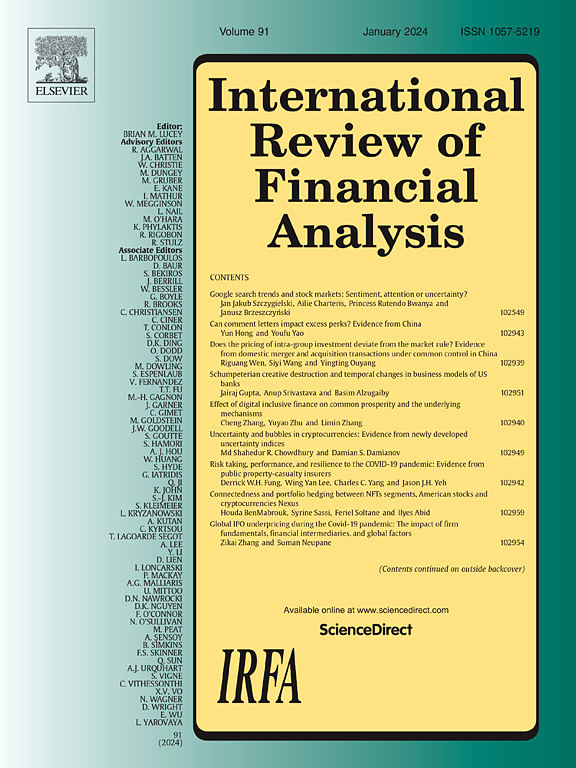
期刊介绍:
The International Review of Financial Analysis (IRFA) is an impartial refereed journal designed to serve as a platform for high-quality financial research. It welcomes a diverse range of financial research topics and maintains an unbiased selection process. While not limited to U.S.-centric subjects, IRFA, as its title suggests, is open to valuable research contributions from around the world.




 京公网安备 11010802042870号
京ICP备2023020795号-1
京公网安备 11010802042870号
京ICP备2023020795号-1

 分享
分享
 求助内容:
求助内容: 应助结果提醒方式:
 扫码关注我们
