{"title":"用于高效多电子还原CO2到CH4的Ag/CdS欧姆结的制备","authors":"Chaoqiang Li , Xiangyu Xu , Aizhong Jia","doi":"10.1016/j.surfin.2025.105807","DOIUrl":null,"url":null,"abstract":"<div><div>Photocatalytic reduction of CO<sub>2</sub> to chemical fuels is a promising strategy to alleviate the greenhouse effect and energy crisis. This article successfully fabricated Ag/CdS composites with ohmic junction using a two-step method and further verified them by DFT calculations. Meanwhile, photoelectrochemical and electron paramagnetic resonance tests show that Ag/CdS has higher photocurrent density and lower charge transfer resistance, suggesting that the ohmic junction achieves ultrafast electron transfer from CdS to Ag under light irradiation, significantly promoting the separation of photogenerated carriers. Furthermore, the localized plasmon resonance (LSPR) of Ag enhances the light absorption of the catalyst and generates a large number of hot electrons for the photocatalytic reduction reaction. The synergistic effect of ohmic junction and LSPR gives high electron density at the reaction site, which promotes the multiple proton-coupled electron reactions leading to highly selective photoconversion of CO<sub>2</sub> to CH<sub>4</sub>. Under the optimized conditions, the CH<sub>4</sub> yield of the synthesized Ag/CdS is 68.6 μmol·g<sup>−1</sup>·h<sup>−1</sup>, which is 25.4 times higher than that of bare CdS, and the CH<sub>4</sub> selectivity increases from 53.8 % to 90.1 %. This study provides a new idea for the design of CdS-based materials for highly selective reduction of CO<sub>2</sub> to CH<sub>4</sub>.</div></div>","PeriodicalId":22081,"journal":{"name":"Surfaces and Interfaces","volume":"58 ","pages":"Article 105807"},"PeriodicalIF":6.3000,"publicationDate":"2025-02-01","publicationTypes":"Journal Article","fieldsOfStudy":null,"isOpenAccess":false,"openAccessPdf":"","citationCount":"0","resultStr":"{\"title\":\"Fabricating an ohmic junction of Ag/CdS for highly efficient multi-electron reduction of CO2 to CH4\",\"authors\":\"Chaoqiang Li , Xiangyu Xu , Aizhong Jia\",\"doi\":\"10.1016/j.surfin.2025.105807\",\"DOIUrl\":null,\"url\":null,\"abstract\":\"<div><div>Photocatalytic reduction of CO<sub>2</sub> to chemical fuels is a promising strategy to alleviate the greenhouse effect and energy crisis. This article successfully fabricated Ag/CdS composites with ohmic junction using a two-step method and further verified them by DFT calculations. Meanwhile, photoelectrochemical and electron paramagnetic resonance tests show that Ag/CdS has higher photocurrent density and lower charge transfer resistance, suggesting that the ohmic junction achieves ultrafast electron transfer from CdS to Ag under light irradiation, significantly promoting the separation of photogenerated carriers. Furthermore, the localized plasmon resonance (LSPR) of Ag enhances the light absorption of the catalyst and generates a large number of hot electrons for the photocatalytic reduction reaction. The synergistic effect of ohmic junction and LSPR gives high electron density at the reaction site, which promotes the multiple proton-coupled electron reactions leading to highly selective photoconversion of CO<sub>2</sub> to CH<sub>4</sub>. Under the optimized conditions, the CH<sub>4</sub> yield of the synthesized Ag/CdS is 68.6 μmol·g<sup>−1</sup>·h<sup>−1</sup>, which is 25.4 times higher than that of bare CdS, and the CH<sub>4</sub> selectivity increases from 53.8 % to 90.1 %. This study provides a new idea for the design of CdS-based materials for highly selective reduction of CO<sub>2</sub> to CH<sub>4</sub>.</div></div>\",\"PeriodicalId\":22081,\"journal\":{\"name\":\"Surfaces and Interfaces\",\"volume\":\"58 \",\"pages\":\"Article 105807\"},\"PeriodicalIF\":6.3000,\"publicationDate\":\"2025-02-01\",\"publicationTypes\":\"Journal Article\",\"fieldsOfStudy\":null,\"isOpenAccess\":false,\"openAccessPdf\":\"\",\"citationCount\":\"0\",\"resultStr\":null,\"platform\":\"Semanticscholar\",\"paperid\":null,\"PeriodicalName\":\"Surfaces and Interfaces\",\"FirstCategoryId\":\"88\",\"ListUrlMain\":\"https://www.sciencedirect.com/science/article/pii/S2468023025000707\",\"RegionNum\":2,\"RegionCategory\":\"材料科学\",\"ArticlePicture\":[],\"TitleCN\":null,\"AbstractTextCN\":null,\"PMCID\":null,\"EPubDate\":\"2025/1/11 0:00:00\",\"PubModel\":\"Epub\",\"JCR\":\"Q2\",\"JCRName\":\"CHEMISTRY, PHYSICAL\",\"Score\":null,\"Total\":0}","platform":"Semanticscholar","paperid":null,"PeriodicalName":"Surfaces and Interfaces","FirstCategoryId":"88","ListUrlMain":"https://www.sciencedirect.com/science/article/pii/S2468023025000707","RegionNum":2,"RegionCategory":"材料科学","ArticlePicture":[],"TitleCN":null,"AbstractTextCN":null,"PMCID":null,"EPubDate":"2025/1/11 0:00:00","PubModel":"Epub","JCR":"Q2","JCRName":"CHEMISTRY, PHYSICAL","Score":null,"Total":0}
Fabricating an ohmic junction of Ag/CdS for highly efficient multi-electron reduction of CO2 to CH4
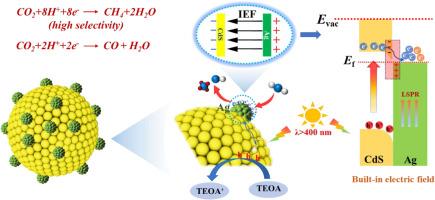
Photocatalytic reduction of CO2 to chemical fuels is a promising strategy to alleviate the greenhouse effect and energy crisis. This article successfully fabricated Ag/CdS composites with ohmic junction using a two-step method and further verified them by DFT calculations. Meanwhile, photoelectrochemical and electron paramagnetic resonance tests show that Ag/CdS has higher photocurrent density and lower charge transfer resistance, suggesting that the ohmic junction achieves ultrafast electron transfer from CdS to Ag under light irradiation, significantly promoting the separation of photogenerated carriers. Furthermore, the localized plasmon resonance (LSPR) of Ag enhances the light absorption of the catalyst and generates a large number of hot electrons for the photocatalytic reduction reaction. The synergistic effect of ohmic junction and LSPR gives high electron density at the reaction site, which promotes the multiple proton-coupled electron reactions leading to highly selective photoconversion of CO2 to CH4. Under the optimized conditions, the CH4 yield of the synthesized Ag/CdS is 68.6 μmol·g−1·h−1, which is 25.4 times higher than that of bare CdS, and the CH4 selectivity increases from 53.8 % to 90.1 %. This study provides a new idea for the design of CdS-based materials for highly selective reduction of CO2 to CH4.
期刊介绍:
The aim of the journal is to provide a respectful outlet for ''sound science'' papers in all research areas on surfaces and interfaces. We define sound science papers as papers that describe new and well-executed research, but that do not necessarily provide brand new insights or are merely a description of research results.
Surfaces and Interfaces publishes research papers in all fields of surface science which may not always find the right home on first submission to our Elsevier sister journals (Applied Surface, Surface and Coatings Technology, Thin Solid Films)




 京公网安备 11010802042870号
京ICP备2023020795号-1
京公网安备 11010802042870号
京ICP备2023020795号-1

 分享
分享
 求助内容:
求助内容: 应助结果提醒方式:
 扫码关注我们
