Jie Wang , Tengfei Hu , Xiaohan Wei , Bin Xu , Xiaoyu Liu , Xiaoliang Zhai , Lin Chen , Wenxian Wang , Wenming Song , Shu Chen , Lihua Cheng , Xiaolin Zhou
{"title":"植物种类对人工湿地反渗透浓缩液处理的影响:性能、植物生长和微生物群落结构","authors":"Jie Wang , Tengfei Hu , Xiaohan Wei , Bin Xu , Xiaoyu Liu , Xiaoliang Zhai , Lin Chen , Wenxian Wang , Wenming Song , Shu Chen , Lihua Cheng , Xiaolin Zhou","doi":"10.1016/j.jwpe.2025.106965","DOIUrl":null,"url":null,"abstract":"<div><div>The efficient treatment of reverse osmosis concentrate (ROC) is crucial for the widespread application of reverse osmosis technology. This study investigated the ROC removal performance of constructed wetlands (CWs) planted with five different plant species. The results showed that plants can improve the efficiency of pollutant removal in CWs. Among the species tested, <em>I. wilsonii</em> showed superior pollutant removal performance, achieving average removal rates of 91.66 % for nitrate, 87.95 % for total nitrogen (TN), 72.40 % for total phosphorus, and 52.30 % for dissolved organic carbon (DOC). After 30 days of CWs operation, the biomass growth, nitrogen uptake, and phosphorus uptake of <em>I. wilsonii</em> were 2.42 g, 27.76 mg, and 14.23 mg per plant, respectively<em>.</em> However, those of the other species ranged from 0.32 to 0.78 g, 3.46–17.23 mg, and 1.05–5.55 mg per plant, respectively. The predominant functional microbial phylum in all CW substrate samples was Proteobacteria, accounting for 42.56 % to 64.44 % of the total microbial community. At the genus level, the dominant genera in unplanted CWs were two heterotrophic denitrifiers: <em>Pseudomonas</em> and <em>Thauera</em>, representing 12.88 % and 8.57 % of the total microbial community, respectively. In <em>I. wilsonii</em> CW, the dominant genera shifted to two autotrophic denitrifiers: <em>Thiobacillus</em> and <em>Sulfurimonas</em>, representing 17.45 % and 7.74 % of the total microbial community, respectively. Redundancy analysis indicated that plant biomass exhibited a positive correlation with pollutant removal, and the abundance of <em>Thiobacillus</em> and <em>Sulfurimonas</em> had a significant positive correlation with DOC and TN removal.</div></div>","PeriodicalId":17528,"journal":{"name":"Journal of water process engineering","volume":"70 ","pages":"Article 106965"},"PeriodicalIF":6.6000,"publicationDate":"2025-02-01","publicationTypes":"Journal Article","fieldsOfStudy":null,"isOpenAccess":false,"openAccessPdf":"","citationCount":"0","resultStr":"{\"title\":\"Effects of plant species on reverse osmosis concentrate treatment in constructed wetlands: Performance, plant growth, and microbial community structure\",\"authors\":\"Jie Wang , Tengfei Hu , Xiaohan Wei , Bin Xu , Xiaoyu Liu , Xiaoliang Zhai , Lin Chen , Wenxian Wang , Wenming Song , Shu Chen , Lihua Cheng , Xiaolin Zhou\",\"doi\":\"10.1016/j.jwpe.2025.106965\",\"DOIUrl\":null,\"url\":null,\"abstract\":\"<div><div>The efficient treatment of reverse osmosis concentrate (ROC) is crucial for the widespread application of reverse osmosis technology. This study investigated the ROC removal performance of constructed wetlands (CWs) planted with five different plant species. The results showed that plants can improve the efficiency of pollutant removal in CWs. Among the species tested, <em>I. wilsonii</em> showed superior pollutant removal performance, achieving average removal rates of 91.66 % for nitrate, 87.95 % for total nitrogen (TN), 72.40 % for total phosphorus, and 52.30 % for dissolved organic carbon (DOC). After 30 days of CWs operation, the biomass growth, nitrogen uptake, and phosphorus uptake of <em>I. wilsonii</em> were 2.42 g, 27.76 mg, and 14.23 mg per plant, respectively<em>.</em> However, those of the other species ranged from 0.32 to 0.78 g, 3.46–17.23 mg, and 1.05–5.55 mg per plant, respectively. The predominant functional microbial phylum in all CW substrate samples was Proteobacteria, accounting for 42.56 % to 64.44 % of the total microbial community. At the genus level, the dominant genera in unplanted CWs were two heterotrophic denitrifiers: <em>Pseudomonas</em> and <em>Thauera</em>, representing 12.88 % and 8.57 % of the total microbial community, respectively. In <em>I. wilsonii</em> CW, the dominant genera shifted to two autotrophic denitrifiers: <em>Thiobacillus</em> and <em>Sulfurimonas</em>, representing 17.45 % and 7.74 % of the total microbial community, respectively. Redundancy analysis indicated that plant biomass exhibited a positive correlation with pollutant removal, and the abundance of <em>Thiobacillus</em> and <em>Sulfurimonas</em> had a significant positive correlation with DOC and TN removal.</div></div>\",\"PeriodicalId\":17528,\"journal\":{\"name\":\"Journal of water process engineering\",\"volume\":\"70 \",\"pages\":\"Article 106965\"},\"PeriodicalIF\":6.6000,\"publicationDate\":\"2025-02-01\",\"publicationTypes\":\"Journal Article\",\"fieldsOfStudy\":null,\"isOpenAccess\":false,\"openAccessPdf\":\"\",\"citationCount\":\"0\",\"resultStr\":null,\"platform\":\"Semanticscholar\",\"paperid\":null,\"PeriodicalName\":\"Journal of water process engineering\",\"FirstCategoryId\":\"5\",\"ListUrlMain\":\"https://www.sciencedirect.com/science/article/pii/S2214714425000376\",\"RegionNum\":2,\"RegionCategory\":\"工程技术\",\"ArticlePicture\":[],\"TitleCN\":null,\"AbstractTextCN\":null,\"PMCID\":null,\"EPubDate\":\"2025/1/14 0:00:00\",\"PubModel\":\"Epub\",\"JCR\":\"Q1\",\"JCRName\":\"ENGINEERING, CHEMICAL\",\"Score\":null,\"Total\":0}","platform":"Semanticscholar","paperid":null,"PeriodicalName":"Journal of water process engineering","FirstCategoryId":"5","ListUrlMain":"https://www.sciencedirect.com/science/article/pii/S2214714425000376","RegionNum":2,"RegionCategory":"工程技术","ArticlePicture":[],"TitleCN":null,"AbstractTextCN":null,"PMCID":null,"EPubDate":"2025/1/14 0:00:00","PubModel":"Epub","JCR":"Q1","JCRName":"ENGINEERING, CHEMICAL","Score":null,"Total":0}
Effects of plant species on reverse osmosis concentrate treatment in constructed wetlands: Performance, plant growth, and microbial community structure
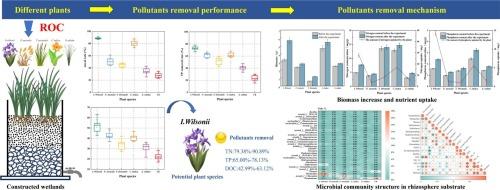
The efficient treatment of reverse osmosis concentrate (ROC) is crucial for the widespread application of reverse osmosis technology. This study investigated the ROC removal performance of constructed wetlands (CWs) planted with five different plant species. The results showed that plants can improve the efficiency of pollutant removal in CWs. Among the species tested, I. wilsonii showed superior pollutant removal performance, achieving average removal rates of 91.66 % for nitrate, 87.95 % for total nitrogen (TN), 72.40 % for total phosphorus, and 52.30 % for dissolved organic carbon (DOC). After 30 days of CWs operation, the biomass growth, nitrogen uptake, and phosphorus uptake of I. wilsonii were 2.42 g, 27.76 mg, and 14.23 mg per plant, respectively. However, those of the other species ranged from 0.32 to 0.78 g, 3.46–17.23 mg, and 1.05–5.55 mg per plant, respectively. The predominant functional microbial phylum in all CW substrate samples was Proteobacteria, accounting for 42.56 % to 64.44 % of the total microbial community. At the genus level, the dominant genera in unplanted CWs were two heterotrophic denitrifiers: Pseudomonas and Thauera, representing 12.88 % and 8.57 % of the total microbial community, respectively. In I. wilsonii CW, the dominant genera shifted to two autotrophic denitrifiers: Thiobacillus and Sulfurimonas, representing 17.45 % and 7.74 % of the total microbial community, respectively. Redundancy analysis indicated that plant biomass exhibited a positive correlation with pollutant removal, and the abundance of Thiobacillus and Sulfurimonas had a significant positive correlation with DOC and TN removal.
期刊介绍:
The Journal of Water Process Engineering aims to publish refereed, high-quality research papers with significant novelty and impact in all areas of the engineering of water and wastewater processing . Papers on advanced and novel treatment processes and technologies are particularly welcome. The Journal considers papers in areas such as nanotechnology and biotechnology applications in water, novel oxidation and separation processes, membrane processes (except those for desalination) , catalytic processes for the removal of water contaminants, sustainable processes, water reuse and recycling, water use and wastewater minimization, integrated/hybrid technology, process modeling of water treatment and novel treatment processes. Submissions on the subject of adsorbents, including standard measurements of adsorption kinetics and equilibrium will only be considered if there is a genuine case for novelty and contribution, for example highly novel, sustainable adsorbents and their use: papers on activated carbon-type materials derived from natural matter, or surfactant-modified clays and related minerals, would not fulfil this criterion. The Journal particularly welcomes contributions involving environmentally, economically and socially sustainable technology for water treatment, including those which are energy-efficient, with minimal or no chemical consumption, and capable of water recycling and reuse that minimizes the direct disposal of wastewater to the aquatic environment. Papers that describe novel ideas for solving issues related to water quality and availability are also welcome, as are those that show the transfer of techniques from other disciplines. The Journal will consider papers dealing with processes for various water matrices including drinking water (except desalination), domestic, urban and industrial wastewaters, in addition to their residues. It is expected that the journal will be of particular relevance to chemical and process engineers working in the field. The Journal welcomes Full Text papers, Short Communications, State-of-the-Art Reviews and Letters to Editors and Case Studies




 京公网安备 11010802042870号
京ICP备2023020795号-1
京公网安备 11010802042870号
京ICP备2023020795号-1

 分享
分享
 求助内容:
求助内容: 应助结果提醒方式:
 扫码关注我们
