Yuan Zhu, Gege Zhao, Tianqi Du, Miao Zhang, Chengcheng Li, Xing Su, Yating Ji, Zaisheng Cai, Yaping Zhao
{"title":"具有高渗透性和防污性的多功能双层电催化膜,用于水中染料的高效去除","authors":"Yuan Zhu, Gege Zhao, Tianqi Du, Miao Zhang, Chengcheng Li, Xing Su, Yating Ji, Zaisheng Cai, Yaping Zhao","doi":"10.1016/j.jwpe.2024.106886","DOIUrl":null,"url":null,"abstract":"<div><div>To solve the problem of flux reduction and membrane damage due to membrane contamination and pressure-driven during membrane separation, a new strategy was proposed for the preparation of multifunctional bilayer membrane doped with iron phthalocyanine (FePc) in PVDF matrix. The membrane consisted of an upper PVDF@P-C-FePc conductive polymer layer and a lower hydrophilic cotton fiber (CF) substrate. The CNTs-loaded FePc enhanced the porosity, hydrophilicity and permeability of the polymer layer, and the ·OH generated during the electrocatalytic process endowed the membrane with good self-cleaning properties. The formation of a wettability gradient between the CF and the PVDF@P-C-FePc benefits further water flux enhancement, while the excellent mechanical properties of cotton fiber greatly improve the mechanical strength and reduce membrane damage. With pressure-driven of 0.1 MPa and electrocatalytic conditions of 6 V, the prepared PVDF@P-C-FePc/CF exhibited excellent water flux (493 L<span><math><mo>∙</mo></math></span>m<sup>-2</sup><span><math><mo>∙</mo></math></span>h<sup>−1</sup>) and a removal efficiency of up to 95 % for 15 mg/L of MB. Because of the good self-cleaning performance, the dye pollutions on the surface were extremely easy to clean, and the flux recovery was close to 100 %, showing good antifouling performance. This proves that the prepared PVDF@P-C-FePc/CF composite membrane possesses the combined advantages of high flux, separation efficiency and antifouling performance at the same time, and shows a broad application prospect in water treatment applications.</div></div>","PeriodicalId":17528,"journal":{"name":"Journal of water process engineering","volume":"70 ","pages":"Article 106886"},"PeriodicalIF":6.7000,"publicationDate":"2025-02-01","publicationTypes":"Journal Article","fieldsOfStudy":null,"isOpenAccess":false,"openAccessPdf":"","citationCount":"0","resultStr":"{\"title\":\"Multifunctional bilayer electrocatalytic membrane with high permeability and antifouling property for efficient removal of dye from water\",\"authors\":\"Yuan Zhu, Gege Zhao, Tianqi Du, Miao Zhang, Chengcheng Li, Xing Su, Yating Ji, Zaisheng Cai, Yaping Zhao\",\"doi\":\"10.1016/j.jwpe.2024.106886\",\"DOIUrl\":null,\"url\":null,\"abstract\":\"<div><div>To solve the problem of flux reduction and membrane damage due to membrane contamination and pressure-driven during membrane separation, a new strategy was proposed for the preparation of multifunctional bilayer membrane doped with iron phthalocyanine (FePc) in PVDF matrix. The membrane consisted of an upper PVDF@P-C-FePc conductive polymer layer and a lower hydrophilic cotton fiber (CF) substrate. The CNTs-loaded FePc enhanced the porosity, hydrophilicity and permeability of the polymer layer, and the ·OH generated during the electrocatalytic process endowed the membrane with good self-cleaning properties. The formation of a wettability gradient between the CF and the PVDF@P-C-FePc benefits further water flux enhancement, while the excellent mechanical properties of cotton fiber greatly improve the mechanical strength and reduce membrane damage. With pressure-driven of 0.1 MPa and electrocatalytic conditions of 6 V, the prepared PVDF@P-C-FePc/CF exhibited excellent water flux (493 L<span><math><mo>∙</mo></math></span>m<sup>-2</sup><span><math><mo>∙</mo></math></span>h<sup>−1</sup>) and a removal efficiency of up to 95 % for 15 mg/L of MB. Because of the good self-cleaning performance, the dye pollutions on the surface were extremely easy to clean, and the flux recovery was close to 100 %, showing good antifouling performance. This proves that the prepared PVDF@P-C-FePc/CF composite membrane possesses the combined advantages of high flux, separation efficiency and antifouling performance at the same time, and shows a broad application prospect in water treatment applications.</div></div>\",\"PeriodicalId\":17528,\"journal\":{\"name\":\"Journal of water process engineering\",\"volume\":\"70 \",\"pages\":\"Article 106886\"},\"PeriodicalIF\":6.7000,\"publicationDate\":\"2025-02-01\",\"publicationTypes\":\"Journal Article\",\"fieldsOfStudy\":null,\"isOpenAccess\":false,\"openAccessPdf\":\"\",\"citationCount\":\"0\",\"resultStr\":null,\"platform\":\"Semanticscholar\",\"paperid\":null,\"PeriodicalName\":\"Journal of water process engineering\",\"FirstCategoryId\":\"5\",\"ListUrlMain\":\"https://www.sciencedirect.com/science/article/pii/S2214714424021196\",\"RegionNum\":2,\"RegionCategory\":\"工程技术\",\"ArticlePicture\":[],\"TitleCN\":null,\"AbstractTextCN\":null,\"PMCID\":null,\"EPubDate\":\"2025/1/5 0:00:00\",\"PubModel\":\"Epub\",\"JCR\":\"Q1\",\"JCRName\":\"ENGINEERING, CHEMICAL\",\"Score\":null,\"Total\":0}","platform":"Semanticscholar","paperid":null,"PeriodicalName":"Journal of water process engineering","FirstCategoryId":"5","ListUrlMain":"https://www.sciencedirect.com/science/article/pii/S2214714424021196","RegionNum":2,"RegionCategory":"工程技术","ArticlePicture":[],"TitleCN":null,"AbstractTextCN":null,"PMCID":null,"EPubDate":"2025/1/5 0:00:00","PubModel":"Epub","JCR":"Q1","JCRName":"ENGINEERING, CHEMICAL","Score":null,"Total":0}
Multifunctional bilayer electrocatalytic membrane with high permeability and antifouling property for efficient removal of dye from water
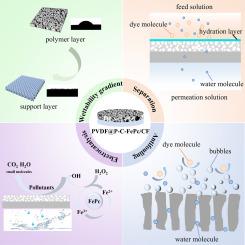
To solve the problem of flux reduction and membrane damage due to membrane contamination and pressure-driven during membrane separation, a new strategy was proposed for the preparation of multifunctional bilayer membrane doped with iron phthalocyanine (FePc) in PVDF matrix. The membrane consisted of an upper PVDF@P-C-FePc conductive polymer layer and a lower hydrophilic cotton fiber (CF) substrate. The CNTs-loaded FePc enhanced the porosity, hydrophilicity and permeability of the polymer layer, and the ·OH generated during the electrocatalytic process endowed the membrane with good self-cleaning properties. The formation of a wettability gradient between the CF and the PVDF@P-C-FePc benefits further water flux enhancement, while the excellent mechanical properties of cotton fiber greatly improve the mechanical strength and reduce membrane damage. With pressure-driven of 0.1 MPa and electrocatalytic conditions of 6 V, the prepared PVDF@P-C-FePc/CF exhibited excellent water flux (493 Lm-2h−1) and a removal efficiency of up to 95 % for 15 mg/L of MB. Because of the good self-cleaning performance, the dye pollutions on the surface were extremely easy to clean, and the flux recovery was close to 100 %, showing good antifouling performance. This proves that the prepared PVDF@P-C-FePc/CF composite membrane possesses the combined advantages of high flux, separation efficiency and antifouling performance at the same time, and shows a broad application prospect in water treatment applications.
期刊介绍:
The Journal of Water Process Engineering aims to publish refereed, high-quality research papers with significant novelty and impact in all areas of the engineering of water and wastewater processing . Papers on advanced and novel treatment processes and technologies are particularly welcome. The Journal considers papers in areas such as nanotechnology and biotechnology applications in water, novel oxidation and separation processes, membrane processes (except those for desalination) , catalytic processes for the removal of water contaminants, sustainable processes, water reuse and recycling, water use and wastewater minimization, integrated/hybrid technology, process modeling of water treatment and novel treatment processes. Submissions on the subject of adsorbents, including standard measurements of adsorption kinetics and equilibrium will only be considered if there is a genuine case for novelty and contribution, for example highly novel, sustainable adsorbents and their use: papers on activated carbon-type materials derived from natural matter, or surfactant-modified clays and related minerals, would not fulfil this criterion. The Journal particularly welcomes contributions involving environmentally, economically and socially sustainable technology for water treatment, including those which are energy-efficient, with minimal or no chemical consumption, and capable of water recycling and reuse that minimizes the direct disposal of wastewater to the aquatic environment. Papers that describe novel ideas for solving issues related to water quality and availability are also welcome, as are those that show the transfer of techniques from other disciplines. The Journal will consider papers dealing with processes for various water matrices including drinking water (except desalination), domestic, urban and industrial wastewaters, in addition to their residues. It is expected that the journal will be of particular relevance to chemical and process engineers working in the field. The Journal welcomes Full Text papers, Short Communications, State-of-the-Art Reviews and Letters to Editors and Case Studies




 京公网安备 11010802042870号
京ICP备2023020795号-1
京公网安备 11010802042870号
京ICP备2023020795号-1

 分享
分享
 求助内容:
求助内容: 应助结果提醒方式:
 扫码关注我们
