E. Şaşıoğlu , M. Tas , S. Ghosh , W. Beida , B. Sanyal , S. Blügel , I. Mertig , I. Galanakis
{"title":"自旋间隙金属:一类用于多功能自旋电子器件的新型材料","authors":"E. Şaşıoğlu , M. Tas , S. Ghosh , W. Beida , B. Sanyal , S. Blügel , I. Mertig , I. Galanakis","doi":"10.1016/j.jmmm.2025.172792","DOIUrl":null,"url":null,"abstract":"<div><div>Gapped metals, a recently proposed class of materials, possess a band gap slightly above or below the Fermi level, behaving as intrinsic p- or n-type semiconductors without requiring external doping. Inspired by this concept, we propose a novel material class: ”spin gapped metals”. These materials exhibit intrinsic p- or n-type character independently for each spin channel, similar to dilute magnetic semiconductors but without the need for transition metal doping. A key advantage of spin gapped metals lies in the absence of band tails that exist within the band gap of conventional p- and n-type semiconductors. Band tails degrade the performance of devices like tunnel field-effect transistors (causing high subthreshold slopes) and negative differential resistance tunnel diodes (resulting in low peak-to-valley current ratios). Here, we demonstrate the viability of spin gapped metals using first-principles electronic band structure calculations on half-Heusler compounds. Our analysis reveals compounds displaying both gapped metal and spin gapped metal behavior, paving the way for next-generation multifunctional devices in spintronics and nanoelectronics.</div></div>","PeriodicalId":366,"journal":{"name":"Journal of Magnetism and Magnetic Materials","volume":"615 ","pages":"Article 172792"},"PeriodicalIF":3.0000,"publicationDate":"2025-03-01","publicationTypes":"Journal Article","fieldsOfStudy":null,"isOpenAccess":false,"openAccessPdf":"","citationCount":"0","resultStr":"{\"title\":\"Spin gapped metals: A novel class of materials for multifunctional spintronic devices\",\"authors\":\"E. Şaşıoğlu , M. Tas , S. Ghosh , W. Beida , B. Sanyal , S. Blügel , I. Mertig , I. Galanakis\",\"doi\":\"10.1016/j.jmmm.2025.172792\",\"DOIUrl\":null,\"url\":null,\"abstract\":\"<div><div>Gapped metals, a recently proposed class of materials, possess a band gap slightly above or below the Fermi level, behaving as intrinsic p- or n-type semiconductors without requiring external doping. Inspired by this concept, we propose a novel material class: ”spin gapped metals”. These materials exhibit intrinsic p- or n-type character independently for each spin channel, similar to dilute magnetic semiconductors but without the need for transition metal doping. A key advantage of spin gapped metals lies in the absence of band tails that exist within the band gap of conventional p- and n-type semiconductors. Band tails degrade the performance of devices like tunnel field-effect transistors (causing high subthreshold slopes) and negative differential resistance tunnel diodes (resulting in low peak-to-valley current ratios). Here, we demonstrate the viability of spin gapped metals using first-principles electronic band structure calculations on half-Heusler compounds. Our analysis reveals compounds displaying both gapped metal and spin gapped metal behavior, paving the way for next-generation multifunctional devices in spintronics and nanoelectronics.</div></div>\",\"PeriodicalId\":366,\"journal\":{\"name\":\"Journal of Magnetism and Magnetic Materials\",\"volume\":\"615 \",\"pages\":\"Article 172792\"},\"PeriodicalIF\":3.0000,\"publicationDate\":\"2025-03-01\",\"publicationTypes\":\"Journal Article\",\"fieldsOfStudy\":null,\"isOpenAccess\":false,\"openAccessPdf\":\"\",\"citationCount\":\"0\",\"resultStr\":null,\"platform\":\"Semanticscholar\",\"paperid\":null,\"PeriodicalName\":\"Journal of Magnetism and Magnetic Materials\",\"FirstCategoryId\":\"88\",\"ListUrlMain\":\"https://www.sciencedirect.com/science/article/pii/S030488532500023X\",\"RegionNum\":3,\"RegionCategory\":\"材料科学\",\"ArticlePicture\":[],\"TitleCN\":null,\"AbstractTextCN\":null,\"PMCID\":null,\"EPubDate\":\"2025/1/16 0:00:00\",\"PubModel\":\"Epub\",\"JCR\":\"Q3\",\"JCRName\":\"MATERIALS SCIENCE, MULTIDISCIPLINARY\",\"Score\":null,\"Total\":0}","platform":"Semanticscholar","paperid":null,"PeriodicalName":"Journal of Magnetism and Magnetic Materials","FirstCategoryId":"88","ListUrlMain":"https://www.sciencedirect.com/science/article/pii/S030488532500023X","RegionNum":3,"RegionCategory":"材料科学","ArticlePicture":[],"TitleCN":null,"AbstractTextCN":null,"PMCID":null,"EPubDate":"2025/1/16 0:00:00","PubModel":"Epub","JCR":"Q3","JCRName":"MATERIALS SCIENCE, MULTIDISCIPLINARY","Score":null,"Total":0}
Spin gapped metals: A novel class of materials for multifunctional spintronic devices
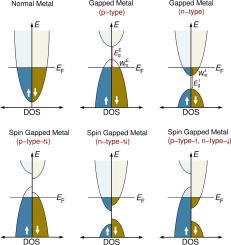
Gapped metals, a recently proposed class of materials, possess a band gap slightly above or below the Fermi level, behaving as intrinsic p- or n-type semiconductors without requiring external doping. Inspired by this concept, we propose a novel material class: ”spin gapped metals”. These materials exhibit intrinsic p- or n-type character independently for each spin channel, similar to dilute magnetic semiconductors but without the need for transition metal doping. A key advantage of spin gapped metals lies in the absence of band tails that exist within the band gap of conventional p- and n-type semiconductors. Band tails degrade the performance of devices like tunnel field-effect transistors (causing high subthreshold slopes) and negative differential resistance tunnel diodes (resulting in low peak-to-valley current ratios). Here, we demonstrate the viability of spin gapped metals using first-principles electronic band structure calculations on half-Heusler compounds. Our analysis reveals compounds displaying both gapped metal and spin gapped metal behavior, paving the way for next-generation multifunctional devices in spintronics and nanoelectronics.
期刊介绍:
The Journal of Magnetism and Magnetic Materials provides an important forum for the disclosure and discussion of original contributions covering the whole spectrum of topics, from basic magnetism to the technology and applications of magnetic materials. The journal encourages greater interaction between the basic and applied sub-disciplines of magnetism with comprehensive review articles, in addition to full-length contributions. In addition, other categories of contributions are welcome, including Critical Focused issues, Current Perspectives and Outreach to the General Public.
Main Categories:
Full-length articles:
Technically original research documents that report results of value to the communities that comprise the journal audience. The link between chemical, structural and microstructural properties on the one hand and magnetic properties on the other hand are encouraged.
In addition to general topics covering all areas of magnetism and magnetic materials, the full-length articles also include three sub-sections, focusing on Nanomagnetism, Spintronics and Applications.
The sub-section on Nanomagnetism contains articles on magnetic nanoparticles, nanowires, thin films, 2D materials and other nanoscale magnetic materials and their applications.
The sub-section on Spintronics contains articles on magnetoresistance, magnetoimpedance, magneto-optical phenomena, Micro-Electro-Mechanical Systems (MEMS), and other topics related to spin current control and magneto-transport phenomena. The sub-section on Applications display papers that focus on applications of magnetic materials. The applications need to show a connection to magnetism.
Review articles:
Review articles organize, clarify, and summarize existing major works in the areas covered by the Journal and provide comprehensive citations to the full spectrum of relevant literature.




 京公网安备 11010802042870号
京ICP备2023020795号-1
京公网安备 11010802042870号
京ICP备2023020795号-1

 分享
分享
 求助内容:
求助内容: 应助结果提醒方式:
 扫码关注我们
