Cuiying Pu , Jiajia Wang , Qiangqiang Liu , Lu Lu , Akil Ahmad , Mohammed B. Alshammari , Istikhar A. Ansari , Mohd Afzal , Abdullah Alarifi
{"title":"光催化降解用Co(II)基配位聚合物的制备:选择性去除阳离子甲基紫染料","authors":"Cuiying Pu , Jiajia Wang , Qiangqiang Liu , Lu Lu , Akil Ahmad , Mohammed B. Alshammari , Istikhar A. Ansari , Mohd Afzal , Abdullah Alarifi","doi":"10.1016/j.poly.2024.117321","DOIUrl":null,"url":null,"abstract":"<div><div>In this study, a new coordination polymer (CP) was designed and synthesized to evaluate the photocatalytic properties for water remediation. The Co(II)-based CP {[Co(HL)(bid)(H<sub>2</sub>O)]·2H<sub>2</sub>O}<sub>n</sub> (<strong>1</strong>) was hydrothermally synthesized using the ligand 5-(4′-carboxyphenoxy)isophthalic acid (H<sub>3</sub>L) and 1,4-bis(1-imidazolyl)-2,5-dimethylbenzene (bid). The coordination polymer (<strong>1</strong>) has been characterized by various spectral techniques, thermogravimetric (TGA), and single crystal X-ray technique. X-ray data revealed that (<strong>1</strong>) exhibits 2D framework having an octahedral coordination geometry around the Co(II) ions, having <em>μ</em><sub>1:</sub><em>η</em><sup>1</sup>-<em>η</em><sup>1</sup> mode with chromophore CoO4N. FT-IR analysis confirmed the asymmetric monodentate binding modes of the carboxylate ligand. The CP <strong>1</strong> has demonstrated optical semiconducting properties, rendering them promising candidates for photocatalytic applications. The catalyst (<strong>1</strong>) has been effectively utilized in the breakdown of several organic dyes, such as methylene blue (MB), methyl orange (MO), methyl violet (MV), and rhodamine B (RhB). The results showed that at pH 4, with a dosage of 30 mg of catalyst (<strong>1</strong>), 92.08 % of MV was degraded at a concentration of 20 ppm. Additionally, the mechanistic pathway for light-driven MV decomposition was investigated through experimental approaches, specifically radical trapping experiments.</div></div>","PeriodicalId":20278,"journal":{"name":"Polyhedron","volume":"267 ","pages":"Article 117321"},"PeriodicalIF":2.6000,"publicationDate":"2025-02-01","publicationTypes":"Journal Article","fieldsOfStudy":null,"isOpenAccess":false,"openAccessPdf":"","citationCount":"0","resultStr":"{\"title\":\"Fabrication of Co(II)-based coordination polymer for photocatalytic degradation: Selective removal of cationic methyl violet dye\",\"authors\":\"Cuiying Pu , Jiajia Wang , Qiangqiang Liu , Lu Lu , Akil Ahmad , Mohammed B. Alshammari , Istikhar A. Ansari , Mohd Afzal , Abdullah Alarifi\",\"doi\":\"10.1016/j.poly.2024.117321\",\"DOIUrl\":null,\"url\":null,\"abstract\":\"<div><div>In this study, a new coordination polymer (CP) was designed and synthesized to evaluate the photocatalytic properties for water remediation. The Co(II)-based CP {[Co(HL)(bid)(H<sub>2</sub>O)]·2H<sub>2</sub>O}<sub>n</sub> (<strong>1</strong>) was hydrothermally synthesized using the ligand 5-(4′-carboxyphenoxy)isophthalic acid (H<sub>3</sub>L) and 1,4-bis(1-imidazolyl)-2,5-dimethylbenzene (bid). The coordination polymer (<strong>1</strong>) has been characterized by various spectral techniques, thermogravimetric (TGA), and single crystal X-ray technique. X-ray data revealed that (<strong>1</strong>) exhibits 2D framework having an octahedral coordination geometry around the Co(II) ions, having <em>μ</em><sub>1:</sub><em>η</em><sup>1</sup>-<em>η</em><sup>1</sup> mode with chromophore CoO4N. FT-IR analysis confirmed the asymmetric monodentate binding modes of the carboxylate ligand. The CP <strong>1</strong> has demonstrated optical semiconducting properties, rendering them promising candidates for photocatalytic applications. The catalyst (<strong>1</strong>) has been effectively utilized in the breakdown of several organic dyes, such as methylene blue (MB), methyl orange (MO), methyl violet (MV), and rhodamine B (RhB). The results showed that at pH 4, with a dosage of 30 mg of catalyst (<strong>1</strong>), 92.08 % of MV was degraded at a concentration of 20 ppm. Additionally, the mechanistic pathway for light-driven MV decomposition was investigated through experimental approaches, specifically radical trapping experiments.</div></div>\",\"PeriodicalId\":20278,\"journal\":{\"name\":\"Polyhedron\",\"volume\":\"267 \",\"pages\":\"Article 117321\"},\"PeriodicalIF\":2.6000,\"publicationDate\":\"2025-02-01\",\"publicationTypes\":\"Journal Article\",\"fieldsOfStudy\":null,\"isOpenAccess\":false,\"openAccessPdf\":\"\",\"citationCount\":\"0\",\"resultStr\":null,\"platform\":\"Semanticscholar\",\"paperid\":null,\"PeriodicalName\":\"Polyhedron\",\"FirstCategoryId\":\"92\",\"ListUrlMain\":\"https://www.sciencedirect.com/science/article/pii/S0277538724004972\",\"RegionNum\":3,\"RegionCategory\":\"化学\",\"ArticlePicture\":[],\"TitleCN\":null,\"AbstractTextCN\":null,\"PMCID\":null,\"EPubDate\":\"2024/11/29 0:00:00\",\"PubModel\":\"Epub\",\"JCR\":\"Q2\",\"JCRName\":\"CHEMISTRY, INORGANIC & NUCLEAR\",\"Score\":null,\"Total\":0}","platform":"Semanticscholar","paperid":null,"PeriodicalName":"Polyhedron","FirstCategoryId":"92","ListUrlMain":"https://www.sciencedirect.com/science/article/pii/S0277538724004972","RegionNum":3,"RegionCategory":"化学","ArticlePicture":[],"TitleCN":null,"AbstractTextCN":null,"PMCID":null,"EPubDate":"2024/11/29 0:00:00","PubModel":"Epub","JCR":"Q2","JCRName":"CHEMISTRY, INORGANIC & NUCLEAR","Score":null,"Total":0}
Fabrication of Co(II)-based coordination polymer for photocatalytic degradation: Selective removal of cationic methyl violet dye
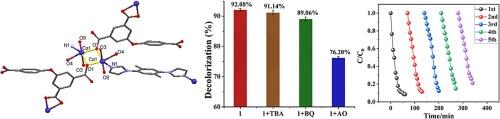
In this study, a new coordination polymer (CP) was designed and synthesized to evaluate the photocatalytic properties for water remediation. The Co(II)-based CP {[Co(HL)(bid)(H2O)]·2H2O}n (1) was hydrothermally synthesized using the ligand 5-(4′-carboxyphenoxy)isophthalic acid (H3L) and 1,4-bis(1-imidazolyl)-2,5-dimethylbenzene (bid). The coordination polymer (1) has been characterized by various spectral techniques, thermogravimetric (TGA), and single crystal X-ray technique. X-ray data revealed that (1) exhibits 2D framework having an octahedral coordination geometry around the Co(II) ions, having μ1:η1-η1 mode with chromophore CoO4N. FT-IR analysis confirmed the asymmetric monodentate binding modes of the carboxylate ligand. The CP 1 has demonstrated optical semiconducting properties, rendering them promising candidates for photocatalytic applications. The catalyst (1) has been effectively utilized in the breakdown of several organic dyes, such as methylene blue (MB), methyl orange (MO), methyl violet (MV), and rhodamine B (RhB). The results showed that at pH 4, with a dosage of 30 mg of catalyst (1), 92.08 % of MV was degraded at a concentration of 20 ppm. Additionally, the mechanistic pathway for light-driven MV decomposition was investigated through experimental approaches, specifically radical trapping experiments.
期刊介绍:
Polyhedron publishes original, fundamental, experimental and theoretical work of the highest quality in all the major areas of inorganic chemistry. This includes synthetic chemistry, coordination chemistry, organometallic chemistry, bioinorganic chemistry, and solid-state and materials chemistry.
Papers should be significant pieces of work, and all new compounds must be appropriately characterized. The inclusion of single-crystal X-ray structural data is strongly encouraged, but papers reporting only the X-ray structure determination of a single compound will usually not be considered. Papers on solid-state or materials chemistry will be expected to have a significant molecular chemistry component (such as the synthesis and characterization of the molecular precursors and/or a systematic study of the use of different precursors or reaction conditions) or demonstrate a cutting-edge application (for example inorganic materials for energy applications). Papers dealing only with stability constants are not considered.




 京公网安备 11010802042870号
京ICP备2023020795号-1
京公网安备 11010802042870号
京ICP备2023020795号-1

 分享
分享
 求助内容:
求助内容: 应助结果提醒方式:
 扫码关注我们
