S. Bharathkumar , Sakar Mohan , Hector Valdes , S. Balakumar
{"title":"证明了BiFeO3纳米颗粒中铒(Er)的取代掺杂增强了太阳能驱动的光催化活性","authors":"S. Bharathkumar , Sakar Mohan , Hector Valdes , S. Balakumar","doi":"10.1016/j.jpcs.2025.112573","DOIUrl":null,"url":null,"abstract":"<div><div>This study reports the synthesis of erbium (Er)-doped bismuth ferrite (BiFeO<sub>3</sub>/BFO) nanoparticles at varying molar concentrations (5, 10, and 15 %) using a sol-gel method. X-ray diffraction (XRD) analysis reveals a structural transformation from rhombohedral to orthorhombic upon Er<sup>3+</sup> doping, confirming the successful incorporation of Er<sup>3+</sup> ions into the BFO lattice. High-resolution transmission electron microscopy (HRTEM) images show that Er-doping leads to a reduction in particle size and a modification of the surface morphology. The bandgap of the Er-doped BFO samples decreases from 2.34 to 2.15 eV with increasing Er content, attributed to the formation of new Er 4f energy levels within the band structure. The magnetic properties of the samples also improve with increasing Er concentration. Photoluminescence (PL) spectra show reduced PL intensity for the 10 % Er-doped BFO sample, indicating a decrease in recombination rates, while electrochemical impedance spectroscopy (EIS) reveals a reduction in charge transfer resistance. Among the samples, the 10 % Er-doped BFO photocatalyst exhibits the highest photocatalytic efficiency. This enhanced activity is attributed to two key factors: efficient separation and migration of photogenerated charge carriers, and a reduced recombination rate of electron-hole pairs, both driven by the rare-earth doping in BFO. Radical trapping experiments further identify hydroxyl (OH•) radicals as the primary species responsible for photocatalytic degradation. This study provides valuable insights into the tunability of BFO's bandgap energy and photocatalytic properties through Er doping.</div></div>","PeriodicalId":16811,"journal":{"name":"Journal of Physics and Chemistry of Solids","volume":"199 ","pages":"Article 112573"},"PeriodicalIF":4.9000,"publicationDate":"2025-04-01","publicationTypes":"Journal Article","fieldsOfStudy":null,"isOpenAccess":false,"openAccessPdf":"","citationCount":"0","resultStr":"{\"title\":\"Demonstrating the substitutional doping of erbium (Er) in BiFeO3 nanoparticles for the enhanced solar-driven photocatalytic activity\",\"authors\":\"S. Bharathkumar , Sakar Mohan , Hector Valdes , S. Balakumar\",\"doi\":\"10.1016/j.jpcs.2025.112573\",\"DOIUrl\":null,\"url\":null,\"abstract\":\"<div><div>This study reports the synthesis of erbium (Er)-doped bismuth ferrite (BiFeO<sub>3</sub>/BFO) nanoparticles at varying molar concentrations (5, 10, and 15 %) using a sol-gel method. X-ray diffraction (XRD) analysis reveals a structural transformation from rhombohedral to orthorhombic upon Er<sup>3+</sup> doping, confirming the successful incorporation of Er<sup>3+</sup> ions into the BFO lattice. High-resolution transmission electron microscopy (HRTEM) images show that Er-doping leads to a reduction in particle size and a modification of the surface morphology. The bandgap of the Er-doped BFO samples decreases from 2.34 to 2.15 eV with increasing Er content, attributed to the formation of new Er 4f energy levels within the band structure. The magnetic properties of the samples also improve with increasing Er concentration. Photoluminescence (PL) spectra show reduced PL intensity for the 10 % Er-doped BFO sample, indicating a decrease in recombination rates, while electrochemical impedance spectroscopy (EIS) reveals a reduction in charge transfer resistance. Among the samples, the 10 % Er-doped BFO photocatalyst exhibits the highest photocatalytic efficiency. This enhanced activity is attributed to two key factors: efficient separation and migration of photogenerated charge carriers, and a reduced recombination rate of electron-hole pairs, both driven by the rare-earth doping in BFO. Radical trapping experiments further identify hydroxyl (OH•) radicals as the primary species responsible for photocatalytic degradation. This study provides valuable insights into the tunability of BFO's bandgap energy and photocatalytic properties through Er doping.</div></div>\",\"PeriodicalId\":16811,\"journal\":{\"name\":\"Journal of Physics and Chemistry of Solids\",\"volume\":\"199 \",\"pages\":\"Article 112573\"},\"PeriodicalIF\":4.9000,\"publicationDate\":\"2025-04-01\",\"publicationTypes\":\"Journal Article\",\"fieldsOfStudy\":null,\"isOpenAccess\":false,\"openAccessPdf\":\"\",\"citationCount\":\"0\",\"resultStr\":null,\"platform\":\"Semanticscholar\",\"paperid\":null,\"PeriodicalName\":\"Journal of Physics and Chemistry of Solids\",\"FirstCategoryId\":\"88\",\"ListUrlMain\":\"https://www.sciencedirect.com/science/article/pii/S0022369725000241\",\"RegionNum\":3,\"RegionCategory\":\"材料科学\",\"ArticlePicture\":[],\"TitleCN\":null,\"AbstractTextCN\":null,\"PMCID\":null,\"EPubDate\":\"2025/1/16 0:00:00\",\"PubModel\":\"Epub\",\"JCR\":\"Q2\",\"JCRName\":\"CHEMISTRY, MULTIDISCIPLINARY\",\"Score\":null,\"Total\":0}","platform":"Semanticscholar","paperid":null,"PeriodicalName":"Journal of Physics and Chemistry of Solids","FirstCategoryId":"88","ListUrlMain":"https://www.sciencedirect.com/science/article/pii/S0022369725000241","RegionNum":3,"RegionCategory":"材料科学","ArticlePicture":[],"TitleCN":null,"AbstractTextCN":null,"PMCID":null,"EPubDate":"2025/1/16 0:00:00","PubModel":"Epub","JCR":"Q2","JCRName":"CHEMISTRY, MULTIDISCIPLINARY","Score":null,"Total":0}
Demonstrating the substitutional doping of erbium (Er) in BiFeO3 nanoparticles for the enhanced solar-driven photocatalytic activity
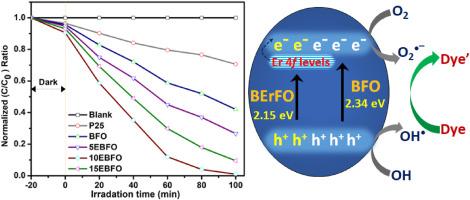
This study reports the synthesis of erbium (Er)-doped bismuth ferrite (BiFeO3/BFO) nanoparticles at varying molar concentrations (5, 10, and 15 %) using a sol-gel method. X-ray diffraction (XRD) analysis reveals a structural transformation from rhombohedral to orthorhombic upon Er3+ doping, confirming the successful incorporation of Er3+ ions into the BFO lattice. High-resolution transmission electron microscopy (HRTEM) images show that Er-doping leads to a reduction in particle size and a modification of the surface morphology. The bandgap of the Er-doped BFO samples decreases from 2.34 to 2.15 eV with increasing Er content, attributed to the formation of new Er 4f energy levels within the band structure. The magnetic properties of the samples also improve with increasing Er concentration. Photoluminescence (PL) spectra show reduced PL intensity for the 10 % Er-doped BFO sample, indicating a decrease in recombination rates, while electrochemical impedance spectroscopy (EIS) reveals a reduction in charge transfer resistance. Among the samples, the 10 % Er-doped BFO photocatalyst exhibits the highest photocatalytic efficiency. This enhanced activity is attributed to two key factors: efficient separation and migration of photogenerated charge carriers, and a reduced recombination rate of electron-hole pairs, both driven by the rare-earth doping in BFO. Radical trapping experiments further identify hydroxyl (OH•) radicals as the primary species responsible for photocatalytic degradation. This study provides valuable insights into the tunability of BFO's bandgap energy and photocatalytic properties through Er doping.
期刊介绍:
The Journal of Physics and Chemistry of Solids is a well-established international medium for publication of archival research in condensed matter and materials sciences. Areas of interest broadly include experimental and theoretical research on electronic, magnetic, spectroscopic and structural properties as well as the statistical mechanics and thermodynamics of materials. The focus is on gaining physical and chemical insight into the properties and potential applications of condensed matter systems.
Within the broad scope of the journal, beyond regular contributions, the editors have identified submissions in the following areas of physics and chemistry of solids to be of special current interest to the journal:
Low-dimensional systems
Exotic states of quantum electron matter including topological phases
Energy conversion and storage
Interfaces, nanoparticles and catalysts.




 京公网安备 11010802042870号
京ICP备2023020795号-1
京公网安备 11010802042870号
京ICP备2023020795号-1

 分享
分享
 求助内容:
求助内容: 应助结果提醒方式:
 扫码关注我们
