{"title":"IVR-UNED:了解辐射场的交互式虚拟环境","authors":"Mario Belotti, Rafael Juárez","doi":"10.1016/j.net.2024.09.002","DOIUrl":null,"url":null,"abstract":"<div><div>As a result of the evolution of High-Performance Computing (HPC) and new cutting-edge projects such as ITER, nuclear analysis has greatly increased in sophistication. Nowadays, nuclear facilities can be modelled in unprecedented detail for radiation transport calculations. Radiation maps can reach great levels of complexity, including multiple radiation sources in vast geometries. These capabilities must be accompanied by an equal capacity to process the results obtained. Nowadays clients are provided with static views pre-decided by nuclear analysts to understand radiation fields. Since the ability to understand such information depends on the unevenly distributed spatial intelligence, this practice can induce biases and limit the usability of the calculations. But beyond analyst-client communication, analysts themselves often fail to identify cleanly all the aspects of a complex radiation field. To overcome to these limitations, we have expanded the videogame engine Unity to create IVR-UNED. It permits to build 3D videogame-like interactive virtual immersive environments, boosting the visualization and insight of the radiation fields through easy on-demand and real-time radiation field postprocessing and visualization. To demonstrate its features, the application to two relevant examples for fusion-related facilities, ITER and IFMIF-DONES, will be presented.</div></div>","PeriodicalId":19272,"journal":{"name":"Nuclear Engineering and Technology","volume":"57 2","pages":"Article 103199"},"PeriodicalIF":2.9000,"publicationDate":"2025-02-01","publicationTypes":"Journal Article","fieldsOfStudy":null,"isOpenAccess":false,"openAccessPdf":"","citationCount":"0","resultStr":"{\"title\":\"IVR-UNED: Interactive virtual environments to understand radiation fields\",\"authors\":\"Mario Belotti, Rafael Juárez\",\"doi\":\"10.1016/j.net.2024.09.002\",\"DOIUrl\":null,\"url\":null,\"abstract\":\"<div><div>As a result of the evolution of High-Performance Computing (HPC) and new cutting-edge projects such as ITER, nuclear analysis has greatly increased in sophistication. Nowadays, nuclear facilities can be modelled in unprecedented detail for radiation transport calculations. Radiation maps can reach great levels of complexity, including multiple radiation sources in vast geometries. These capabilities must be accompanied by an equal capacity to process the results obtained. Nowadays clients are provided with static views pre-decided by nuclear analysts to understand radiation fields. Since the ability to understand such information depends on the unevenly distributed spatial intelligence, this practice can induce biases and limit the usability of the calculations. But beyond analyst-client communication, analysts themselves often fail to identify cleanly all the aspects of a complex radiation field. To overcome to these limitations, we have expanded the videogame engine Unity to create IVR-UNED. It permits to build 3D videogame-like interactive virtual immersive environments, boosting the visualization and insight of the radiation fields through easy on-demand and real-time radiation field postprocessing and visualization. To demonstrate its features, the application to two relevant examples for fusion-related facilities, ITER and IFMIF-DONES, will be presented.</div></div>\",\"PeriodicalId\":19272,\"journal\":{\"name\":\"Nuclear Engineering and Technology\",\"volume\":\"57 2\",\"pages\":\"Article 103199\"},\"PeriodicalIF\":2.9000,\"publicationDate\":\"2025-02-01\",\"publicationTypes\":\"Journal Article\",\"fieldsOfStudy\":null,\"isOpenAccess\":false,\"openAccessPdf\":\"\",\"citationCount\":\"0\",\"resultStr\":null,\"platform\":\"Semanticscholar\",\"paperid\":null,\"PeriodicalName\":\"Nuclear Engineering and Technology\",\"FirstCategoryId\":\"5\",\"ListUrlMain\":\"https://www.sciencedirect.com/science/article/pii/S1738573324004467\",\"RegionNum\":3,\"RegionCategory\":\"工程技术\",\"ArticlePicture\":[],\"TitleCN\":null,\"AbstractTextCN\":null,\"PMCID\":null,\"EPubDate\":\"2024/9/4 0:00:00\",\"PubModel\":\"Epub\",\"JCR\":\"Q1\",\"JCRName\":\"NUCLEAR SCIENCE & TECHNOLOGY\",\"Score\":null,\"Total\":0}","platform":"Semanticscholar","paperid":null,"PeriodicalName":"Nuclear Engineering and Technology","FirstCategoryId":"5","ListUrlMain":"https://www.sciencedirect.com/science/article/pii/S1738573324004467","RegionNum":3,"RegionCategory":"工程技术","ArticlePicture":[],"TitleCN":null,"AbstractTextCN":null,"PMCID":null,"EPubDate":"2024/9/4 0:00:00","PubModel":"Epub","JCR":"Q1","JCRName":"NUCLEAR SCIENCE & TECHNOLOGY","Score":null,"Total":0}
IVR-UNED: Interactive virtual environments to understand radiation fields
As a result of the evolution of High-Performance Computing (HPC) and new cutting-edge projects such as ITER, nuclear analysis has greatly increased in sophistication. Nowadays, nuclear facilities can be modelled in unprecedented detail for radiation transport calculations. Radiation maps can reach great levels of complexity, including multiple radiation sources in vast geometries. These capabilities must be accompanied by an equal capacity to process the results obtained. Nowadays clients are provided with static views pre-decided by nuclear analysts to understand radiation fields. Since the ability to understand such information depends on the unevenly distributed spatial intelligence, this practice can induce biases and limit the usability of the calculations. But beyond analyst-client communication, analysts themselves often fail to identify cleanly all the aspects of a complex radiation field. To overcome to these limitations, we have expanded the videogame engine Unity to create IVR-UNED. It permits to build 3D videogame-like interactive virtual immersive environments, boosting the visualization and insight of the radiation fields through easy on-demand and real-time radiation field postprocessing and visualization. To demonstrate its features, the application to two relevant examples for fusion-related facilities, ITER and IFMIF-DONES, will be presented.
期刊介绍:
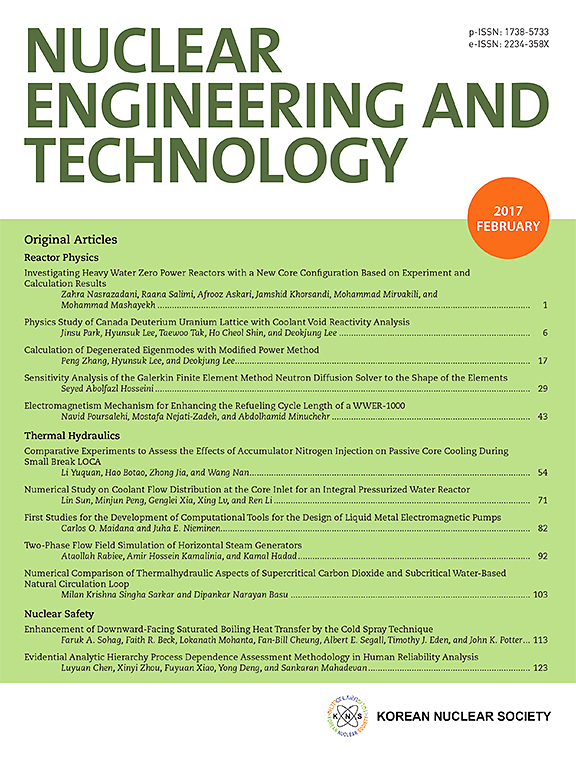
Nuclear Engineering and Technology (NET), an international journal of the Korean Nuclear Society (KNS), publishes peer-reviewed papers on original research, ideas and developments in all areas of the field of nuclear science and technology. NET bimonthly publishes original articles, reviews, and technical notes. The journal is listed in the Science Citation Index Expanded (SCIE) of Thomson Reuters.
NET covers all fields for peaceful utilization of nuclear energy and radiation as follows:
1) Reactor Physics
2) Thermal Hydraulics
3) Nuclear Safety
4) Nuclear I&C
5) Nuclear Physics, Fusion, and Laser Technology
6) Nuclear Fuel Cycle and Radioactive Waste Management
7) Nuclear Fuel and Reactor Materials
8) Radiation Application
9) Radiation Protection
10) Nuclear Structural Analysis and Plant Management & Maintenance
11) Nuclear Policy, Economics, and Human Resource Development




 京公网安备 11010802042870号
京ICP备2023020795号-1
京公网安备 11010802042870号
京ICP备2023020795号-1

 分享
分享
 求助内容:
求助内容: 应助结果提醒方式:
 扫码关注我们
