M.R. Shahzad , Wajiha Habib , Asifa Ashraf , Faisal Javed , Awatef Abidi , Maha Alammari , Ali M. Mubaraki
{"title":"一般各向同性带电流体球内物质耦合重力形式","authors":"M.R. Shahzad , Wajiha Habib , Asifa Ashraf , Faisal Javed , Awatef Abidi , Maha Alammari , Ali M. Mubaraki","doi":"10.1016/j.dark.2024.101726","DOIUrl":null,"url":null,"abstract":"<div><div>In this paper, we proposed a new mathematical model of charged isotropic compact relativistic object in the <span><math><mrow><mi>f</mi><mrow><mo>(</mo><mi>R</mi><mo>,</mo><mi>T</mi><mo>)</mo></mrow></mrow></math></span> gravity. In the <span><math><mrow><mi>f</mi><mrow><mo>(</mo><mi>R</mi><mo>,</mo><mi>T</mi><mo>)</mo></mrow></mrow></math></span> framework, the gravitational action involves the trace of the energy–momentum tensor <span><math><mi>T</mi></math></span> and the Ricci scalar <span><math><mi>R</mi></math></span>. We choose a specific <span><math><mrow><mi>f</mi><mrow><mo>(</mo><mi>R</mi><mo>,</mo><mi>T</mi><mo>)</mo></mrow></mrow></math></span> framework such that <span><math><mrow><mi>f</mi><mrow><mo>(</mo><mi>R</mi><mo>,</mo><mi>T</mi><mo>)</mo></mrow><mo>=</mo><mi>R</mi><mo>+</mo><mn>2</mn><mi>χ</mi><mi>T</mi></mrow></math></span>, in which <span><math><mi>χ</mi></math></span> represents the coupling parameter, which is responsible for measuring the deviation from the standard Einstein’s general theory of relativity (GR). A short overview of the modified <span><math><mrow><mi>f</mi><mrow><mo>(</mo><mi>R</mi><mo>,</mo><mi>T</mi><mo>)</mo></mrow></mrow></math></span> gravity theory is presented and the field equations are formulated in this novel modified gravity. It is shown that for a specific limit of the coupling parameter, the standard <span><math><mrow><mi>G</mi><mi>R</mi></mrow></math></span> can be restored from the considered <span><math><mrow><mi>f</mi><mrow><mo>(</mo><mi>R</mi><mo>,</mo><mi>T</mi><mo>)</mo></mrow></mrow></math></span> model. We modeled, mathematically, a specific charged compact star <span><math><mrow><mi>X</mi><mi>T</mi><mi>E</mi><mi>J</mi><mn>1739</mn><mo>−</mo><mn>217</mn></mrow></math></span> (M=1.51<span><math><msub><mrow><mi>M</mi></mrow><mrow><mo>⨀</mo></mrow></msub></math></span>, R=10.9 km), within the <span><math><mrow><mi>f</mi><mrow><mo>(</mo><mi>R</mi><mo>,</mo><mi>T</mi><mo>)</mo></mrow></mrow></math></span> extended gravity theory framework by taking benefit from the well studied Heintzmann IIa ansatz [H. Heintzmann, Z. Physik 228, 489–493 (1969)]. To examine the reliability and physical plausibility of Our model, different physical characteristics such as the energy density and pressure, electric field, energy conditions, stability analysis via Herrara cracking technique and the adiabatic index, equilibrium conditions under different forces, mass–radius relationship, compactness and surface red-shift are studied carefully, which are essential for confirming the model’s physical feasibility. The mathematically established results are more accurately represented by graphical illustrations for the various chosen values of the coupling parameter <span><math><mi>χ</mi></math></span>. In this study, we also compared our findings with the standard GR results and the observational facts, and we inferred that for nonzero values of the coupling parameter, <span><math><mi>χ</mi></math></span>, our results in <span><math><mrow><mi>f</mi><mrow><mo>(</mo><mi>R</mi><mo>,</mo><mi>T</mi><mo>)</mo></mrow></mrow></math></span> framework are closely related to the observational facts in comparison with the standard <span><math><mrow><mi>G</mi><mi>R</mi></mrow></math></span>. We conclude that our presented model is well consistent with all the requirements and viably modeled the compact star <span><math><mrow><mi>X</mi><mi>T</mi><mi>E</mi><mi>J</mi><mn>1739</mn><mo>−</mo><mn>217</mn></mrow></math></span>.</div></div>","PeriodicalId":48774,"journal":{"name":"Physics of the Dark Universe","volume":"47 ","pages":"Article 101726"},"PeriodicalIF":6.4000,"publicationDate":"2025-02-01","publicationTypes":"Journal Article","fieldsOfStudy":null,"isOpenAccess":false,"openAccessPdf":"","citationCount":"0","resultStr":"{\"title\":\"General isotropic charged fluid spheres within the matter coupling gravity formalism\",\"authors\":\"M.R. Shahzad , Wajiha Habib , Asifa Ashraf , Faisal Javed , Awatef Abidi , Maha Alammari , Ali M. Mubaraki\",\"doi\":\"10.1016/j.dark.2024.101726\",\"DOIUrl\":null,\"url\":null,\"abstract\":\"<div><div>In this paper, we proposed a new mathematical model of charged isotropic compact relativistic object in the <span><math><mrow><mi>f</mi><mrow><mo>(</mo><mi>R</mi><mo>,</mo><mi>T</mi><mo>)</mo></mrow></mrow></math></span> gravity. In the <span><math><mrow><mi>f</mi><mrow><mo>(</mo><mi>R</mi><mo>,</mo><mi>T</mi><mo>)</mo></mrow></mrow></math></span> framework, the gravitational action involves the trace of the energy–momentum tensor <span><math><mi>T</mi></math></span> and the Ricci scalar <span><math><mi>R</mi></math></span>. We choose a specific <span><math><mrow><mi>f</mi><mrow><mo>(</mo><mi>R</mi><mo>,</mo><mi>T</mi><mo>)</mo></mrow></mrow></math></span> framework such that <span><math><mrow><mi>f</mi><mrow><mo>(</mo><mi>R</mi><mo>,</mo><mi>T</mi><mo>)</mo></mrow><mo>=</mo><mi>R</mi><mo>+</mo><mn>2</mn><mi>χ</mi><mi>T</mi></mrow></math></span>, in which <span><math><mi>χ</mi></math></span> represents the coupling parameter, which is responsible for measuring the deviation from the standard Einstein’s general theory of relativity (GR). A short overview of the modified <span><math><mrow><mi>f</mi><mrow><mo>(</mo><mi>R</mi><mo>,</mo><mi>T</mi><mo>)</mo></mrow></mrow></math></span> gravity theory is presented and the field equations are formulated in this novel modified gravity. It is shown that for a specific limit of the coupling parameter, the standard <span><math><mrow><mi>G</mi><mi>R</mi></mrow></math></span> can be restored from the considered <span><math><mrow><mi>f</mi><mrow><mo>(</mo><mi>R</mi><mo>,</mo><mi>T</mi><mo>)</mo></mrow></mrow></math></span> model. We modeled, mathematically, a specific charged compact star <span><math><mrow><mi>X</mi><mi>T</mi><mi>E</mi><mi>J</mi><mn>1739</mn><mo>−</mo><mn>217</mn></mrow></math></span> (M=1.51<span><math><msub><mrow><mi>M</mi></mrow><mrow><mo>⨀</mo></mrow></msub></math></span>, R=10.9 km), within the <span><math><mrow><mi>f</mi><mrow><mo>(</mo><mi>R</mi><mo>,</mo><mi>T</mi><mo>)</mo></mrow></mrow></math></span> extended gravity theory framework by taking benefit from the well studied Heintzmann IIa ansatz [H. Heintzmann, Z. Physik 228, 489–493 (1969)]. To examine the reliability and physical plausibility of Our model, different physical characteristics such as the energy density and pressure, electric field, energy conditions, stability analysis via Herrara cracking technique and the adiabatic index, equilibrium conditions under different forces, mass–radius relationship, compactness and surface red-shift are studied carefully, which are essential for confirming the model’s physical feasibility. The mathematically established results are more accurately represented by graphical illustrations for the various chosen values of the coupling parameter <span><math><mi>χ</mi></math></span>. In this study, we also compared our findings with the standard GR results and the observational facts, and we inferred that for nonzero values of the coupling parameter, <span><math><mi>χ</mi></math></span>, our results in <span><math><mrow><mi>f</mi><mrow><mo>(</mo><mi>R</mi><mo>,</mo><mi>T</mi><mo>)</mo></mrow></mrow></math></span> framework are closely related to the observational facts in comparison with the standard <span><math><mrow><mi>G</mi><mi>R</mi></mrow></math></span>. We conclude that our presented model is well consistent with all the requirements and viably modeled the compact star <span><math><mrow><mi>X</mi><mi>T</mi><mi>E</mi><mi>J</mi><mn>1739</mn><mo>−</mo><mn>217</mn></mrow></math></span>.</div></div>\",\"PeriodicalId\":48774,\"journal\":{\"name\":\"Physics of the Dark Universe\",\"volume\":\"47 \",\"pages\":\"Article 101726\"},\"PeriodicalIF\":6.4000,\"publicationDate\":\"2025-02-01\",\"publicationTypes\":\"Journal Article\",\"fieldsOfStudy\":null,\"isOpenAccess\":false,\"openAccessPdf\":\"\",\"citationCount\":\"0\",\"resultStr\":null,\"platform\":\"Semanticscholar\",\"paperid\":null,\"PeriodicalName\":\"Physics of the Dark Universe\",\"FirstCategoryId\":\"101\",\"ListUrlMain\":\"https://www.sciencedirect.com/science/article/pii/S221268642400308X\",\"RegionNum\":2,\"RegionCategory\":\"物理与天体物理\",\"ArticlePicture\":[],\"TitleCN\":null,\"AbstractTextCN\":null,\"PMCID\":null,\"EPubDate\":\"2024/11/28 0:00:00\",\"PubModel\":\"Epub\",\"JCR\":\"Q1\",\"JCRName\":\"ASTRONOMY & ASTROPHYSICS\",\"Score\":null,\"Total\":0}","platform":"Semanticscholar","paperid":null,"PeriodicalName":"Physics of the Dark Universe","FirstCategoryId":"101","ListUrlMain":"https://www.sciencedirect.com/science/article/pii/S221268642400308X","RegionNum":2,"RegionCategory":"物理与天体物理","ArticlePicture":[],"TitleCN":null,"AbstractTextCN":null,"PMCID":null,"EPubDate":"2024/11/28 0:00:00","PubModel":"Epub","JCR":"Q1","JCRName":"ASTRONOMY & ASTROPHYSICS","Score":null,"Total":0}
General isotropic charged fluid spheres within the matter coupling gravity formalism
In this paper, we proposed a new mathematical model of charged isotropic compact relativistic object in the gravity. In the framework, the gravitational action involves the trace of the energy–momentum tensor and the Ricci scalar . We choose a specific framework such that , in which represents the coupling parameter, which is responsible for measuring the deviation from the standard Einstein’s general theory of relativity (GR). A short overview of the modified gravity theory is presented and the field equations are formulated in this novel modified gravity. It is shown that for a specific limit of the coupling parameter, the standard can be restored from the considered model. We modeled, mathematically, a specific charged compact star (M=1.51, R=10.9 km), within the extended gravity theory framework by taking benefit from the well studied Heintzmann IIa ansatz [H. Heintzmann, Z. Physik 228, 489–493 (1969)]. To examine the reliability and physical plausibility of Our model, different physical characteristics such as the energy density and pressure, electric field, energy conditions, stability analysis via Herrara cracking technique and the adiabatic index, equilibrium conditions under different forces, mass–radius relationship, compactness and surface red-shift are studied carefully, which are essential for confirming the model’s physical feasibility. The mathematically established results are more accurately represented by graphical illustrations for the various chosen values of the coupling parameter . In this study, we also compared our findings with the standard GR results and the observational facts, and we inferred that for nonzero values of the coupling parameter, , our results in framework are closely related to the observational facts in comparison with the standard . We conclude that our presented model is well consistent with all the requirements and viably modeled the compact star .
期刊介绍:
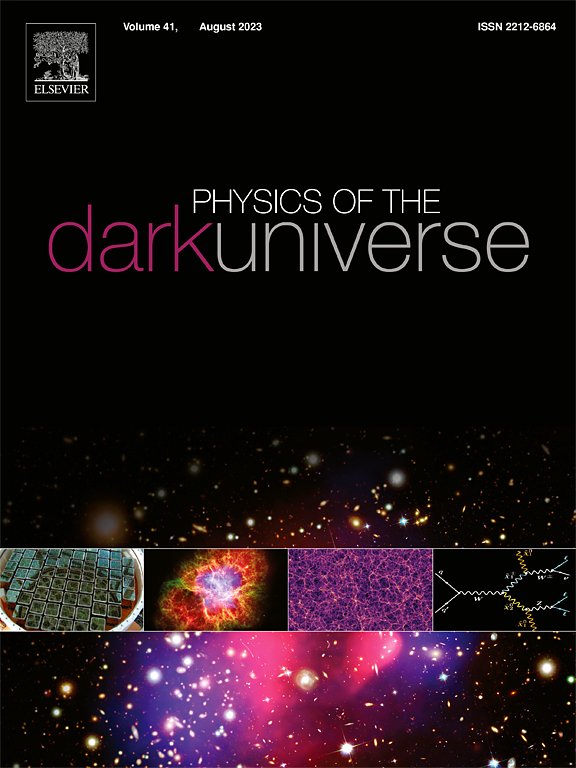
Physics of the Dark Universe is an innovative online-only journal that offers rapid publication of peer-reviewed, original research articles considered of high scientific impact.
The journal is focused on the understanding of Dark Matter, Dark Energy, Early Universe, gravitational waves and neutrinos, covering all theoretical, experimental and phenomenological aspects.




 京公网安备 11010802042870号
京ICP备2023020795号-1
京公网安备 11010802042870号
京ICP备2023020795号-1

 分享
分享
 求助内容:
求助内容: 应助结果提醒方式:
 扫码关注我们
