{"title":"考虑星系环境的恒星形成主序和双峰色","authors":"Pius Privatus , Umananda Dev Goswami","doi":"10.1016/j.dark.2024.101802","DOIUrl":null,"url":null,"abstract":"<div><div>This study involves the use of friend-of-friend method on the volume limited samples constructed from the Sloan Digital Sky Survey Data Release 12 (SDSS DR12) to classify the galaxies into isolated and non-isolated environments hence to investigate the influence of the galaxy environment on the main sequence of star formation, and colour bimodality. We classified the galaxies into the luminous volume-limited sample with <span><math><mrow><mo>−</mo><mn>22</mn><mo>.</mo><mn>5</mn><mo>≤</mo><msub><mrow><mi>M</mi></mrow><mrow><mi>r</mi></mrow></msub><mo>≤</mo><mo>−</mo><mn>20</mn><mo>.</mo><mn>5</mn></mrow></math></span> (mag), and the faint volume-limited sample with <span><math><mrow><mo>−</mo><mn>20</mn><mo>.</mo><mn>5</mn><mo>≤</mo><msub><mrow><mi>M</mi></mrow><mrow><mi>r</mi></mrow></msub><mo>≤</mo><mo>−</mo><mn>18</mn><mo>.</mo><mn>5</mn></mrow></math></span> (mag). Using the WHAN diagnostic diagram we assigned the samples into star-forming, strong AGN, weak AGN, and retired galaxies based on their environment (isolated and non-isolated). The friend-of-friend method was successful in producing consistent results regarding the stellar mass-SFR and stellar mass-colour known relations. Apart from that the decrease in the slope of the main sequence for star-forming galaxies by 0.04 dex and intercept by 0.39 dex for the luminous sample was observed while the faint sample a decrease of 0.08 dex in slope and 0.74 dex in intercept was observed between isolated and non-isolated galaxies. A significant difference on the number of galaxies between isolated and non-isolated galaxies within, above and below the main sequence by 7.47%, 28.51%, 14.59% for the luminous sample while for the faint sample by 16.15%, 32.60%, 35.23% on average, respectively are observed. A significant difference in the number of galaxies in the blue cloud, green valley, and red sequence by 10.30%, 20.61%, 5.74% for luminous sample while for faint sample by 28.46%, 41.36%, 8.95% on average, respectively was observed. The study concludes that the galaxy environment influences the shaping and positioning of galaxies along the star formation main sequence and colour bimodality.</div></div>","PeriodicalId":48774,"journal":{"name":"Physics of the Dark Universe","volume":"47 ","pages":"Article 101802"},"PeriodicalIF":6.4000,"publicationDate":"2025-02-01","publicationTypes":"Journal Article","fieldsOfStudy":null,"isOpenAccess":false,"openAccessPdf":"","citationCount":"0","resultStr":"{\"title\":\"Main sequence of star formation and colour bimodality considering galaxy environment\",\"authors\":\"Pius Privatus , Umananda Dev Goswami\",\"doi\":\"10.1016/j.dark.2024.101802\",\"DOIUrl\":null,\"url\":null,\"abstract\":\"<div><div>This study involves the use of friend-of-friend method on the volume limited samples constructed from the Sloan Digital Sky Survey Data Release 12 (SDSS DR12) to classify the galaxies into isolated and non-isolated environments hence to investigate the influence of the galaxy environment on the main sequence of star formation, and colour bimodality. We classified the galaxies into the luminous volume-limited sample with <span><math><mrow><mo>−</mo><mn>22</mn><mo>.</mo><mn>5</mn><mo>≤</mo><msub><mrow><mi>M</mi></mrow><mrow><mi>r</mi></mrow></msub><mo>≤</mo><mo>−</mo><mn>20</mn><mo>.</mo><mn>5</mn></mrow></math></span> (mag), and the faint volume-limited sample with <span><math><mrow><mo>−</mo><mn>20</mn><mo>.</mo><mn>5</mn><mo>≤</mo><msub><mrow><mi>M</mi></mrow><mrow><mi>r</mi></mrow></msub><mo>≤</mo><mo>−</mo><mn>18</mn><mo>.</mo><mn>5</mn></mrow></math></span> (mag). Using the WHAN diagnostic diagram we assigned the samples into star-forming, strong AGN, weak AGN, and retired galaxies based on their environment (isolated and non-isolated). The friend-of-friend method was successful in producing consistent results regarding the stellar mass-SFR and stellar mass-colour known relations. Apart from that the decrease in the slope of the main sequence for star-forming galaxies by 0.04 dex and intercept by 0.39 dex for the luminous sample was observed while the faint sample a decrease of 0.08 dex in slope and 0.74 dex in intercept was observed between isolated and non-isolated galaxies. A significant difference on the number of galaxies between isolated and non-isolated galaxies within, above and below the main sequence by 7.47%, 28.51%, 14.59% for the luminous sample while for the faint sample by 16.15%, 32.60%, 35.23% on average, respectively are observed. A significant difference in the number of galaxies in the blue cloud, green valley, and red sequence by 10.30%, 20.61%, 5.74% for luminous sample while for faint sample by 28.46%, 41.36%, 8.95% on average, respectively was observed. The study concludes that the galaxy environment influences the shaping and positioning of galaxies along the star formation main sequence and colour bimodality.</div></div>\",\"PeriodicalId\":48774,\"journal\":{\"name\":\"Physics of the Dark Universe\",\"volume\":\"47 \",\"pages\":\"Article 101802\"},\"PeriodicalIF\":6.4000,\"publicationDate\":\"2025-02-01\",\"publicationTypes\":\"Journal Article\",\"fieldsOfStudy\":null,\"isOpenAccess\":false,\"openAccessPdf\":\"\",\"citationCount\":\"0\",\"resultStr\":null,\"platform\":\"Semanticscholar\",\"paperid\":null,\"PeriodicalName\":\"Physics of the Dark Universe\",\"FirstCategoryId\":\"101\",\"ListUrlMain\":\"https://www.sciencedirect.com/science/article/pii/S2212686424003856\",\"RegionNum\":2,\"RegionCategory\":\"物理与天体物理\",\"ArticlePicture\":[],\"TitleCN\":null,\"AbstractTextCN\":null,\"PMCID\":null,\"EPubDate\":\"2025/1/6 0:00:00\",\"PubModel\":\"Epub\",\"JCR\":\"Q1\",\"JCRName\":\"ASTRONOMY & ASTROPHYSICS\",\"Score\":null,\"Total\":0}","platform":"Semanticscholar","paperid":null,"PeriodicalName":"Physics of the Dark Universe","FirstCategoryId":"101","ListUrlMain":"https://www.sciencedirect.com/science/article/pii/S2212686424003856","RegionNum":2,"RegionCategory":"物理与天体物理","ArticlePicture":[],"TitleCN":null,"AbstractTextCN":null,"PMCID":null,"EPubDate":"2025/1/6 0:00:00","PubModel":"Epub","JCR":"Q1","JCRName":"ASTRONOMY & ASTROPHYSICS","Score":null,"Total":0}
Main sequence of star formation and colour bimodality considering galaxy environment
This study involves the use of friend-of-friend method on the volume limited samples constructed from the Sloan Digital Sky Survey Data Release 12 (SDSS DR12) to classify the galaxies into isolated and non-isolated environments hence to investigate the influence of the galaxy environment on the main sequence of star formation, and colour bimodality. We classified the galaxies into the luminous volume-limited sample with (mag), and the faint volume-limited sample with (mag). Using the WHAN diagnostic diagram we assigned the samples into star-forming, strong AGN, weak AGN, and retired galaxies based on their environment (isolated and non-isolated). The friend-of-friend method was successful in producing consistent results regarding the stellar mass-SFR and stellar mass-colour known relations. Apart from that the decrease in the slope of the main sequence for star-forming galaxies by 0.04 dex and intercept by 0.39 dex for the luminous sample was observed while the faint sample a decrease of 0.08 dex in slope and 0.74 dex in intercept was observed between isolated and non-isolated galaxies. A significant difference on the number of galaxies between isolated and non-isolated galaxies within, above and below the main sequence by 7.47%, 28.51%, 14.59% for the luminous sample while for the faint sample by 16.15%, 32.60%, 35.23% on average, respectively are observed. A significant difference in the number of galaxies in the blue cloud, green valley, and red sequence by 10.30%, 20.61%, 5.74% for luminous sample while for faint sample by 28.46%, 41.36%, 8.95% on average, respectively was observed. The study concludes that the galaxy environment influences the shaping and positioning of galaxies along the star formation main sequence and colour bimodality.
期刊介绍:
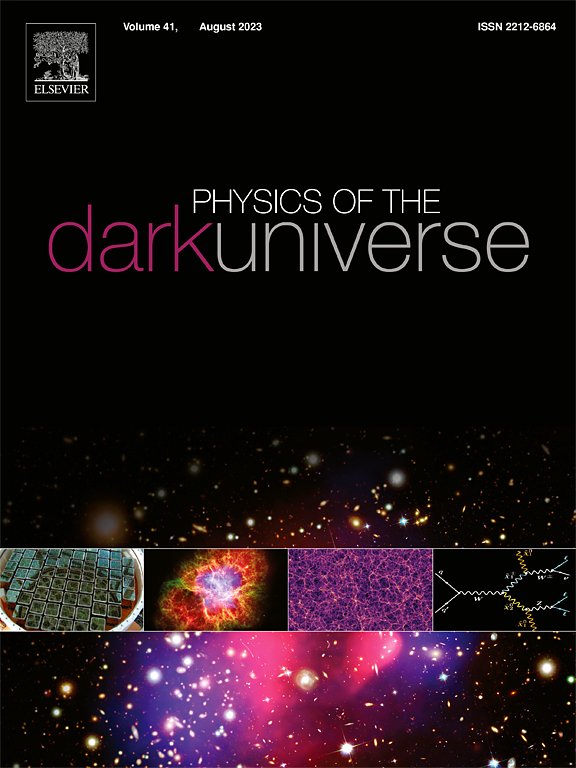
Physics of the Dark Universe is an innovative online-only journal that offers rapid publication of peer-reviewed, original research articles considered of high scientific impact.
The journal is focused on the understanding of Dark Matter, Dark Energy, Early Universe, gravitational waves and neutrinos, covering all theoretical, experimental and phenomenological aspects.




 京公网安备 11010802042870号
京ICP备2023020795号-1
京公网安备 11010802042870号
京ICP备2023020795号-1

 分享
分享
 求助内容:
求助内容: 应助结果提醒方式:
 扫码关注我们
