Neha C. Patil , Umesh V. Shembade , Mayuri G. Magadum , Jaywant V. Mane , Dnyandevo N. Zambare , Tanaji R. Bhosale , Annasaheb V. Moholkar , Sandeep B. Wategaonkar
{"title":"钢网涂层钨酸钴微花作为超级电容器和析氧反应的高效无粘结剂电极","authors":"Neha C. Patil , Umesh V. Shembade , Mayuri G. Magadum , Jaywant V. Mane , Dnyandevo N. Zambare , Tanaji R. Bhosale , Annasaheb V. Moholkar , Sandeep B. Wategaonkar","doi":"10.1016/j.jpcs.2025.112579","DOIUrl":null,"url":null,"abstract":"<div><div>This research successfully synthesized cobalt tungstate (CoWO<sub>4</sub>) microflowers on flexible steel mesh (CoW-SM) using the successive ionic layer adsorption and reaction (SILAR) technique for water splitting and energy storage applications. The physicochemical characterization revealed an amorphous structure with a non-uniform, microflower-like (MFs) morphology, which siginifies the better electrochemical performance. Further, X-ray photoelectron spectroscopy (XPS) analysis confirmed the formation of high-purity CoWO<sub>4</sub> Fs. Additionally, the specific surface area (SSA) was determined using N<sub>2</sub> adsorption/desorption, with the optimized sample exhibiting an SSA of 35.4 m<sup>2</sup>/g and an average pore diameter of 3.24 nm. In contrast to physiochemical analysis, the electrochemical and electrocatalytic investigations were conducted using a three-electrode system. As a result, the (CoWO<sub>4</sub>) CoW–C electrode demonstrated exceptional performance, achieving a maximum capacitance (Cs) of 697 F/g and a capacity of 87 mAh/g at a current density of 5 mA/cm<sup>2</sup>. Furthermore, the CoW–C electrode exhibited superior electrocatalytic properties in 1 M KOH, with a low Tafel slope (94 mV/dec), a small overpotential (220 mV), and a high electrochemically active surface area (ECSA) of 78 cm<sup>2</sup>, alongside excellent durability over 5 hours. Therefore, these findings highlight the significant potential of the synthesized CoWO<sub>4</sub> MFs for high-performance supercapacitors and water-splitting applications.</div></div>","PeriodicalId":16811,"journal":{"name":"Journal of Physics and Chemistry of Solids","volume":"200 ","pages":"Article 112579"},"PeriodicalIF":4.9000,"publicationDate":"2025-05-01","publicationTypes":"Journal Article","fieldsOfStudy":null,"isOpenAccess":false,"openAccessPdf":"","citationCount":"0","resultStr":"{\"title\":\"A steel mesh coated cobalt tungstate microflowers as efficient binder-free electrodes for supercapacitors and oxygen evolution reactions\",\"authors\":\"Neha C. Patil , Umesh V. Shembade , Mayuri G. Magadum , Jaywant V. Mane , Dnyandevo N. Zambare , Tanaji R. Bhosale , Annasaheb V. Moholkar , Sandeep B. Wategaonkar\",\"doi\":\"10.1016/j.jpcs.2025.112579\",\"DOIUrl\":null,\"url\":null,\"abstract\":\"<div><div>This research successfully synthesized cobalt tungstate (CoWO<sub>4</sub>) microflowers on flexible steel mesh (CoW-SM) using the successive ionic layer adsorption and reaction (SILAR) technique for water splitting and energy storage applications. The physicochemical characterization revealed an amorphous structure with a non-uniform, microflower-like (MFs) morphology, which siginifies the better electrochemical performance. Further, X-ray photoelectron spectroscopy (XPS) analysis confirmed the formation of high-purity CoWO<sub>4</sub> Fs. Additionally, the specific surface area (SSA) was determined using N<sub>2</sub> adsorption/desorption, with the optimized sample exhibiting an SSA of 35.4 m<sup>2</sup>/g and an average pore diameter of 3.24 nm. In contrast to physiochemical analysis, the electrochemical and electrocatalytic investigations were conducted using a three-electrode system. As a result, the (CoWO<sub>4</sub>) CoW–C electrode demonstrated exceptional performance, achieving a maximum capacitance (Cs) of 697 F/g and a capacity of 87 mAh/g at a current density of 5 mA/cm<sup>2</sup>. Furthermore, the CoW–C electrode exhibited superior electrocatalytic properties in 1 M KOH, with a low Tafel slope (94 mV/dec), a small overpotential (220 mV), and a high electrochemically active surface area (ECSA) of 78 cm<sup>2</sup>, alongside excellent durability over 5 hours. Therefore, these findings highlight the significant potential of the synthesized CoWO<sub>4</sub> MFs for high-performance supercapacitors and water-splitting applications.</div></div>\",\"PeriodicalId\":16811,\"journal\":{\"name\":\"Journal of Physics and Chemistry of Solids\",\"volume\":\"200 \",\"pages\":\"Article 112579\"},\"PeriodicalIF\":4.9000,\"publicationDate\":\"2025-05-01\",\"publicationTypes\":\"Journal Article\",\"fieldsOfStudy\":null,\"isOpenAccess\":false,\"openAccessPdf\":\"\",\"citationCount\":\"0\",\"resultStr\":null,\"platform\":\"Semanticscholar\",\"paperid\":null,\"PeriodicalName\":\"Journal of Physics and Chemistry of Solids\",\"FirstCategoryId\":\"88\",\"ListUrlMain\":\"https://www.sciencedirect.com/science/article/pii/S0022369725000307\",\"RegionNum\":3,\"RegionCategory\":\"材料科学\",\"ArticlePicture\":[],\"TitleCN\":null,\"AbstractTextCN\":null,\"PMCID\":null,\"EPubDate\":\"2025/1/19 0:00:00\",\"PubModel\":\"Epub\",\"JCR\":\"Q2\",\"JCRName\":\"CHEMISTRY, MULTIDISCIPLINARY\",\"Score\":null,\"Total\":0}","platform":"Semanticscholar","paperid":null,"PeriodicalName":"Journal of Physics and Chemistry of Solids","FirstCategoryId":"88","ListUrlMain":"https://www.sciencedirect.com/science/article/pii/S0022369725000307","RegionNum":3,"RegionCategory":"材料科学","ArticlePicture":[],"TitleCN":null,"AbstractTextCN":null,"PMCID":null,"EPubDate":"2025/1/19 0:00:00","PubModel":"Epub","JCR":"Q2","JCRName":"CHEMISTRY, MULTIDISCIPLINARY","Score":null,"Total":0}
引用次数: 0
摘要
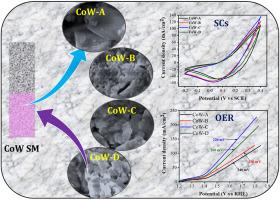
本研究利用连续离子层吸附反应(SILAR)技术成功合成了钨酸钴(CoWO4)在柔性钢网(co - sm)上的微花,并将其应用于水裂解和储能。物理化学表征表明其具有非均匀的微花状(MFs)非晶结构,表明其具有较好的电化学性能。此外,x射线光电子能谱(XPS)分析证实了高纯度cowo4fs的形成。此外,采用N2吸附/解吸法测定了样品的比表面积(SSA),优化后样品的比表面积为35.4 m2/g,平均孔径为3.24 nm。与物理化学分析相反,电化学和电催化研究使用三电极系统进行。结果表明,(CoWO4) co - c电极表现出优异的性能,在电流密度为5 mA/cm2时,最大电容(Cs)达到697 F/g,容量达到87 mAh/g。此外,该co - c电极在1 M KOH下表现出优异的电催化性能,具有低的塔菲尔斜率(94 mV/dec),小的过电位(220 mV), 78 cm2的高电化学活性表面积(ECSA),以及超过5小时的优异耐久性。因此,这些发现突出了合成的CoWO4 MFs在高性能超级电容器和水分解应用方面的巨大潜力。
A steel mesh coated cobalt tungstate microflowers as efficient binder-free electrodes for supercapacitors and oxygen evolution reactions
This research successfully synthesized cobalt tungstate (CoWO4) microflowers on flexible steel mesh (CoW-SM) using the successive ionic layer adsorption and reaction (SILAR) technique for water splitting and energy storage applications. The physicochemical characterization revealed an amorphous structure with a non-uniform, microflower-like (MFs) morphology, which siginifies the better electrochemical performance. Further, X-ray photoelectron spectroscopy (XPS) analysis confirmed the formation of high-purity CoWO4 Fs. Additionally, the specific surface area (SSA) was determined using N2 adsorption/desorption, with the optimized sample exhibiting an SSA of 35.4 m2/g and an average pore diameter of 3.24 nm. In contrast to physiochemical analysis, the electrochemical and electrocatalytic investigations were conducted using a three-electrode system. As a result, the (CoWO4) CoW–C electrode demonstrated exceptional performance, achieving a maximum capacitance (Cs) of 697 F/g and a capacity of 87 mAh/g at a current density of 5 mA/cm2. Furthermore, the CoW–C electrode exhibited superior electrocatalytic properties in 1 M KOH, with a low Tafel slope (94 mV/dec), a small overpotential (220 mV), and a high electrochemically active surface area (ECSA) of 78 cm2, alongside excellent durability over 5 hours. Therefore, these findings highlight the significant potential of the synthesized CoWO4 MFs for high-performance supercapacitors and water-splitting applications.
期刊介绍:
The Journal of Physics and Chemistry of Solids is a well-established international medium for publication of archival research in condensed matter and materials sciences. Areas of interest broadly include experimental and theoretical research on electronic, magnetic, spectroscopic and structural properties as well as the statistical mechanics and thermodynamics of materials. The focus is on gaining physical and chemical insight into the properties and potential applications of condensed matter systems.
Within the broad scope of the journal, beyond regular contributions, the editors have identified submissions in the following areas of physics and chemistry of solids to be of special current interest to the journal:
Low-dimensional systems
Exotic states of quantum electron matter including topological phases
Energy conversion and storage
Interfaces, nanoparticles and catalysts.




 京公网安备 11010802042870号
京ICP备2023020795号-1
京公网安备 11010802042870号
京ICP备2023020795号-1

 分享
分享
 求助内容:
求助内容: 应助结果提醒方式:
 扫码关注我们
