P. Rosaiah , Leelavathi Harikrishnan , Dhanalakshmi Radhalayam , Mohammad Rezaul Karim , S.V. Prabhakar Vattikuti , Nunna Guru Prakash , Tae Jo Ko
{"title":"花状Bi2WO6异质结光催化剂上ZnBi2O4的层次化结构及其去除茜素红的研究","authors":"P. Rosaiah , Leelavathi Harikrishnan , Dhanalakshmi Radhalayam , Mohammad Rezaul Karim , S.V. Prabhakar Vattikuti , Nunna Guru Prakash , Tae Jo Ko","doi":"10.1016/j.surfin.2025.105777","DOIUrl":null,"url":null,"abstract":"<div><div>In this study, we investigated the fabrication and photocatalytic performance of ZnBi<sub>2</sub>O<sub>4</sub>@Bi<sub>2</sub>WO<sub>6</sub> nanocomposites for the degradation of organic pollutants. The nanocomposites were synthesized via a hydrothermal method followed by ultrasonic treatment, resulting in a unique composite structure. X-ray diffraction (XRD) confirmed successful material synthesis, and scanning electron microscopy (SEM) revealed the morphologies of Bi<sub>2</sub>WO<sub>6</sub> nanoflowers and ZnBi<sub>2</sub>O<sub>4</sub> nanocubes, with the composites exhibiting a hybrid network-like structure. UV–visible spectroscopy showed a significant redshift in the optical absorption edge, indicating that ZnBi<sub>2</sub>O<sub>4</sub> incorporation effectively reduced the band gap of the nanocomposite, enhancing its visible light absorption. Photoluminescence (PL) spectroscopy demonstrated that the nanocomposites promoted efficient charge separation and minimized recombination, critical factors for improved photocatalytic performance. Under visible light, the ZnBi<sub>2</sub>O<sub>4</sub>@Bi<sub>2</sub>WO<sub>6</sub> nanocomposites achieved a degradation efficiency of 96.8 % for alizarin red S (ARS), following pseudo-first-order kinetics. The composites also exhibited excellent stability, with only a 6.05 % loss in activity after five degradation cycles, confirming their long-term durability. Trapping experiments identified hydroxyl radicals (<sup>·</sup>OH), holes (h<sup>+</sup>), and electrons (e<sup>–</sup>) as active species in the degradation mechanism. Overall, ZnBi<sub>2</sub>O<sub>4</sub>@Bi<sub>2</sub>WO<sub>6</sub> nanocomposites show strong potential as efficient and stable photocatalysts for removing hazardous organic pollutants from wastewater, offering a sustainable solution for environmental cleanup.</div></div>","PeriodicalId":22081,"journal":{"name":"Surfaces and Interfaces","volume":"58 ","pages":"Article 105777"},"PeriodicalIF":6.0000,"publicationDate":"2025-02-01","publicationTypes":"Journal Article","fieldsOfStudy":null,"isOpenAccess":false,"openAccessPdf":"","citationCount":"0","resultStr":"{\"title\":\"Hierarchical construction of ZnBi2O4 anchored on flower-like Bi2WO6 heterojunction photocatalyst for removal of alizarin red S\",\"authors\":\"P. Rosaiah , Leelavathi Harikrishnan , Dhanalakshmi Radhalayam , Mohammad Rezaul Karim , S.V. Prabhakar Vattikuti , Nunna Guru Prakash , Tae Jo Ko\",\"doi\":\"10.1016/j.surfin.2025.105777\",\"DOIUrl\":null,\"url\":null,\"abstract\":\"<div><div>In this study, we investigated the fabrication and photocatalytic performance of ZnBi<sub>2</sub>O<sub>4</sub>@Bi<sub>2</sub>WO<sub>6</sub> nanocomposites for the degradation of organic pollutants. The nanocomposites were synthesized via a hydrothermal method followed by ultrasonic treatment, resulting in a unique composite structure. X-ray diffraction (XRD) confirmed successful material synthesis, and scanning electron microscopy (SEM) revealed the morphologies of Bi<sub>2</sub>WO<sub>6</sub> nanoflowers and ZnBi<sub>2</sub>O<sub>4</sub> nanocubes, with the composites exhibiting a hybrid network-like structure. UV–visible spectroscopy showed a significant redshift in the optical absorption edge, indicating that ZnBi<sub>2</sub>O<sub>4</sub> incorporation effectively reduced the band gap of the nanocomposite, enhancing its visible light absorption. Photoluminescence (PL) spectroscopy demonstrated that the nanocomposites promoted efficient charge separation and minimized recombination, critical factors for improved photocatalytic performance. Under visible light, the ZnBi<sub>2</sub>O<sub>4</sub>@Bi<sub>2</sub>WO<sub>6</sub> nanocomposites achieved a degradation efficiency of 96.8 % for alizarin red S (ARS), following pseudo-first-order kinetics. The composites also exhibited excellent stability, with only a 6.05 % loss in activity after five degradation cycles, confirming their long-term durability. Trapping experiments identified hydroxyl radicals (<sup>·</sup>OH), holes (h<sup>+</sup>), and electrons (e<sup>–</sup>) as active species in the degradation mechanism. Overall, ZnBi<sub>2</sub>O<sub>4</sub>@Bi<sub>2</sub>WO<sub>6</sub> nanocomposites show strong potential as efficient and stable photocatalysts for removing hazardous organic pollutants from wastewater, offering a sustainable solution for environmental cleanup.</div></div>\",\"PeriodicalId\":22081,\"journal\":{\"name\":\"Surfaces and Interfaces\",\"volume\":\"58 \",\"pages\":\"Article 105777\"},\"PeriodicalIF\":6.0000,\"publicationDate\":\"2025-02-01\",\"publicationTypes\":\"Journal Article\",\"fieldsOfStudy\":null,\"isOpenAccess\":false,\"openAccessPdf\":\"\",\"citationCount\":\"0\",\"resultStr\":null,\"platform\":\"Semanticscholar\",\"paperid\":null,\"PeriodicalName\":\"Surfaces and Interfaces\",\"FirstCategoryId\":\"88\",\"ListUrlMain\":\"https://www.sciencedirect.com/science/article/pii/S2468023025000409\",\"RegionNum\":2,\"RegionCategory\":\"材料科学\",\"ArticlePicture\":[],\"TitleCN\":null,\"AbstractTextCN\":null,\"PMCID\":null,\"EPubDate\":\"2025/1/15 0:00:00\",\"PubModel\":\"Epub\",\"JCR\":\"Q2\",\"JCRName\":\"CHEMISTRY, PHYSICAL\",\"Score\":null,\"Total\":0}","platform":"Semanticscholar","paperid":null,"PeriodicalName":"Surfaces and Interfaces","FirstCategoryId":"88","ListUrlMain":"https://www.sciencedirect.com/science/article/pii/S2468023025000409","RegionNum":2,"RegionCategory":"材料科学","ArticlePicture":[],"TitleCN":null,"AbstractTextCN":null,"PMCID":null,"EPubDate":"2025/1/15 0:00:00","PubModel":"Epub","JCR":"Q2","JCRName":"CHEMISTRY, PHYSICAL","Score":null,"Total":0}
Hierarchical construction of ZnBi2O4 anchored on flower-like Bi2WO6 heterojunction photocatalyst for removal of alizarin red S
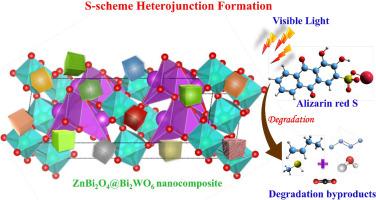
In this study, we investigated the fabrication and photocatalytic performance of ZnBi2O4@Bi2WO6 nanocomposites for the degradation of organic pollutants. The nanocomposites were synthesized via a hydrothermal method followed by ultrasonic treatment, resulting in a unique composite structure. X-ray diffraction (XRD) confirmed successful material synthesis, and scanning electron microscopy (SEM) revealed the morphologies of Bi2WO6 nanoflowers and ZnBi2O4 nanocubes, with the composites exhibiting a hybrid network-like structure. UV–visible spectroscopy showed a significant redshift in the optical absorption edge, indicating that ZnBi2O4 incorporation effectively reduced the band gap of the nanocomposite, enhancing its visible light absorption. Photoluminescence (PL) spectroscopy demonstrated that the nanocomposites promoted efficient charge separation and minimized recombination, critical factors for improved photocatalytic performance. Under visible light, the ZnBi2O4@Bi2WO6 nanocomposites achieved a degradation efficiency of 96.8 % for alizarin red S (ARS), following pseudo-first-order kinetics. The composites also exhibited excellent stability, with only a 6.05 % loss in activity after five degradation cycles, confirming their long-term durability. Trapping experiments identified hydroxyl radicals (·OH), holes (h+), and electrons (e–) as active species in the degradation mechanism. Overall, ZnBi2O4@Bi2WO6 nanocomposites show strong potential as efficient and stable photocatalysts for removing hazardous organic pollutants from wastewater, offering a sustainable solution for environmental cleanup.
期刊介绍:
The aim of the journal is to provide a respectful outlet for ''sound science'' papers in all research areas on surfaces and interfaces. We define sound science papers as papers that describe new and well-executed research, but that do not necessarily provide brand new insights or are merely a description of research results.
Surfaces and Interfaces publishes research papers in all fields of surface science which may not always find the right home on first submission to our Elsevier sister journals (Applied Surface, Surface and Coatings Technology, Thin Solid Films)




 京公网安备 11010802042870号
京ICP备2023020795号-1
京公网安备 11010802042870号
京ICP备2023020795号-1

 分享
分享
 求助内容:
求助内容: 应助结果提醒方式:
 扫码关注我们
