Weiting Sheng , Xiaoyun Bi , Zhaoyan Huang, Liangzhang Tang, Honghan Sun, Zhibo Cao, Can Jiang
{"title":"超灵敏大量程应变传感器用网状聚合物介质化学镀在橡胶表面制备金属微裂纹","authors":"Weiting Sheng , Xiaoyun Bi , Zhaoyan Huang, Liangzhang Tang, Honghan Sun, Zhibo Cao, Can Jiang","doi":"10.1016/j.surfin.2025.105882","DOIUrl":null,"url":null,"abstract":"<div><div>Strain sensors based on crack-sensitive structures have gained attention for their exceptional sensitivity. However, the geometry of the crack structures significantly impacts the balance between sensitivity and strain range, while the controllable formation of such cracks remains a challenge, often leading to performance variations. Herein, we developed an ultrasensitive strain sensor using a mesh-like polymer-mediated electroless plating (MPMEP) strategy to construct controlled nickel microcrack structures on natural rubber (NR). Poly(acrylic acid) brushes grafted via surface-initiated ATRP on NR served as interfacial layers, ensuring consistent crack morphology. The sensor achieved a high gauge factor of 417, a wide strain range of 50 %, and rapid response/recovery times (46/58 ms), with stable performance over 10,000 cycles. Compared to existing technologies, our MPMEP strategy uniquely combines high sensitivity with scalability. Moreover, its robustness and flexibility position it for wearable applications, including real-time human motion monitoring and health management. This work addresses long-standing challenges in crack-based strain sensors, presenting a reproducible and scalable platform for next-generation flexible electronics.</div></div>","PeriodicalId":22081,"journal":{"name":"Surfaces and Interfaces","volume":"58 ","pages":"Article 105882"},"PeriodicalIF":6.3000,"publicationDate":"2025-02-01","publicationTypes":"Journal Article","fieldsOfStudy":null,"isOpenAccess":false,"openAccessPdf":"","citationCount":"0","resultStr":"{\"title\":\"Controllable fabrication of metal microcracks on rubber by mesh-like polymer mediated electroless plating for ultrasensitive and wide-range strain sensors\",\"authors\":\"Weiting Sheng , Xiaoyun Bi , Zhaoyan Huang, Liangzhang Tang, Honghan Sun, Zhibo Cao, Can Jiang\",\"doi\":\"10.1016/j.surfin.2025.105882\",\"DOIUrl\":null,\"url\":null,\"abstract\":\"<div><div>Strain sensors based on crack-sensitive structures have gained attention for their exceptional sensitivity. However, the geometry of the crack structures significantly impacts the balance between sensitivity and strain range, while the controllable formation of such cracks remains a challenge, often leading to performance variations. Herein, we developed an ultrasensitive strain sensor using a mesh-like polymer-mediated electroless plating (MPMEP) strategy to construct controlled nickel microcrack structures on natural rubber (NR). Poly(acrylic acid) brushes grafted via surface-initiated ATRP on NR served as interfacial layers, ensuring consistent crack morphology. The sensor achieved a high gauge factor of 417, a wide strain range of 50 %, and rapid response/recovery times (46/58 ms), with stable performance over 10,000 cycles. Compared to existing technologies, our MPMEP strategy uniquely combines high sensitivity with scalability. Moreover, its robustness and flexibility position it for wearable applications, including real-time human motion monitoring and health management. This work addresses long-standing challenges in crack-based strain sensors, presenting a reproducible and scalable platform for next-generation flexible electronics.</div></div>\",\"PeriodicalId\":22081,\"journal\":{\"name\":\"Surfaces and Interfaces\",\"volume\":\"58 \",\"pages\":\"Article 105882\"},\"PeriodicalIF\":6.3000,\"publicationDate\":\"2025-02-01\",\"publicationTypes\":\"Journal Article\",\"fieldsOfStudy\":null,\"isOpenAccess\":false,\"openAccessPdf\":\"\",\"citationCount\":\"0\",\"resultStr\":null,\"platform\":\"Semanticscholar\",\"paperid\":null,\"PeriodicalName\":\"Surfaces and Interfaces\",\"FirstCategoryId\":\"88\",\"ListUrlMain\":\"https://www.sciencedirect.com/science/article/pii/S2468023025001452\",\"RegionNum\":2,\"RegionCategory\":\"材料科学\",\"ArticlePicture\":[],\"TitleCN\":null,\"AbstractTextCN\":null,\"PMCID\":null,\"EPubDate\":\"2025/1/20 0:00:00\",\"PubModel\":\"Epub\",\"JCR\":\"Q2\",\"JCRName\":\"CHEMISTRY, PHYSICAL\",\"Score\":null,\"Total\":0}","platform":"Semanticscholar","paperid":null,"PeriodicalName":"Surfaces and Interfaces","FirstCategoryId":"88","ListUrlMain":"https://www.sciencedirect.com/science/article/pii/S2468023025001452","RegionNum":2,"RegionCategory":"材料科学","ArticlePicture":[],"TitleCN":null,"AbstractTextCN":null,"PMCID":null,"EPubDate":"2025/1/20 0:00:00","PubModel":"Epub","JCR":"Q2","JCRName":"CHEMISTRY, PHYSICAL","Score":null,"Total":0}
Controllable fabrication of metal microcracks on rubber by mesh-like polymer mediated electroless plating for ultrasensitive and wide-range strain sensors
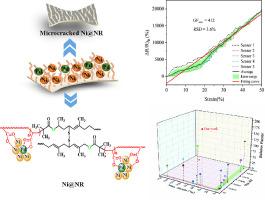
Strain sensors based on crack-sensitive structures have gained attention for their exceptional sensitivity. However, the geometry of the crack structures significantly impacts the balance between sensitivity and strain range, while the controllable formation of such cracks remains a challenge, often leading to performance variations. Herein, we developed an ultrasensitive strain sensor using a mesh-like polymer-mediated electroless plating (MPMEP) strategy to construct controlled nickel microcrack structures on natural rubber (NR). Poly(acrylic acid) brushes grafted via surface-initiated ATRP on NR served as interfacial layers, ensuring consistent crack morphology. The sensor achieved a high gauge factor of 417, a wide strain range of 50 %, and rapid response/recovery times (46/58 ms), with stable performance over 10,000 cycles. Compared to existing technologies, our MPMEP strategy uniquely combines high sensitivity with scalability. Moreover, its robustness and flexibility position it for wearable applications, including real-time human motion monitoring and health management. This work addresses long-standing challenges in crack-based strain sensors, presenting a reproducible and scalable platform for next-generation flexible electronics.
期刊介绍:
The aim of the journal is to provide a respectful outlet for ''sound science'' papers in all research areas on surfaces and interfaces. We define sound science papers as papers that describe new and well-executed research, but that do not necessarily provide brand new insights or are merely a description of research results.
Surfaces and Interfaces publishes research papers in all fields of surface science which may not always find the right home on first submission to our Elsevier sister journals (Applied Surface, Surface and Coatings Technology, Thin Solid Films)




 京公网安备 11010802042870号
京ICP备2023020795号-1
京公网安备 11010802042870号
京ICP备2023020795号-1

 分享
分享
 求助内容:
求助内容: 应助结果提醒方式:
 扫码关注我们
