Xiao Li , Qian Zheng , Honghong Yu , Tingting Du , Tian Hu , Lanyue Gao , Lihong Jia , Qi Sun
{"title":"BMAL1恢复了睡眠剥夺诱导的海马体依赖性识别记忆","authors":"Xiao Li , Qian Zheng , Honghong Yu , Tingting Du , Tian Hu , Lanyue Gao , Lihong Jia , Qi Sun","doi":"10.1016/j.neuroscience.2025.01.067","DOIUrl":null,"url":null,"abstract":"<div><div>Sleep plays an important role in the process of memory. This study investigated the role of the circadian clock gene, BMAL1 of the master circadian clock in mediating the impairment of hippocampus-dependent recognition memory caused by sleep deprivation. After 4 weeks of sleep deprivation, the novel object recognitiontask was used to evaluate the recognition memory of mice, the expression levels of circadian clock genes, and Nrf2 and PKA/CREB/BDNF signal pathways were detected by Western blot, Realtime-qPCR, and immunofluorescence. The mice in the SD group exhibited a significant decrease in the duration of exploration of novel objects. The protein expression levels of PER1, PER2, CLOCK, and BMAL1, and PKA/CREB/BDNF pathway in the hippocampus of the SD group were significantly reduced, and the Nrf2-mediated anti-oxidative capacity was also compromised in the SD group. Moreover, these aberrations could be mitigated through compensation with BMAL1 in the SCN of the hypothalamus. Sleep deprivation resulted in a reduction in the expression of the core clock gene BMAL1 in the hippocampus, leading to an imbalance in the antioxidant system and damaging down-regulating the PKA/CREB/BDNF signal pathway that related to the proteins associated with recognition memory in the hippocampal synapse plasticity and oxidative stress, which could be reversed by overexpression compensation of BMAL1 in the SCN that might rely on the multi-synaptic neural projections to the hippocampus.</div></div>","PeriodicalId":19142,"journal":{"name":"Neuroscience","volume":"569 ","pages":"Pages 1-11"},"PeriodicalIF":2.8000,"publicationDate":"2025-03-17","publicationTypes":"Journal Article","fieldsOfStudy":null,"isOpenAccess":false,"openAccessPdf":"","citationCount":"0","resultStr":"{\"title\":\"BMAL1 rescued the hippocampus-dependent recognition memory induced by sleep deprivation\",\"authors\":\"Xiao Li , Qian Zheng , Honghong Yu , Tingting Du , Tian Hu , Lanyue Gao , Lihong Jia , Qi Sun\",\"doi\":\"10.1016/j.neuroscience.2025.01.067\",\"DOIUrl\":null,\"url\":null,\"abstract\":\"<div><div>Sleep plays an important role in the process of memory. This study investigated the role of the circadian clock gene, BMAL1 of the master circadian clock in mediating the impairment of hippocampus-dependent recognition memory caused by sleep deprivation. After 4 weeks of sleep deprivation, the novel object recognitiontask was used to evaluate the recognition memory of mice, the expression levels of circadian clock genes, and Nrf2 and PKA/CREB/BDNF signal pathways were detected by Western blot, Realtime-qPCR, and immunofluorescence. The mice in the SD group exhibited a significant decrease in the duration of exploration of novel objects. The protein expression levels of PER1, PER2, CLOCK, and BMAL1, and PKA/CREB/BDNF pathway in the hippocampus of the SD group were significantly reduced, and the Nrf2-mediated anti-oxidative capacity was also compromised in the SD group. Moreover, these aberrations could be mitigated through compensation with BMAL1 in the SCN of the hypothalamus. Sleep deprivation resulted in a reduction in the expression of the core clock gene BMAL1 in the hippocampus, leading to an imbalance in the antioxidant system and damaging down-regulating the PKA/CREB/BDNF signal pathway that related to the proteins associated with recognition memory in the hippocampal synapse plasticity and oxidative stress, which could be reversed by overexpression compensation of BMAL1 in the SCN that might rely on the multi-synaptic neural projections to the hippocampus.</div></div>\",\"PeriodicalId\":19142,\"journal\":{\"name\":\"Neuroscience\",\"volume\":\"569 \",\"pages\":\"Pages 1-11\"},\"PeriodicalIF\":2.8000,\"publicationDate\":\"2025-03-17\",\"publicationTypes\":\"Journal Article\",\"fieldsOfStudy\":null,\"isOpenAccess\":false,\"openAccessPdf\":\"\",\"citationCount\":\"0\",\"resultStr\":null,\"platform\":\"Semanticscholar\",\"paperid\":null,\"PeriodicalName\":\"Neuroscience\",\"FirstCategoryId\":\"3\",\"ListUrlMain\":\"https://www.sciencedirect.com/science/article/pii/S0306452225000831\",\"RegionNum\":3,\"RegionCategory\":\"医学\",\"ArticlePicture\":[],\"TitleCN\":null,\"AbstractTextCN\":null,\"PMCID\":null,\"EPubDate\":\"2025/2/2 0:00:00\",\"PubModel\":\"Epub\",\"JCR\":\"Q2\",\"JCRName\":\"NEUROSCIENCES\",\"Score\":null,\"Total\":0}","platform":"Semanticscholar","paperid":null,"PeriodicalName":"Neuroscience","FirstCategoryId":"3","ListUrlMain":"https://www.sciencedirect.com/science/article/pii/S0306452225000831","RegionNum":3,"RegionCategory":"医学","ArticlePicture":[],"TitleCN":null,"AbstractTextCN":null,"PMCID":null,"EPubDate":"2025/2/2 0:00:00","PubModel":"Epub","JCR":"Q2","JCRName":"NEUROSCIENCES","Score":null,"Total":0}
BMAL1 rescued the hippocampus-dependent recognition memory induced by sleep deprivation
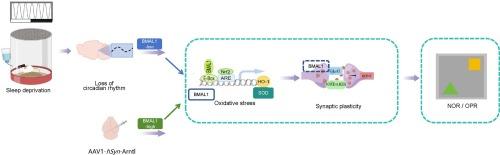
Sleep plays an important role in the process of memory. This study investigated the role of the circadian clock gene, BMAL1 of the master circadian clock in mediating the impairment of hippocampus-dependent recognition memory caused by sleep deprivation. After 4 weeks of sleep deprivation, the novel object recognitiontask was used to evaluate the recognition memory of mice, the expression levels of circadian clock genes, and Nrf2 and PKA/CREB/BDNF signal pathways were detected by Western blot, Realtime-qPCR, and immunofluorescence. The mice in the SD group exhibited a significant decrease in the duration of exploration of novel objects. The protein expression levels of PER1, PER2, CLOCK, and BMAL1, and PKA/CREB/BDNF pathway in the hippocampus of the SD group were significantly reduced, and the Nrf2-mediated anti-oxidative capacity was also compromised in the SD group. Moreover, these aberrations could be mitigated through compensation with BMAL1 in the SCN of the hypothalamus. Sleep deprivation resulted in a reduction in the expression of the core clock gene BMAL1 in the hippocampus, leading to an imbalance in the antioxidant system and damaging down-regulating the PKA/CREB/BDNF signal pathway that related to the proteins associated with recognition memory in the hippocampal synapse plasticity and oxidative stress, which could be reversed by overexpression compensation of BMAL1 in the SCN that might rely on the multi-synaptic neural projections to the hippocampus.
期刊介绍:
Neuroscience publishes papers describing the results of original research on any aspect of the scientific study of the nervous system. Any paper, however short, will be considered for publication provided that it reports significant, new and carefully confirmed findings with full experimental details.




 京公网安备 11010802042870号
京ICP备2023020795号-1
京公网安备 11010802042870号
京ICP备2023020795号-1

 分享
分享
 求助内容:
求助内容: 应助结果提醒方式:
 扫码关注我们
