Xueqi Cheng;Yuanzheng Wang;Yixing Fan;Jiafeng Guo;Ruqing Zhang;Keping Bi
{"title":"GSM-EL:用于实体链接的可推广的符号操作方法","authors":"Xueqi Cheng;Yuanzheng Wang;Yixing Fan;Jiafeng Guo;Ruqing Zhang;Keping Bi","doi":"10.1109/TKDE.2024.3523399","DOIUrl":null,"url":null,"abstract":"Entity linking (EL) is a challenging task as it typically requires matching an ambiguous entity mention with its corresponding entity in a knowledge base (KB). The mainstream studies focus on learning and evaluating linking models on the same corpus and obtained significant performance achievement, however, they often overlook the generalization ability to out-of-domain corpus, which is more realistic yet much more challenging. To address this issue, we introduce a novel neural-symbolic model for entity linking, which is inspired by the symbol-manipulation mechanism in human brains. Specifically, we abstract diverse features into unified variables, then combine them using neural operators to capture diverse relevance requirements, and finally aggregate relevance scores through voting. We conduct experiments on eleven benchmark datasets with different types of text, and the results show that our method outperforms nearly all baselines. Notably, the best performance of our method on seven out-of-domain datasets highlights its generalization ability.","PeriodicalId":13496,"journal":{"name":"IEEE Transactions on Knowledge and Data Engineering","volume":"37 3","pages":"1213-1226"},"PeriodicalIF":10.4000,"publicationDate":"2024-12-27","publicationTypes":"Journal Article","fieldsOfStudy":null,"isOpenAccess":false,"openAccessPdf":"","citationCount":"0","resultStr":"{\"title\":\"GSM-EL: A Generalizable Symbol-Manipulation Approach for Entity Linking\",\"authors\":\"Xueqi Cheng;Yuanzheng Wang;Yixing Fan;Jiafeng Guo;Ruqing Zhang;Keping Bi\",\"doi\":\"10.1109/TKDE.2024.3523399\",\"DOIUrl\":null,\"url\":null,\"abstract\":\"Entity linking (EL) is a challenging task as it typically requires matching an ambiguous entity mention with its corresponding entity in a knowledge base (KB). The mainstream studies focus on learning and evaluating linking models on the same corpus and obtained significant performance achievement, however, they often overlook the generalization ability to out-of-domain corpus, which is more realistic yet much more challenging. To address this issue, we introduce a novel neural-symbolic model for entity linking, which is inspired by the symbol-manipulation mechanism in human brains. Specifically, we abstract diverse features into unified variables, then combine them using neural operators to capture diverse relevance requirements, and finally aggregate relevance scores through voting. We conduct experiments on eleven benchmark datasets with different types of text, and the results show that our method outperforms nearly all baselines. Notably, the best performance of our method on seven out-of-domain datasets highlights its generalization ability.\",\"PeriodicalId\":13496,\"journal\":{\"name\":\"IEEE Transactions on Knowledge and Data Engineering\",\"volume\":\"37 3\",\"pages\":\"1213-1226\"},\"PeriodicalIF\":10.4000,\"publicationDate\":\"2024-12-27\",\"publicationTypes\":\"Journal Article\",\"fieldsOfStudy\":null,\"isOpenAccess\":false,\"openAccessPdf\":\"\",\"citationCount\":\"0\",\"resultStr\":null,\"platform\":\"Semanticscholar\",\"paperid\":null,\"PeriodicalName\":\"IEEE Transactions on Knowledge and Data Engineering\",\"FirstCategoryId\":\"94\",\"ListUrlMain\":\"https://ieeexplore.ieee.org/document/10817094/\",\"RegionNum\":2,\"RegionCategory\":\"计算机科学\",\"ArticlePicture\":[],\"TitleCN\":null,\"AbstractTextCN\":null,\"PMCID\":null,\"EPubDate\":\"\",\"PubModel\":\"\",\"JCR\":\"Q1\",\"JCRName\":\"COMPUTER SCIENCE, ARTIFICIAL INTELLIGENCE\",\"Score\":null,\"Total\":0}","platform":"Semanticscholar","paperid":null,"PeriodicalName":"IEEE Transactions on Knowledge and Data Engineering","FirstCategoryId":"94","ListUrlMain":"https://ieeexplore.ieee.org/document/10817094/","RegionNum":2,"RegionCategory":"计算机科学","ArticlePicture":[],"TitleCN":null,"AbstractTextCN":null,"PMCID":null,"EPubDate":"","PubModel":"","JCR":"Q1","JCRName":"COMPUTER SCIENCE, ARTIFICIAL INTELLIGENCE","Score":null,"Total":0}
GSM-EL: A Generalizable Symbol-Manipulation Approach for Entity Linking
Entity linking (EL) is a challenging task as it typically requires matching an ambiguous entity mention with its corresponding entity in a knowledge base (KB). The mainstream studies focus on learning and evaluating linking models on the same corpus and obtained significant performance achievement, however, they often overlook the generalization ability to out-of-domain corpus, which is more realistic yet much more challenging. To address this issue, we introduce a novel neural-symbolic model for entity linking, which is inspired by the symbol-manipulation mechanism in human brains. Specifically, we abstract diverse features into unified variables, then combine them using neural operators to capture diverse relevance requirements, and finally aggregate relevance scores through voting. We conduct experiments on eleven benchmark datasets with different types of text, and the results show that our method outperforms nearly all baselines. Notably, the best performance of our method on seven out-of-domain datasets highlights its generalization ability.
期刊介绍:
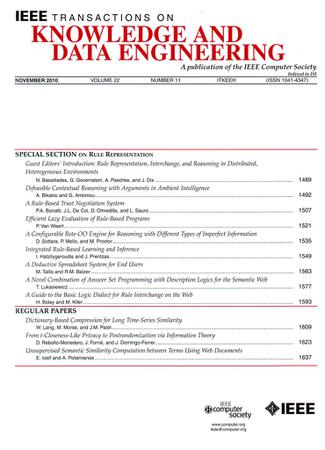
The IEEE Transactions on Knowledge and Data Engineering encompasses knowledge and data engineering aspects within computer science, artificial intelligence, electrical engineering, computer engineering, and related fields. It provides an interdisciplinary platform for disseminating new developments in knowledge and data engineering and explores the practicality of these concepts in both hardware and software. Specific areas covered include knowledge-based and expert systems, AI techniques for knowledge and data management, tools, and methodologies, distributed processing, real-time systems, architectures, data management practices, database design, query languages, security, fault tolerance, statistical databases, algorithms, performance evaluation, and applications.




 京公网安备 11010802042870号
京ICP备2023020795号-1
京公网安备 11010802042870号
京ICP备2023020795号-1

 分享
分享
 求助内容:
求助内容: 应助结果提醒方式:
 扫码关注我们
