Xuan Rao;Renhe Jiang;Shuo Shang;Lisi Chen;Peng Han;Bin Yao;Panos Kalnis
{"title":"基于自适应图对比学习的下一个兴趣点推荐","authors":"Xuan Rao;Renhe Jiang;Shuo Shang;Lisi Chen;Peng Han;Bin Yao;Panos Kalnis","doi":"10.1109/TKDE.2024.3509480","DOIUrl":null,"url":null,"abstract":"<italic>Next point-of-interest (POI) recommendation</i> predicts user’s next movement and facilitates location-based applications such as destination suggestion and travel planning. State-of-the-art (SOTA) methods learn an adaptive graph from user trajectories and compute POI representations using graph neural networks (GNNs). However, a single graph cannot capture the <italic>diverse dependencies</i> among the POIs (e.g., geographical proximity and transition frequency). To tackle this limitation, we propose the <underline><i>A</i></u><italic>daptive</i> <underline><i>G</i></u><italic>raph</i> <underline><i>C</i></u><italic>ontrastive</i> <underline><i>L</i></u><italic>earning</i> (<italic>AGCL</i>) framework. AGCL constructs multiple adaptive graphs, each modeling a kind of POI dependency and producing one POI representation; and the POI representations from different graphs are merged into a <italic>multi-facet representation</i> that encodes comprehensive information. To train the POI representations, we tailor a <italic>graph-based contrastive learning</i>, which encourages the representations of similar POIs to align and dissimilar POIs to differentiate. Moreover, to learn the sequential regularities of user trajectories, we design an attention mechanism to integrate spatial-temporal information into the POI representations. An explicit <italic>spatial-temporal bias</i> is also employed to adjust the predictions for enhanced accuracy. We compare AGCL with 10 state-of-the-art baselines on 3 datasets. The results show that AGCL outperforms all baselines and achieves an improvement of 10.14% over the best performing baseline in average accuracy.","PeriodicalId":13496,"journal":{"name":"IEEE Transactions on Knowledge and Data Engineering","volume":"37 3","pages":"1366-1379"},"PeriodicalIF":10.4000,"publicationDate":"2024-11-29","publicationTypes":"Journal Article","fieldsOfStudy":null,"isOpenAccess":false,"openAccessPdf":"","citationCount":"0","resultStr":"{\"title\":\"Next Point-of-Interest Recommendation With Adaptive Graph Contrastive Learning\",\"authors\":\"Xuan Rao;Renhe Jiang;Shuo Shang;Lisi Chen;Peng Han;Bin Yao;Panos Kalnis\",\"doi\":\"10.1109/TKDE.2024.3509480\",\"DOIUrl\":null,\"url\":null,\"abstract\":\"<italic>Next point-of-interest (POI) recommendation</i> predicts user’s next movement and facilitates location-based applications such as destination suggestion and travel planning. State-of-the-art (SOTA) methods learn an adaptive graph from user trajectories and compute POI representations using graph neural networks (GNNs). However, a single graph cannot capture the <italic>diverse dependencies</i> among the POIs (e.g., geographical proximity and transition frequency). To tackle this limitation, we propose the <underline><i>A</i></u><italic>daptive</i> <underline><i>G</i></u><italic>raph</i> <underline><i>C</i></u><italic>ontrastive</i> <underline><i>L</i></u><italic>earning</i> (<italic>AGCL</i>) framework. AGCL constructs multiple adaptive graphs, each modeling a kind of POI dependency and producing one POI representation; and the POI representations from different graphs are merged into a <italic>multi-facet representation</i> that encodes comprehensive information. To train the POI representations, we tailor a <italic>graph-based contrastive learning</i>, which encourages the representations of similar POIs to align and dissimilar POIs to differentiate. Moreover, to learn the sequential regularities of user trajectories, we design an attention mechanism to integrate spatial-temporal information into the POI representations. An explicit <italic>spatial-temporal bias</i> is also employed to adjust the predictions for enhanced accuracy. We compare AGCL with 10 state-of-the-art baselines on 3 datasets. The results show that AGCL outperforms all baselines and achieves an improvement of 10.14% over the best performing baseline in average accuracy.\",\"PeriodicalId\":13496,\"journal\":{\"name\":\"IEEE Transactions on Knowledge and Data Engineering\",\"volume\":\"37 3\",\"pages\":\"1366-1379\"},\"PeriodicalIF\":10.4000,\"publicationDate\":\"2024-11-29\",\"publicationTypes\":\"Journal Article\",\"fieldsOfStudy\":null,\"isOpenAccess\":false,\"openAccessPdf\":\"\",\"citationCount\":\"0\",\"resultStr\":null,\"platform\":\"Semanticscholar\",\"paperid\":null,\"PeriodicalName\":\"IEEE Transactions on Knowledge and Data Engineering\",\"FirstCategoryId\":\"94\",\"ListUrlMain\":\"https://ieeexplore.ieee.org/document/10772008/\",\"RegionNum\":2,\"RegionCategory\":\"计算机科学\",\"ArticlePicture\":[],\"TitleCN\":null,\"AbstractTextCN\":null,\"PMCID\":null,\"EPubDate\":\"\",\"PubModel\":\"\",\"JCR\":\"Q1\",\"JCRName\":\"COMPUTER SCIENCE, ARTIFICIAL INTELLIGENCE\",\"Score\":null,\"Total\":0}","platform":"Semanticscholar","paperid":null,"PeriodicalName":"IEEE Transactions on Knowledge and Data Engineering","FirstCategoryId":"94","ListUrlMain":"https://ieeexplore.ieee.org/document/10772008/","RegionNum":2,"RegionCategory":"计算机科学","ArticlePicture":[],"TitleCN":null,"AbstractTextCN":null,"PMCID":null,"EPubDate":"","PubModel":"","JCR":"Q1","JCRName":"COMPUTER SCIENCE, ARTIFICIAL INTELLIGENCE","Score":null,"Total":0}
Next Point-of-Interest Recommendation With Adaptive Graph Contrastive Learning
Next point-of-interest (POI) recommendation predicts user’s next movement and facilitates location-based applications such as destination suggestion and travel planning. State-of-the-art (SOTA) methods learn an adaptive graph from user trajectories and compute POI representations using graph neural networks (GNNs). However, a single graph cannot capture the diverse dependencies among the POIs (e.g., geographical proximity and transition frequency). To tackle this limitation, we propose the Adaptive Graph Contrastive Learning (AGCL) framework. AGCL constructs multiple adaptive graphs, each modeling a kind of POI dependency and producing one POI representation; and the POI representations from different graphs are merged into a multi-facet representation that encodes comprehensive information. To train the POI representations, we tailor a graph-based contrastive learning, which encourages the representations of similar POIs to align and dissimilar POIs to differentiate. Moreover, to learn the sequential regularities of user trajectories, we design an attention mechanism to integrate spatial-temporal information into the POI representations. An explicit spatial-temporal bias is also employed to adjust the predictions for enhanced accuracy. We compare AGCL with 10 state-of-the-art baselines on 3 datasets. The results show that AGCL outperforms all baselines and achieves an improvement of 10.14% over the best performing baseline in average accuracy.
期刊介绍:
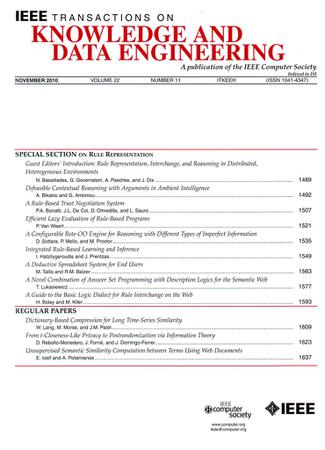
The IEEE Transactions on Knowledge and Data Engineering encompasses knowledge and data engineering aspects within computer science, artificial intelligence, electrical engineering, computer engineering, and related fields. It provides an interdisciplinary platform for disseminating new developments in knowledge and data engineering and explores the practicality of these concepts in both hardware and software. Specific areas covered include knowledge-based and expert systems, AI techniques for knowledge and data management, tools, and methodologies, distributed processing, real-time systems, architectures, data management practices, database design, query languages, security, fault tolerance, statistical databases, algorithms, performance evaluation, and applications.




 京公网安备 11010802042870号
京ICP备2023020795号-1
京公网安备 11010802042870号
京ICP备2023020795号-1

 分享
分享
 求助内容:
求助内容: 应助结果提醒方式:
 扫码关注我们
