Xiaosha Wang , Qiaohui Zhang , Yu Guo , Shihui Zeng , Qingqing Xuan , Qiuling Song
{"title":"镍催化的B2(OH)4/H2O体系中腈胺的转移氢化交叉偶联","authors":"Xiaosha Wang , Qiaohui Zhang , Yu Guo , Shihui Zeng , Qingqing Xuan , Qiuling Song","doi":"10.1039/d4gc05928j","DOIUrl":null,"url":null,"abstract":"<div><div>H<sub>2</sub>O, which is the most environmentally benign solvent and exists widely in nature, usually provides hydrogen as a proton source. However, we found that H<sub>2</sub>O could serve as a hydride provider in the presence of B<sub>2</sub>(OH)<sub>4</sub>; thus, it can offer an expedient and efficient method for the synthesis of deuterated compounds, as D<sub>2</sub>O is the cheapest and most readily available deuterium source. Herein, we describe the application of a B<sub>2</sub>(OH)<sub>4</sub>/H<sub>2</sub>O system in Ni-catalyzed transfer hydrogenative cross-coupling reactions of nitriles with amines. Under this catalytic system, various interesting secondary amines and 2,3-dihydro-1<em>H</em>-perimidines could be obtained <em>via</em> intermolecular reactions. Moreover, indoles, which are crucial building blocks in pharmaceuticals, natural products and bioactive molecules, could also be obtained <em>via</em> intramolecular reactions with 2-(2-aminoaryl)acetonitriles as substrates.</div></div>","PeriodicalId":78,"journal":{"name":"Green Chemistry","volume":"27 5","pages":"Pages 1365-1373"},"PeriodicalIF":9.2000,"publicationDate":"2025-01-07","publicationTypes":"Journal Article","fieldsOfStudy":null,"isOpenAccess":false,"openAccessPdf":"","citationCount":"0","resultStr":"{\"title\":\"Nickel-catalyzed transfer hydrogenative cross-coupling of nitriles and amines with B2(OH)4/H2O system†\",\"authors\":\"Xiaosha Wang , Qiaohui Zhang , Yu Guo , Shihui Zeng , Qingqing Xuan , Qiuling Song\",\"doi\":\"10.1039/d4gc05928j\",\"DOIUrl\":null,\"url\":null,\"abstract\":\"<div><div>H<sub>2</sub>O, which is the most environmentally benign solvent and exists widely in nature, usually provides hydrogen as a proton source. However, we found that H<sub>2</sub>O could serve as a hydride provider in the presence of B<sub>2</sub>(OH)<sub>4</sub>; thus, it can offer an expedient and efficient method for the synthesis of deuterated compounds, as D<sub>2</sub>O is the cheapest and most readily available deuterium source. Herein, we describe the application of a B<sub>2</sub>(OH)<sub>4</sub>/H<sub>2</sub>O system in Ni-catalyzed transfer hydrogenative cross-coupling reactions of nitriles with amines. Under this catalytic system, various interesting secondary amines and 2,3-dihydro-1<em>H</em>-perimidines could be obtained <em>via</em> intermolecular reactions. Moreover, indoles, which are crucial building blocks in pharmaceuticals, natural products and bioactive molecules, could also be obtained <em>via</em> intramolecular reactions with 2-(2-aminoaryl)acetonitriles as substrates.</div></div>\",\"PeriodicalId\":78,\"journal\":{\"name\":\"Green Chemistry\",\"volume\":\"27 5\",\"pages\":\"Pages 1365-1373\"},\"PeriodicalIF\":9.2000,\"publicationDate\":\"2025-01-07\",\"publicationTypes\":\"Journal Article\",\"fieldsOfStudy\":null,\"isOpenAccess\":false,\"openAccessPdf\":\"\",\"citationCount\":\"0\",\"resultStr\":null,\"platform\":\"Semanticscholar\",\"paperid\":null,\"PeriodicalName\":\"Green Chemistry\",\"FirstCategoryId\":\"92\",\"ListUrlMain\":\"https://www.sciencedirect.com/org/science/article/pii/S1463926224010094\",\"RegionNum\":1,\"RegionCategory\":\"化学\",\"ArticlePicture\":[],\"TitleCN\":null,\"AbstractTextCN\":null,\"PMCID\":null,\"EPubDate\":\"2024/12/30 0:00:00\",\"PubModel\":\"Epub\",\"JCR\":\"Q1\",\"JCRName\":\"CHEMISTRY, MULTIDISCIPLINARY\",\"Score\":null,\"Total\":0}","platform":"Semanticscholar","paperid":null,"PeriodicalName":"Green Chemistry","FirstCategoryId":"92","ListUrlMain":"https://www.sciencedirect.com/org/science/article/pii/S1463926224010094","RegionNum":1,"RegionCategory":"化学","ArticlePicture":[],"TitleCN":null,"AbstractTextCN":null,"PMCID":null,"EPubDate":"2024/12/30 0:00:00","PubModel":"Epub","JCR":"Q1","JCRName":"CHEMISTRY, MULTIDISCIPLINARY","Score":null,"Total":0}
Nickel-catalyzed transfer hydrogenative cross-coupling of nitriles and amines with B2(OH)4/H2O system†
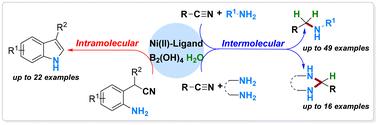
H2O, which is the most environmentally benign solvent and exists widely in nature, usually provides hydrogen as a proton source. However, we found that H2O could serve as a hydride provider in the presence of B2(OH)4; thus, it can offer an expedient and efficient method for the synthesis of deuterated compounds, as D2O is the cheapest and most readily available deuterium source. Herein, we describe the application of a B2(OH)4/H2O system in Ni-catalyzed transfer hydrogenative cross-coupling reactions of nitriles with amines. Under this catalytic system, various interesting secondary amines and 2,3-dihydro-1H-perimidines could be obtained via intermolecular reactions. Moreover, indoles, which are crucial building blocks in pharmaceuticals, natural products and bioactive molecules, could also be obtained via intramolecular reactions with 2-(2-aminoaryl)acetonitriles as substrates.
期刊介绍:
Green Chemistry is a journal that provides a unique forum for the publication of innovative research on the development of alternative green and sustainable technologies. The scope of Green Chemistry is based on the definition proposed by Anastas and Warner (Green Chemistry: Theory and Practice, P T Anastas and J C Warner, Oxford University Press, Oxford, 1998), which defines green chemistry as the utilisation of a set of principles that reduces or eliminates the use or generation of hazardous substances in the design, manufacture and application of chemical products. Green Chemistry aims to reduce the environmental impact of the chemical enterprise by developing a technology base that is inherently non-toxic to living things and the environment. The journal welcomes submissions on all aspects of research relating to this endeavor and publishes original and significant cutting-edge research that is likely to be of wide general appeal. For a work to be published, it must present a significant advance in green chemistry, including a comparison with existing methods and a demonstration of advantages over those methods.




 京公网安备 11010802042870号
京ICP备2023020795号-1
京公网安备 11010802042870号
京ICP备2023020795号-1

 分享
分享
 求助内容:
求助内容: 应助结果提醒方式:
 扫码关注我们
