{"title":"lcl - kcl熔体电化学测量用Am和Cm模拟剂的确定和选择","authors":"A. A. Filatov, Yu. P. Zaikov","doi":"10.1134/S0036029524701659","DOIUrl":null,"url":null,"abstract":"<p><b>Abstract</b>—Spent nuclear fuel (SNF) processing is strongly difficult because of high radioactivity of its actinides including the most active americium and curium. Primary experiments on their extraction using nonradioactive imitators are preferable, but the choice of them is impeded by a necessity to obey a broad range of physicochemical properties with imitated elements. In this work, the choice is substantiated and the most appropriate imitators are proposed on the basis of literature data to study the separation of americium and curium in chloride melts. Europium and gadolinium can serve as imitators for chemical processes in the molten LiCl–KCl eutectic, but a high difference of potentials of americium and curium does not allow their use for studying the electrochemical kinetics. The arbitrary potentials and electroreduction kinetics of a series of metals (Mg, Sc, Sr, Ba, Pr, Nd, Ce, Eu, and Gd) in the chloride melts at various temperatures are analyzed. A high convergence of the reduction potentials of magnesium and scandium with those of the imitated elements assumes their application as electrochemical imitators for studying separately americium and curium (without their simultaneous presence in the solution). In spite of the resembling reduction potentials, the combined use of the Mg/Sc pair for the study of this process seems doubtful, since the electrochemical kinetics of these elements differs strongly from the kinetics of the target actinides. The Nd/Ce pair can serve as a more suitable pair for the combined study of the electrochemical kinetics of americium and curium due to the high affinity of both chemical and electrochemical properties to the imitated elements. A comparison of the electrochemical kinetics of cerium and curium reduction in the chloride melts shows that both elements exist in the melt in the oxidation state 3+ and are reduced in one step. In turn, both neodymium and americium are reduced in two steps, and the transition from the oxidation state 3+ to 2+ begins for both elements in a potential range of –1.5 V versus the silver chloride reference electrode.</p>","PeriodicalId":769,"journal":{"name":"Russian Metallurgy (Metally)","volume":"2024 4","pages":"841 - 845"},"PeriodicalIF":0.3000,"publicationDate":"2025-01-23","publicationTypes":"Journal Article","fieldsOfStudy":null,"isOpenAccess":false,"openAccessPdf":"","citationCount":"0","resultStr":"{\"title\":\"Substantiation and Choice of Am and Cm Imitators for Electrochemical Measurements in a LiCl–KCl Melt\",\"authors\":\"A. A. Filatov, Yu. P. Zaikov\",\"doi\":\"10.1134/S0036029524701659\",\"DOIUrl\":null,\"url\":null,\"abstract\":\"<p><b>Abstract</b>—Spent nuclear fuel (SNF) processing is strongly difficult because of high radioactivity of its actinides including the most active americium and curium. Primary experiments on their extraction using nonradioactive imitators are preferable, but the choice of them is impeded by a necessity to obey a broad range of physicochemical properties with imitated elements. In this work, the choice is substantiated and the most appropriate imitators are proposed on the basis of literature data to study the separation of americium and curium in chloride melts. Europium and gadolinium can serve as imitators for chemical processes in the molten LiCl–KCl eutectic, but a high difference of potentials of americium and curium does not allow their use for studying the electrochemical kinetics. The arbitrary potentials and electroreduction kinetics of a series of metals (Mg, Sc, Sr, Ba, Pr, Nd, Ce, Eu, and Gd) in the chloride melts at various temperatures are analyzed. A high convergence of the reduction potentials of magnesium and scandium with those of the imitated elements assumes their application as electrochemical imitators for studying separately americium and curium (without their simultaneous presence in the solution). In spite of the resembling reduction potentials, the combined use of the Mg/Sc pair for the study of this process seems doubtful, since the electrochemical kinetics of these elements differs strongly from the kinetics of the target actinides. The Nd/Ce pair can serve as a more suitable pair for the combined study of the electrochemical kinetics of americium and curium due to the high affinity of both chemical and electrochemical properties to the imitated elements. A comparison of the electrochemical kinetics of cerium and curium reduction in the chloride melts shows that both elements exist in the melt in the oxidation state 3+ and are reduced in one step. In turn, both neodymium and americium are reduced in two steps, and the transition from the oxidation state 3+ to 2+ begins for both elements in a potential range of –1.5 V versus the silver chloride reference electrode.</p>\",\"PeriodicalId\":769,\"journal\":{\"name\":\"Russian Metallurgy (Metally)\",\"volume\":\"2024 4\",\"pages\":\"841 - 845\"},\"PeriodicalIF\":0.3000,\"publicationDate\":\"2025-01-23\",\"publicationTypes\":\"Journal Article\",\"fieldsOfStudy\":null,\"isOpenAccess\":false,\"openAccessPdf\":\"\",\"citationCount\":\"0\",\"resultStr\":null,\"platform\":\"Semanticscholar\",\"paperid\":null,\"PeriodicalName\":\"Russian Metallurgy (Metally)\",\"FirstCategoryId\":\"5\",\"ListUrlMain\":\"https://link.springer.com/article/10.1134/S0036029524701659\",\"RegionNum\":0,\"RegionCategory\":null,\"ArticlePicture\":[],\"TitleCN\":null,\"AbstractTextCN\":null,\"PMCID\":null,\"EPubDate\":\"\",\"PubModel\":\"\",\"JCR\":\"Q4\",\"JCRName\":\"METALLURGY & METALLURGICAL ENGINEERING\",\"Score\":null,\"Total\":0}","platform":"Semanticscholar","paperid":null,"PeriodicalName":"Russian Metallurgy (Metally)","FirstCategoryId":"5","ListUrlMain":"https://link.springer.com/article/10.1134/S0036029524701659","RegionNum":0,"RegionCategory":null,"ArticlePicture":[],"TitleCN":null,"AbstractTextCN":null,"PMCID":null,"EPubDate":"","PubModel":"","JCR":"Q4","JCRName":"METALLURGY & METALLURGICAL ENGINEERING","Score":null,"Total":0}
Substantiation and Choice of Am and Cm Imitators for Electrochemical Measurements in a LiCl–KCl Melt
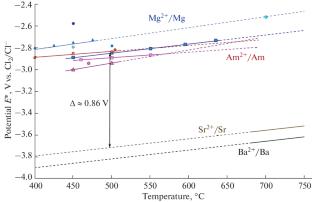
Abstract—Spent nuclear fuel (SNF) processing is strongly difficult because of high radioactivity of its actinides including the most active americium and curium. Primary experiments on their extraction using nonradioactive imitators are preferable, but the choice of them is impeded by a necessity to obey a broad range of physicochemical properties with imitated elements. In this work, the choice is substantiated and the most appropriate imitators are proposed on the basis of literature data to study the separation of americium and curium in chloride melts. Europium and gadolinium can serve as imitators for chemical processes in the molten LiCl–KCl eutectic, but a high difference of potentials of americium and curium does not allow their use for studying the electrochemical kinetics. The arbitrary potentials and electroreduction kinetics of a series of metals (Mg, Sc, Sr, Ba, Pr, Nd, Ce, Eu, and Gd) in the chloride melts at various temperatures are analyzed. A high convergence of the reduction potentials of magnesium and scandium with those of the imitated elements assumes their application as electrochemical imitators for studying separately americium and curium (without their simultaneous presence in the solution). In spite of the resembling reduction potentials, the combined use of the Mg/Sc pair for the study of this process seems doubtful, since the electrochemical kinetics of these elements differs strongly from the kinetics of the target actinides. The Nd/Ce pair can serve as a more suitable pair for the combined study of the electrochemical kinetics of americium and curium due to the high affinity of both chemical and electrochemical properties to the imitated elements. A comparison of the electrochemical kinetics of cerium and curium reduction in the chloride melts shows that both elements exist in the melt in the oxidation state 3+ and are reduced in one step. In turn, both neodymium and americium are reduced in two steps, and the transition from the oxidation state 3+ to 2+ begins for both elements in a potential range of –1.5 V versus the silver chloride reference electrode.
期刊介绍:
Russian Metallurgy (Metally) publishes results of original experimental and theoretical research in the form of reviews and regular articles devoted to topical problems of metallurgy, physical metallurgy, and treatment of ferrous, nonferrous, rare, and other metals and alloys, intermetallic compounds, and metallic composite materials. The journal focuses on physicochemical properties of metallurgical materials (ores, slags, matters, and melts of metals and alloys); physicochemical processes (thermodynamics and kinetics of pyrometallurgical, hydrometallurgical, electrochemical, and other processes); theoretical metallurgy; metal forming; thermoplastic and thermochemical treatment; computation and experimental determination of phase diagrams and thermokinetic diagrams; mechanisms and kinetics of phase transitions in metallic materials; relations between the chemical composition, phase and structural states of materials and their physicochemical and service properties; interaction between metallic materials and external media; and effects of radiation on these materials.




 京公网安备 11010802042870号
京ICP备2023020795号-1
京公网安备 11010802042870号
京ICP备2023020795号-1

 分享
分享
 求助内容:
求助内容: 应助结果提醒方式:
 扫码关注我们
