{"title":"5-氟尿嘧啶控释ipn的制备与表征:在伤口敷料中的应用前景评价","authors":"Gulay Bayramoglu, Alican Yuksel, M. Yakup Arica","doi":"10.1007/s10924-024-03439-7","DOIUrl":null,"url":null,"abstract":"<div><p>A series of interpenetrating polymer networks (IPNs) were prepared in the film form using 2-hydroxypropyl methacrylate (HPMA) polyethylene glycol methacrylate (PEG-MA) and hydroxypropyl-chitosan (HPCH) for controlled release of 5-fluorouracil (5-FU). The prepared IPNs formulations have been characterized using Fourier transform infrared (FTIR) spectroscopy, scanning electron microscopy (SEM), swelling, and contact angle studies. In addition, the platelet adhesion, red blood cell hemolysis, and permeability to 5-FU were also studied with prepared IPNs films. The prepared p(HPMA-co-PEG–MA/HPCH)-1-6 IPNs films were loaded with different amounts of 5-FU and the drug release was studied in a continuous release system. The drug 5-FU has four amine and oxygen groups, and these functional groups interact via hydrogen bonding interaction with PEG-MA and HPCH units of the IPNs, thus, the drug was slowly released. The amount of 5-FU release from the p(HPMA-co-PEG–MA/HPCH) networks increased when the ratio of HPMA decreased or HPCH increased. The antitumor activity of 5-FU released from the prepared IPNs and remaining biological activity was measured using a human hepatocellular carcinoma cell line (SNU398). In vitro studies showed that the tested IPNs formulations were effective for the growth of the SNU398 human hepatocellular carcinoma cells. These experimental results showed that the prepared IPN films exhibited suitable physio-chemical, biocompatibility, and desired drug release profiles, thus, they could be used in various biomedical applications such as wound dressing for skin treatment.</p></div>","PeriodicalId":659,"journal":{"name":"Journal of Polymers and the Environment","volume":"33 2","pages":"698 - 716"},"PeriodicalIF":5.0000,"publicationDate":"2024-10-24","publicationTypes":"Journal Article","fieldsOfStudy":null,"isOpenAccess":false,"openAccessPdf":"","citationCount":"0","resultStr":"{\"title\":\"Preparation and Characterization of IPNs for Controlled Release of 5-Fluorouracil: Evaluation of Possible Use in Wound Dressing\",\"authors\":\"Gulay Bayramoglu, Alican Yuksel, M. Yakup Arica\",\"doi\":\"10.1007/s10924-024-03439-7\",\"DOIUrl\":null,\"url\":null,\"abstract\":\"<div><p>A series of interpenetrating polymer networks (IPNs) were prepared in the film form using 2-hydroxypropyl methacrylate (HPMA) polyethylene glycol methacrylate (PEG-MA) and hydroxypropyl-chitosan (HPCH) for controlled release of 5-fluorouracil (5-FU). The prepared IPNs formulations have been characterized using Fourier transform infrared (FTIR) spectroscopy, scanning electron microscopy (SEM), swelling, and contact angle studies. In addition, the platelet adhesion, red blood cell hemolysis, and permeability to 5-FU were also studied with prepared IPNs films. The prepared p(HPMA-co-PEG–MA/HPCH)-1-6 IPNs films were loaded with different amounts of 5-FU and the drug release was studied in a continuous release system. The drug 5-FU has four amine and oxygen groups, and these functional groups interact via hydrogen bonding interaction with PEG-MA and HPCH units of the IPNs, thus, the drug was slowly released. The amount of 5-FU release from the p(HPMA-co-PEG–MA/HPCH) networks increased when the ratio of HPMA decreased or HPCH increased. The antitumor activity of 5-FU released from the prepared IPNs and remaining biological activity was measured using a human hepatocellular carcinoma cell line (SNU398). In vitro studies showed that the tested IPNs formulations were effective for the growth of the SNU398 human hepatocellular carcinoma cells. These experimental results showed that the prepared IPN films exhibited suitable physio-chemical, biocompatibility, and desired drug release profiles, thus, they could be used in various biomedical applications such as wound dressing for skin treatment.</p></div>\",\"PeriodicalId\":659,\"journal\":{\"name\":\"Journal of Polymers and the Environment\",\"volume\":\"33 2\",\"pages\":\"698 - 716\"},\"PeriodicalIF\":5.0000,\"publicationDate\":\"2024-10-24\",\"publicationTypes\":\"Journal Article\",\"fieldsOfStudy\":null,\"isOpenAccess\":false,\"openAccessPdf\":\"\",\"citationCount\":\"0\",\"resultStr\":null,\"platform\":\"Semanticscholar\",\"paperid\":null,\"PeriodicalName\":\"Journal of Polymers and the Environment\",\"FirstCategoryId\":\"5\",\"ListUrlMain\":\"https://link.springer.com/article/10.1007/s10924-024-03439-7\",\"RegionNum\":3,\"RegionCategory\":\"工程技术\",\"ArticlePicture\":[],\"TitleCN\":null,\"AbstractTextCN\":null,\"PMCID\":null,\"EPubDate\":\"\",\"PubModel\":\"\",\"JCR\":\"Q2\",\"JCRName\":\"ENGINEERING, ENVIRONMENTAL\",\"Score\":null,\"Total\":0}","platform":"Semanticscholar","paperid":null,"PeriodicalName":"Journal of Polymers and the Environment","FirstCategoryId":"5","ListUrlMain":"https://link.springer.com/article/10.1007/s10924-024-03439-7","RegionNum":3,"RegionCategory":"工程技术","ArticlePicture":[],"TitleCN":null,"AbstractTextCN":null,"PMCID":null,"EPubDate":"","PubModel":"","JCR":"Q2","JCRName":"ENGINEERING, ENVIRONMENTAL","Score":null,"Total":0}
引用次数: 0
摘要
以2-羟丙基甲基丙烯酸酯(HPMA)、聚乙二醇甲基丙烯酸酯(PEG-MA)和羟丙基壳聚糖(HPCH)为材料,制备了一系列互穿聚合物网络(ipn),用于5-氟尿嘧啶(5-FU)的控释。利用傅里叶变换红外光谱(FTIR)、扫描电子显微镜(SEM)、膨胀和接触角研究对制备的ipn进行了表征。此外,还研究了制备的IPNs膜对血小板粘附、红细胞溶血和5-FU通透性的影响。制备的p(HPMA-co-PEG-MA /HPCH)-1-6 IPNs膜载不同量的5-FU,并在连续释放系统中研究药物的释放。药物5-FU具有4个胺基和氧基,这些官能团与ipn的PEG-MA和HPCH单元通过氢键相互作用,从而使药物缓慢释放。当HPMA比例降低或HPCH比例增加时,p(HPMA-co- peg - ma /HPCH)网络的5-FU释放量增加。利用人肝癌细胞株(SNU398)测定了制备的IPNs释放的5-FU的抗肿瘤活性和剩余的生物活性。体外实验表明,所制备的IPNs制剂对人肝癌细胞SNU398的生长有一定的促进作用。实验结果表明,制备的IPN膜具有良好的理化、生物相容性和理想的药物释放特性,可用于各种生物医学应用,如皮肤治疗伤口敷料。
Preparation and Characterization of IPNs for Controlled Release of 5-Fluorouracil: Evaluation of Possible Use in Wound Dressing
A series of interpenetrating polymer networks (IPNs) were prepared in the film form using 2-hydroxypropyl methacrylate (HPMA) polyethylene glycol methacrylate (PEG-MA) and hydroxypropyl-chitosan (HPCH) for controlled release of 5-fluorouracil (5-FU). The prepared IPNs formulations have been characterized using Fourier transform infrared (FTIR) spectroscopy, scanning electron microscopy (SEM), swelling, and contact angle studies. In addition, the platelet adhesion, red blood cell hemolysis, and permeability to 5-FU were also studied with prepared IPNs films. The prepared p(HPMA-co-PEG–MA/HPCH)-1-6 IPNs films were loaded with different amounts of 5-FU and the drug release was studied in a continuous release system. The drug 5-FU has four amine and oxygen groups, and these functional groups interact via hydrogen bonding interaction with PEG-MA and HPCH units of the IPNs, thus, the drug was slowly released. The amount of 5-FU release from the p(HPMA-co-PEG–MA/HPCH) networks increased when the ratio of HPMA decreased or HPCH increased. The antitumor activity of 5-FU released from the prepared IPNs and remaining biological activity was measured using a human hepatocellular carcinoma cell line (SNU398). In vitro studies showed that the tested IPNs formulations were effective for the growth of the SNU398 human hepatocellular carcinoma cells. These experimental results showed that the prepared IPN films exhibited suitable physio-chemical, biocompatibility, and desired drug release profiles, thus, they could be used in various biomedical applications such as wound dressing for skin treatment.
期刊介绍:
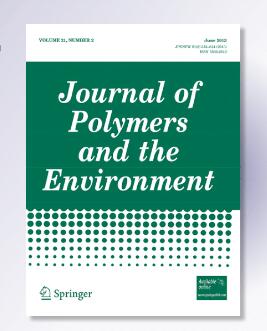
The Journal of Polymers and the Environment fills the need for an international forum in this diverse and rapidly expanding field. The journal serves a crucial role for the publication of information from a wide range of disciplines and is a central outlet for the publication of high-quality peer-reviewed original papers, review articles and short communications. The journal is intentionally interdisciplinary in regard to contributions and covers the following subjects - polymers, environmentally degradable polymers, and degradation pathways: biological, photochemical, oxidative and hydrolytic; new environmental materials: derived by chemical and biosynthetic routes; environmental blends and composites; developments in processing and reactive processing of environmental polymers; characterization of environmental materials: mechanical, physical, thermal, rheological, morphological, and others; recyclable polymers and plastics recycling environmental testing: in-laboratory simulations, outdoor exposures, and standardization of methodologies; environmental fate: end products and intermediates of biodegradation; microbiology and enzymology of polymer biodegradation; solid-waste management and public legislation specific to environmental polymers; and other related topics.





 京公网安备 11010802042870号
京ICP备2023020795号-1
京公网安备 11010802042870号
京ICP备2023020795号-1

 分享
分享
 求助内容:
求助内容: 应助结果提醒方式:
 扫码关注我们
