Benedikt T. Hiller, Lea Schübel, Mirko Rennert, David Krieg, Michael Nase, Florian Puch
{"title":"不同年份酿酒葡萄渣作为生物基聚丁二酸丁二烯可持续抗氧化剂的研究","authors":"Benedikt T. Hiller, Lea Schübel, Mirko Rennert, David Krieg, Michael Nase, Florian Puch","doi":"10.1007/s10924-024-03456-6","DOIUrl":null,"url":null,"abstract":"<div><p>Biopolyesters such as poly(butylene succinate) (PBS) show great potential to be used as biobased alternatives to conventional petroleum-based polyolefins. To access technical applications, biobased materials are mostly stabilized using conventional additives, which impair their biobased character. Wine grape pomace (WP), a largely unused, low-value by-product of winemaking, shows great potential to improve the thermo-oxidative stability. Since WP is a natural material, annual variations must be considered for its use as stabilizing bio-filler on an industrial scale. This study investigates the impact of annual variations of WP on the stabilizing effects in PBS. WP of two different varieties and three vintages were studied. The composition and properties of the native by-products were analyzed, and WP-based functional fillers were prepared by industrial mill-drying. The bio-fillers obtained were analyzed regarding their physical, thermal, biochemical, and antioxidant properties and blended into PBS with filler contents up to 20 wt.-% by twin-screw extrusion. The biocomposites’ thermal and thermo-oxidative properties were investigated subsequently. All WP varieties and vintages increased the thermo-oxidative stability of PBS by at least 24% at a filler content of 3 wt.-%, demonstrating the potential of WP as a reliable stabilizer. However, the maximum stabilization effect achieved varied slightly. The results of this study showed that minor differences in the bio-filler properties can be related to meteorological data, while the antioxidant activity, pH, and fat content could be used as bioanalytical indicators to evaluate the thermo-oxidative stabilization effects of WP-based functional fillers to enable reliable industrial applications of WP as a polymer stabilizer.</p></div>","PeriodicalId":659,"journal":{"name":"Journal of Polymers and the Environment","volume":"33 2","pages":"963 - 989"},"PeriodicalIF":5.0000,"publicationDate":"2024-11-29","publicationTypes":"Journal Article","fieldsOfStudy":null,"isOpenAccess":false,"openAccessPdf":"https://link.springer.com/content/pdf/10.1007/s10924-024-03456-6.pdf","citationCount":"0","resultStr":"{\"title\":\"Study of Wine Grape Pomaces from Different Vintages Regarding Their Use as Reliable Sustainable Antioxidants in Biobased Poly(Butylene Succinate)\",\"authors\":\"Benedikt T. Hiller, Lea Schübel, Mirko Rennert, David Krieg, Michael Nase, Florian Puch\",\"doi\":\"10.1007/s10924-024-03456-6\",\"DOIUrl\":null,\"url\":null,\"abstract\":\"<div><p>Biopolyesters such as poly(butylene succinate) (PBS) show great potential to be used as biobased alternatives to conventional petroleum-based polyolefins. To access technical applications, biobased materials are mostly stabilized using conventional additives, which impair their biobased character. Wine grape pomace (WP), a largely unused, low-value by-product of winemaking, shows great potential to improve the thermo-oxidative stability. Since WP is a natural material, annual variations must be considered for its use as stabilizing bio-filler on an industrial scale. This study investigates the impact of annual variations of WP on the stabilizing effects in PBS. WP of two different varieties and three vintages were studied. The composition and properties of the native by-products were analyzed, and WP-based functional fillers were prepared by industrial mill-drying. The bio-fillers obtained were analyzed regarding their physical, thermal, biochemical, and antioxidant properties and blended into PBS with filler contents up to 20 wt.-% by twin-screw extrusion. The biocomposites’ thermal and thermo-oxidative properties were investigated subsequently. All WP varieties and vintages increased the thermo-oxidative stability of PBS by at least 24% at a filler content of 3 wt.-%, demonstrating the potential of WP as a reliable stabilizer. However, the maximum stabilization effect achieved varied slightly. The results of this study showed that minor differences in the bio-filler properties can be related to meteorological data, while the antioxidant activity, pH, and fat content could be used as bioanalytical indicators to evaluate the thermo-oxidative stabilization effects of WP-based functional fillers to enable reliable industrial applications of WP as a polymer stabilizer.</p></div>\",\"PeriodicalId\":659,\"journal\":{\"name\":\"Journal of Polymers and the Environment\",\"volume\":\"33 2\",\"pages\":\"963 - 989\"},\"PeriodicalIF\":5.0000,\"publicationDate\":\"2024-11-29\",\"publicationTypes\":\"Journal Article\",\"fieldsOfStudy\":null,\"isOpenAccess\":false,\"openAccessPdf\":\"https://link.springer.com/content/pdf/10.1007/s10924-024-03456-6.pdf\",\"citationCount\":\"0\",\"resultStr\":null,\"platform\":\"Semanticscholar\",\"paperid\":null,\"PeriodicalName\":\"Journal of Polymers and the Environment\",\"FirstCategoryId\":\"5\",\"ListUrlMain\":\"https://link.springer.com/article/10.1007/s10924-024-03456-6\",\"RegionNum\":3,\"RegionCategory\":\"工程技术\",\"ArticlePicture\":[],\"TitleCN\":null,\"AbstractTextCN\":null,\"PMCID\":null,\"EPubDate\":\"\",\"PubModel\":\"\",\"JCR\":\"Q2\",\"JCRName\":\"ENGINEERING, ENVIRONMENTAL\",\"Score\":null,\"Total\":0}","platform":"Semanticscholar","paperid":null,"PeriodicalName":"Journal of Polymers and the Environment","FirstCategoryId":"5","ListUrlMain":"https://link.springer.com/article/10.1007/s10924-024-03456-6","RegionNum":3,"RegionCategory":"工程技术","ArticlePicture":[],"TitleCN":null,"AbstractTextCN":null,"PMCID":null,"EPubDate":"","PubModel":"","JCR":"Q2","JCRName":"ENGINEERING, ENVIRONMENTAL","Score":null,"Total":0}
Study of Wine Grape Pomaces from Different Vintages Regarding Their Use as Reliable Sustainable Antioxidants in Biobased Poly(Butylene Succinate)
Biopolyesters such as poly(butylene succinate) (PBS) show great potential to be used as biobased alternatives to conventional petroleum-based polyolefins. To access technical applications, biobased materials are mostly stabilized using conventional additives, which impair their biobased character. Wine grape pomace (WP), a largely unused, low-value by-product of winemaking, shows great potential to improve the thermo-oxidative stability. Since WP is a natural material, annual variations must be considered for its use as stabilizing bio-filler on an industrial scale. This study investigates the impact of annual variations of WP on the stabilizing effects in PBS. WP of two different varieties and three vintages were studied. The composition and properties of the native by-products were analyzed, and WP-based functional fillers were prepared by industrial mill-drying. The bio-fillers obtained were analyzed regarding their physical, thermal, biochemical, and antioxidant properties and blended into PBS with filler contents up to 20 wt.-% by twin-screw extrusion. The biocomposites’ thermal and thermo-oxidative properties were investigated subsequently. All WP varieties and vintages increased the thermo-oxidative stability of PBS by at least 24% at a filler content of 3 wt.-%, demonstrating the potential of WP as a reliable stabilizer. However, the maximum stabilization effect achieved varied slightly. The results of this study showed that minor differences in the bio-filler properties can be related to meteorological data, while the antioxidant activity, pH, and fat content could be used as bioanalytical indicators to evaluate the thermo-oxidative stabilization effects of WP-based functional fillers to enable reliable industrial applications of WP as a polymer stabilizer.
期刊介绍:
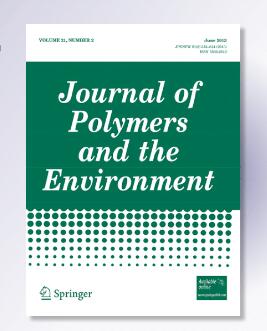
The Journal of Polymers and the Environment fills the need for an international forum in this diverse and rapidly expanding field. The journal serves a crucial role for the publication of information from a wide range of disciplines and is a central outlet for the publication of high-quality peer-reviewed original papers, review articles and short communications. The journal is intentionally interdisciplinary in regard to contributions and covers the following subjects - polymers, environmentally degradable polymers, and degradation pathways: biological, photochemical, oxidative and hydrolytic; new environmental materials: derived by chemical and biosynthetic routes; environmental blends and composites; developments in processing and reactive processing of environmental polymers; characterization of environmental materials: mechanical, physical, thermal, rheological, morphological, and others; recyclable polymers and plastics recycling environmental testing: in-laboratory simulations, outdoor exposures, and standardization of methodologies; environmental fate: end products and intermediates of biodegradation; microbiology and enzymology of polymer biodegradation; solid-waste management and public legislation specific to environmental polymers; and other related topics.




 京公网安备 11010802042870号
京ICP备2023020795号-1
京公网安备 11010802042870号
京ICP备2023020795号-1

 分享
分享
 求助内容:
求助内容: 应助结果提醒方式:
 扫码关注我们
