Hailong Lu, Xinmei Zhou, Chuli Liu, Xiong Ma, Hongjin Chen, Caixia Wang, Rong Ma
{"title":"樱桃侵染细胞壁降解酶及寄主抗性的初步研究","authors":"Hailong Lu, Xinmei Zhou, Chuli Liu, Xiong Ma, Hongjin Chen, Caixia Wang, Rong Ma","doi":"10.1111/jph.70016","DOIUrl":null,"url":null,"abstract":"<div>\n \n <p>The <i>Prunus davidiana</i> (Carrière) Franch. is an important tree species in Northwest China. However, fungal perforation caused by <i>Wilsonomyces carpophilus</i> can harm a variety of stone fruits, such as <i>P. davidiana</i>, seriously affecting the protection of germplasm resources and the cultivation of stone fruit in economic forests. In this study, the main pathogenic factors and host resistance strategies were explored by detecting the main cell wall-degrading enzymes, the activities of the resistant enzymes and substances produced by the host when <i>W. carpophilus</i> infects <i>P. davidiana</i>. In the present study, the pathogenicity of <i>W. carpophilus</i> (CFCC 71543) was determined on <i>P. davidiana</i>. The changes of six cell wall-degrading enzymes, including carboxymethyl cellulase (Cx), β-glucosidase, polymethylgalacturonase (PMG), polygalacturonase (PG), polygalacturonate trans-eliminase (PGTE) and pectin methyl trans-eliminase (PMTE), produced by different strains when they invaded the host were determined using 3,5-dinitrosalicylic acid and ultraviolet colorimetry. Additionally, the changes in phenylalanine ammonia-lyase (PAL), polyphenol oxidase (PPO), peroxidase (POD), superoxide dismutase (SOD), catalase (CAT), malondialdehyde (MDA), total phenol (TP), plant flavonoids, tannins and four other resistant substances were determined 2–16 days after inoculation. The results showed that the main cell wall-degrading enzyme of the strain (CFCC 71543) when infecting <i>P. davidiana</i> was PMG, with enzyme activity as high as 1548.456 U/g at 4 dpi, which was 3.988 times that of the control group. The level of five antioxidant enzymes and four resistant substances increased by varying degrees after infection by <i>W. carpophilus</i>. The main resistance enzyme of <i>P. davidiana</i> was POD, and POD activity reached 4184.889 U/g 8 days after inoculation, which was 4.074 times that of the control group. The main resistant substance was MDA, and the MDA content reached a peak of 217.63 nmol/g 8 days after inoculation, which was 2.376 times that in the control group. This is the first study to demonstrate that PMG is key in the infection of <i>P. davidiana</i> by <i>W. carpophilus</i>. The host produces five enzymes to resist infection by pathogenic bacteria, among which POD activity is the highest. Among the four resistant substances, MDA had strong resistance; the content of other resistant substances did not increase exponentially, and the resistance effect was not pronounced. These results provide a theoretical basis for an in-depth understanding of the pathogenic mechanism and are of great significance for the prevention and control of perforations.</p>\n </div>","PeriodicalId":16843,"journal":{"name":"Journal of Phytopathology","volume":"173 1","pages":""},"PeriodicalIF":1.1000,"publicationDate":"2025-01-08","publicationTypes":"Journal Article","fieldsOfStudy":null,"isOpenAccess":false,"openAccessPdf":"","citationCount":"0","resultStr":"{\"title\":\"Preliminary Study on Cell Wall-Degrading Enzymes and Host Resistance of Prunus davidiana Infected by Wilsonomyces carpophilus\",\"authors\":\"Hailong Lu, Xinmei Zhou, Chuli Liu, Xiong Ma, Hongjin Chen, Caixia Wang, Rong Ma\",\"doi\":\"10.1111/jph.70016\",\"DOIUrl\":null,\"url\":null,\"abstract\":\"<div>\\n \\n <p>The <i>Prunus davidiana</i> (Carrière) Franch. is an important tree species in Northwest China. However, fungal perforation caused by <i>Wilsonomyces carpophilus</i> can harm a variety of stone fruits, such as <i>P. davidiana</i>, seriously affecting the protection of germplasm resources and the cultivation of stone fruit in economic forests. In this study, the main pathogenic factors and host resistance strategies were explored by detecting the main cell wall-degrading enzymes, the activities of the resistant enzymes and substances produced by the host when <i>W. carpophilus</i> infects <i>P. davidiana</i>. In the present study, the pathogenicity of <i>W. carpophilus</i> (CFCC 71543) was determined on <i>P. davidiana</i>. The changes of six cell wall-degrading enzymes, including carboxymethyl cellulase (Cx), β-glucosidase, polymethylgalacturonase (PMG), polygalacturonase (PG), polygalacturonate trans-eliminase (PGTE) and pectin methyl trans-eliminase (PMTE), produced by different strains when they invaded the host were determined using 3,5-dinitrosalicylic acid and ultraviolet colorimetry. Additionally, the changes in phenylalanine ammonia-lyase (PAL), polyphenol oxidase (PPO), peroxidase (POD), superoxide dismutase (SOD), catalase (CAT), malondialdehyde (MDA), total phenol (TP), plant flavonoids, tannins and four other resistant substances were determined 2–16 days after inoculation. The results showed that the main cell wall-degrading enzyme of the strain (CFCC 71543) when infecting <i>P. davidiana</i> was PMG, with enzyme activity as high as 1548.456 U/g at 4 dpi, which was 3.988 times that of the control group. The level of five antioxidant enzymes and four resistant substances increased by varying degrees after infection by <i>W. carpophilus</i>. The main resistance enzyme of <i>P. davidiana</i> was POD, and POD activity reached 4184.889 U/g 8 days after inoculation, which was 4.074 times that of the control group. The main resistant substance was MDA, and the MDA content reached a peak of 217.63 nmol/g 8 days after inoculation, which was 2.376 times that in the control group. This is the first study to demonstrate that PMG is key in the infection of <i>P. davidiana</i> by <i>W. carpophilus</i>. The host produces five enzymes to resist infection by pathogenic bacteria, among which POD activity is the highest. Among the four resistant substances, MDA had strong resistance; the content of other resistant substances did not increase exponentially, and the resistance effect was not pronounced. These results provide a theoretical basis for an in-depth understanding of the pathogenic mechanism and are of great significance for the prevention and control of perforations.</p>\\n </div>\",\"PeriodicalId\":16843,\"journal\":{\"name\":\"Journal of Phytopathology\",\"volume\":\"173 1\",\"pages\":\"\"},\"PeriodicalIF\":1.1000,\"publicationDate\":\"2025-01-08\",\"publicationTypes\":\"Journal Article\",\"fieldsOfStudy\":null,\"isOpenAccess\":false,\"openAccessPdf\":\"\",\"citationCount\":\"0\",\"resultStr\":null,\"platform\":\"Semanticscholar\",\"paperid\":null,\"PeriodicalName\":\"Journal of Phytopathology\",\"FirstCategoryId\":\"97\",\"ListUrlMain\":\"https://onlinelibrary.wiley.com/doi/10.1111/jph.70016\",\"RegionNum\":4,\"RegionCategory\":\"农林科学\",\"ArticlePicture\":[],\"TitleCN\":null,\"AbstractTextCN\":null,\"PMCID\":null,\"EPubDate\":\"\",\"PubModel\":\"\",\"JCR\":\"Q3\",\"JCRName\":\"PLANT SCIENCES\",\"Score\":null,\"Total\":0}","platform":"Semanticscholar","paperid":null,"PeriodicalName":"Journal of Phytopathology","FirstCategoryId":"97","ListUrlMain":"https://onlinelibrary.wiley.com/doi/10.1111/jph.70016","RegionNum":4,"RegionCategory":"农林科学","ArticlePicture":[],"TitleCN":null,"AbstractTextCN":null,"PMCID":null,"EPubDate":"","PubModel":"","JCR":"Q3","JCRName":"PLANT SCIENCES","Score":null,"Total":0}
引用次数: 0
摘要
法国李子属(carriritre)。是中国西北地区重要的乔木树种。然而,由carpophilus引起的真菌穿孔会对戴维安等多种核果造成危害,严重影响了经济林种质资源的保护和核果的种植。本研究通过检测carpophilus侵染P. davidiana时主要的细胞壁降解酶、抗性酶活性和宿主产生的物质,探讨了病原菌的主要致病因素和宿主的抗性策略。本研究测定了carpophilus (CFCC 71543)对P. davidiana的致病性。采用3,5-二硝基水杨酸法和紫外比色法测定了不同菌株入侵宿主时产生的羧甲基纤维素酶(Cx)、β-葡萄糖苷酶、聚甲基半乳糖醛酸酶(PMG)、聚半乳糖醛酸酶(PG)、聚半乳糖醛酸反式消除酶(PGTE)和果胶甲基反式消除酶(PMTE) 6种细胞壁降解酶的变化。同时测定了接种后2 ~ 16 d苯丙氨酸解氨酶(PAL)、多酚氧化酶(PPO)、过氧化物酶(POD)、超氧化物歧化酶(SOD)、过氧化氢酶(CAT)、丙二醛(MDA)、总酚(TP)、总黄酮、单宁等4种抗性物质的变化。结果表明,菌株(CFCC 71543)在侵染紫花苜蓿时,其主要的细胞壁降解酶为PMG,在4 dpi时酶活性高达1548.456 U/g,是对照组的3.988倍。5种抗氧化酶和4种抗性物质的水平在感染后均有不同程度的升高。耐药酶以POD为主,接种后8 d POD活性达到4184.889 U/g,是对照组的4.074倍。主要抗性物质为丙二醛(MDA),接种后8 d MDA含量达到217.63 nmol/g的峰值,是对照组的2.376倍。这是首次证实PMG在葡萄球菌感染中起关键作用的研究。宿主产生5种酶来抵抗病原菌的感染,其中POD活性最高。4种抗性物质中,MDA抗性较强;其他抗性物质含量没有呈指数增长,抗性效果不明显。这些结果为深入了解穿孔的发病机制提供了理论基础,对穿孔的防治具有重要意义。
Preliminary Study on Cell Wall-Degrading Enzymes and Host Resistance of Prunus davidiana Infected by Wilsonomyces carpophilus
The Prunus davidiana (Carrière) Franch. is an important tree species in Northwest China. However, fungal perforation caused by Wilsonomyces carpophilus can harm a variety of stone fruits, such as P. davidiana, seriously affecting the protection of germplasm resources and the cultivation of stone fruit in economic forests. In this study, the main pathogenic factors and host resistance strategies were explored by detecting the main cell wall-degrading enzymes, the activities of the resistant enzymes and substances produced by the host when W. carpophilus infects P. davidiana. In the present study, the pathogenicity of W. carpophilus (CFCC 71543) was determined on P. davidiana. The changes of six cell wall-degrading enzymes, including carboxymethyl cellulase (Cx), β-glucosidase, polymethylgalacturonase (PMG), polygalacturonase (PG), polygalacturonate trans-eliminase (PGTE) and pectin methyl trans-eliminase (PMTE), produced by different strains when they invaded the host were determined using 3,5-dinitrosalicylic acid and ultraviolet colorimetry. Additionally, the changes in phenylalanine ammonia-lyase (PAL), polyphenol oxidase (PPO), peroxidase (POD), superoxide dismutase (SOD), catalase (CAT), malondialdehyde (MDA), total phenol (TP), plant flavonoids, tannins and four other resistant substances were determined 2–16 days after inoculation. The results showed that the main cell wall-degrading enzyme of the strain (CFCC 71543) when infecting P. davidiana was PMG, with enzyme activity as high as 1548.456 U/g at 4 dpi, which was 3.988 times that of the control group. The level of five antioxidant enzymes and four resistant substances increased by varying degrees after infection by W. carpophilus. The main resistance enzyme of P. davidiana was POD, and POD activity reached 4184.889 U/g 8 days after inoculation, which was 4.074 times that of the control group. The main resistant substance was MDA, and the MDA content reached a peak of 217.63 nmol/g 8 days after inoculation, which was 2.376 times that in the control group. This is the first study to demonstrate that PMG is key in the infection of P. davidiana by W. carpophilus. The host produces five enzymes to resist infection by pathogenic bacteria, among which POD activity is the highest. Among the four resistant substances, MDA had strong resistance; the content of other resistant substances did not increase exponentially, and the resistance effect was not pronounced. These results provide a theoretical basis for an in-depth understanding of the pathogenic mechanism and are of great significance for the prevention and control of perforations.
期刊介绍:
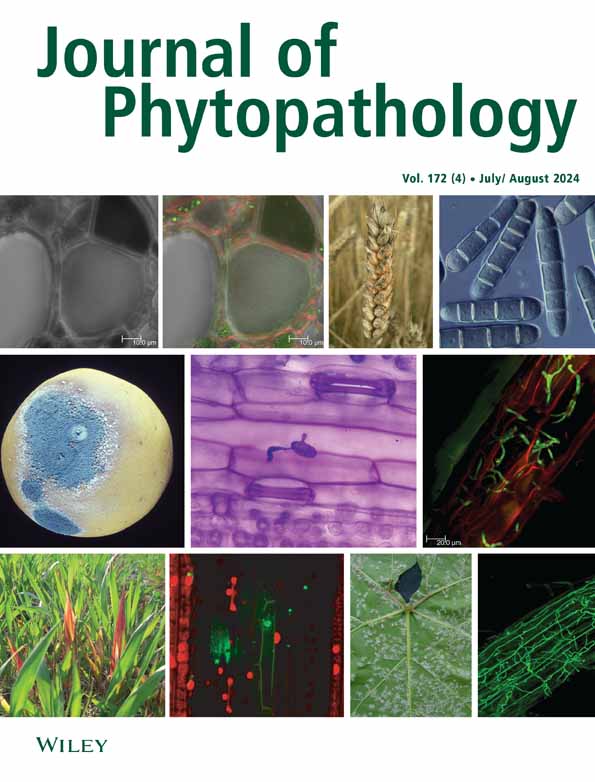
Journal of Phytopathology publishes original and review articles on all scientific aspects of applied phytopathology in agricultural and horticultural crops. Preference is given to contributions improving our understanding of the biotic and abiotic determinants of plant diseases, including epidemics and damage potential, as a basis for innovative disease management, modelling and forecasting. This includes practical aspects and the development of methods for disease diagnosis as well as infection bioassays.
Studies at the population, organism, physiological, biochemical and molecular genetic level are welcome. The journal scope comprises the pathology and epidemiology of plant diseases caused by microbial pathogens, viruses and nematodes.
Accepted papers should advance our conceptual knowledge of plant diseases, rather than presenting descriptive or screening data unrelated to phytopathological mechanisms or functions. Results from unrepeated experimental conditions or data with no or inappropriate statistical processing will not be considered. Authors are encouraged to look at past issues to ensure adherence to the standards of the journal.




 京公网安备 11010802042870号
京ICP备2023020795号-1
京公网安备 11010802042870号
京ICP备2023020795号-1

 分享
分享
 求助内容:
求助内容: 应助结果提醒方式:
 扫码关注我们
