Shahab Zomorodbakhsh, Andreia C. S. Gonzalez, Inês G. Cruz, Giusi Piccirillo, Teresa M. R. Maria, Inês S. Marques, Andreia F. Peixoto, João M. Gil, Fábio Ferreira, Rui M. B. Carrilho
{"title":"桉木改性生物炭材料作为高效CO2吸附剂和可回收催化剂的研究","authors":"Shahab Zomorodbakhsh, Andreia C. S. Gonzalez, Inês G. Cruz, Giusi Piccirillo, Teresa M. R. Maria, Inês S. Marques, Andreia F. Peixoto, João M. Gil, Fábio Ferreira, Rui M. B. Carrilho","doi":"10.1002/adsu.202400431","DOIUrl":null,"url":null,"abstract":"<p>Highly porous carbon materials derived from renewable resources constitute a promising and sustainable strategy regarding the enhancement of CO<sub>2</sub> capture technologies. In this work, the valorization of <i>Eucalyptus globulus</i> wood, a forest invasive species present in European forests, is performed through its transformation in biochar. The deposition of nitrogen and different metals (aluminum, copper and chromium) onto biochar is performed, using the magnetron sputtering as a pioneering technique, to produce coated biochar nanoparticles with improved properties. The resultant modified biochar particles maintain a highly porous structure and present a remarkable CO<sub>2</sub> adsorption capacity (up to 4.80 mmol g<sup>−1</sup> for <b>N@BC</b>), which is attributed to the synergy of their large total surface area (527 m<sup>2</sup> g<sup>−1</sup>) and microporosity (pore diameter = 21 Å), with a high content of nitrogen and oxygen heteroatom moieties (40.4% N, 11.4% O). Their application as heterogeneous bifunctional catalysts in CO<sub>2</sub> cycloaddition to epichlorohydrin is performed, in the absence of any solvent or co-catalyst, under moderate conditions (20 bar CO<sub>2</sub>, 120 °C), leading to good conversions (up to 58% conversion) and excellent selectivity for cyclic carbonates. Cu-coated biochar is shown to be more stable than non-modified material, being recycled and reused along 4 consecutive runs without loss of catalytic activity or selectivity.</p>","PeriodicalId":7294,"journal":{"name":"Advanced Sustainable Systems","volume":"9 1","pages":""},"PeriodicalIF":6.1000,"publicationDate":"2024-10-09","publicationTypes":"Journal Article","fieldsOfStudy":null,"isOpenAccess":false,"openAccessPdf":"","citationCount":"0","resultStr":"{\"title\":\"Modified Biochar Materials From Eucalyptus globulus Wood as Efficient CO2 Adsorbents and Recyclable Catalysts\",\"authors\":\"Shahab Zomorodbakhsh, Andreia C. S. Gonzalez, Inês G. Cruz, Giusi Piccirillo, Teresa M. R. Maria, Inês S. Marques, Andreia F. Peixoto, João M. Gil, Fábio Ferreira, Rui M. B. Carrilho\",\"doi\":\"10.1002/adsu.202400431\",\"DOIUrl\":null,\"url\":null,\"abstract\":\"<p>Highly porous carbon materials derived from renewable resources constitute a promising and sustainable strategy regarding the enhancement of CO<sub>2</sub> capture technologies. In this work, the valorization of <i>Eucalyptus globulus</i> wood, a forest invasive species present in European forests, is performed through its transformation in biochar. The deposition of nitrogen and different metals (aluminum, copper and chromium) onto biochar is performed, using the magnetron sputtering as a pioneering technique, to produce coated biochar nanoparticles with improved properties. The resultant modified biochar particles maintain a highly porous structure and present a remarkable CO<sub>2</sub> adsorption capacity (up to 4.80 mmol g<sup>−1</sup> for <b>N@BC</b>), which is attributed to the synergy of their large total surface area (527 m<sup>2</sup> g<sup>−1</sup>) and microporosity (pore diameter = 21 Å), with a high content of nitrogen and oxygen heteroatom moieties (40.4% N, 11.4% O). Their application as heterogeneous bifunctional catalysts in CO<sub>2</sub> cycloaddition to epichlorohydrin is performed, in the absence of any solvent or co-catalyst, under moderate conditions (20 bar CO<sub>2</sub>, 120 °C), leading to good conversions (up to 58% conversion) and excellent selectivity for cyclic carbonates. Cu-coated biochar is shown to be more stable than non-modified material, being recycled and reused along 4 consecutive runs without loss of catalytic activity or selectivity.</p>\",\"PeriodicalId\":7294,\"journal\":{\"name\":\"Advanced Sustainable Systems\",\"volume\":\"9 1\",\"pages\":\"\"},\"PeriodicalIF\":6.1000,\"publicationDate\":\"2024-10-09\",\"publicationTypes\":\"Journal Article\",\"fieldsOfStudy\":null,\"isOpenAccess\":false,\"openAccessPdf\":\"\",\"citationCount\":\"0\",\"resultStr\":null,\"platform\":\"Semanticscholar\",\"paperid\":null,\"PeriodicalName\":\"Advanced Sustainable Systems\",\"FirstCategoryId\":\"88\",\"ListUrlMain\":\"https://advanced.onlinelibrary.wiley.com/doi/10.1002/adsu.202400431\",\"RegionNum\":3,\"RegionCategory\":\"材料科学\",\"ArticlePicture\":[],\"TitleCN\":null,\"AbstractTextCN\":null,\"PMCID\":null,\"EPubDate\":\"\",\"PubModel\":\"\",\"JCR\":\"Q2\",\"JCRName\":\"GREEN & SUSTAINABLE SCIENCE & TECHNOLOGY\",\"Score\":null,\"Total\":0}","platform":"Semanticscholar","paperid":null,"PeriodicalName":"Advanced Sustainable Systems","FirstCategoryId":"88","ListUrlMain":"https://advanced.onlinelibrary.wiley.com/doi/10.1002/adsu.202400431","RegionNum":3,"RegionCategory":"材料科学","ArticlePicture":[],"TitleCN":null,"AbstractTextCN":null,"PMCID":null,"EPubDate":"","PubModel":"","JCR":"Q2","JCRName":"GREEN & SUSTAINABLE SCIENCE & TECHNOLOGY","Score":null,"Total":0}
引用次数: 0
摘要
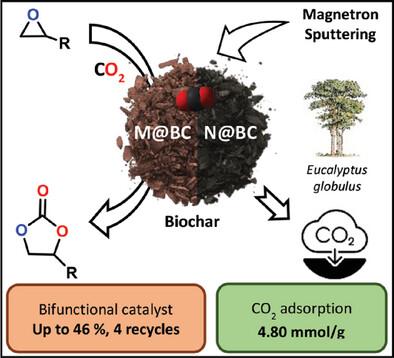
来自可再生资源的高多孔碳材料是加强二氧化碳捕获技术的一种有前途的可持续战略。在这项工作中,蓝桉(Eucalyptus globulus)木材是一种存在于欧洲森林的森林入侵物种,通过其在生物炭中的转化进行了增值。氮和不同的金属(铝、铜和铬)沉积在生物炭上,使用磁控溅射作为一种开创性的技术,以生产具有改进性能的涂层生物炭纳米颗粒。得到的改性生物炭颗粒保持了高孔隙结构,具有显著的CO2吸附能力(N@BC高达4.80 mmol g−1),这是由于其大的总表面积(527 m2 g−1)和微孔隙(孔径= 21 Å),以及高含量的氮氧杂原子(40.4% N, 11.4% O)的协同作用。在没有任何溶剂或助催化剂的情况下,在中等条件下(20 bar CO2, 120°C),导致良好的转化率(高达58%的转化率)和对环碳酸盐的优良选择性。cu包覆生物炭被证明比未改性的材料更稳定,可以连续4次循环使用而不损失催化活性或选择性。
Modified Biochar Materials From Eucalyptus globulus Wood as Efficient CO2 Adsorbents and Recyclable Catalysts
Highly porous carbon materials derived from renewable resources constitute a promising and sustainable strategy regarding the enhancement of CO2 capture technologies. In this work, the valorization of Eucalyptus globulus wood, a forest invasive species present in European forests, is performed through its transformation in biochar. The deposition of nitrogen and different metals (aluminum, copper and chromium) onto biochar is performed, using the magnetron sputtering as a pioneering technique, to produce coated biochar nanoparticles with improved properties. The resultant modified biochar particles maintain a highly porous structure and present a remarkable CO2 adsorption capacity (up to 4.80 mmol g−1 for N@BC), which is attributed to the synergy of their large total surface area (527 m2 g−1) and microporosity (pore diameter = 21 Å), with a high content of nitrogen and oxygen heteroatom moieties (40.4% N, 11.4% O). Their application as heterogeneous bifunctional catalysts in CO2 cycloaddition to epichlorohydrin is performed, in the absence of any solvent or co-catalyst, under moderate conditions (20 bar CO2, 120 °C), leading to good conversions (up to 58% conversion) and excellent selectivity for cyclic carbonates. Cu-coated biochar is shown to be more stable than non-modified material, being recycled and reused along 4 consecutive runs without loss of catalytic activity or selectivity.
期刊介绍:
Advanced Sustainable Systems, a part of the esteemed Advanced portfolio, serves as an interdisciplinary sustainability science journal. It focuses on impactful research in the advancement of sustainable, efficient, and less wasteful systems and technologies. Aligned with the UN's Sustainable Development Goals, the journal bridges knowledge gaps between fundamental research, implementation, and policy-making. Covering diverse topics such as climate change, food sustainability, environmental science, renewable energy, water, urban development, and socio-economic challenges, it contributes to the understanding and promotion of sustainable systems.






 京公网安备 11010802042870号
京ICP备2023020795号-1
京公网安备 11010802042870号
京ICP备2023020795号-1

 分享
分享
 求助内容:
求助内容: 应助结果提醒方式:
 扫码关注我们
