Mackenzie Tietjen, Maria D. Esteve-Gasent, Ivan Castro-Arellano, Andrew Y. Li, Raul F. Medina
{"title":"利用群体遗传学研究肩胛骨棘猴寄主相关分化的缺失","authors":"Mackenzie Tietjen, Maria D. Esteve-Gasent, Ivan Castro-Arellano, Andrew Y. Li, Raul F. Medina","doi":"10.1111/eea.13533","DOIUrl":null,"url":null,"abstract":"<p>The blacklegged tick, <i>Ixodes scapularis</i> (Say) (Acari: Ixodidae), is a vector of pathogens that cause diseases including anaplasmosis, babesiosis, and Lyme disease. It is a generalist vector feeding on a wide variety of vertebrate hosts. The transmission cycles of these pathogens are affected by the tick's host selection because host species differ in their ability to clear, maintain, or amplify these pathogens. Several generalist parasites exhibit host-associated differentiation (HAD), a process that results in genetically distinct populations associated with different host species. Knowing whether <i>I. scapularis</i> exhibits HAD is important to better understand the ecology of these diseases. To test for HAD in <i>I. scapularis</i>, whole-genome resequencing was performed on ticks collected directly from six hosts in the southern United States (i.e., cotton mice [Cricetidae: <i>Peromyscus gossypinus</i> Le Conte], opossum [Didelphidae: <i>Didelphis virginiana</i> Kerr], raccoon [Procyonidae: <i>Procyon lotor</i> L.], gray fox [Canidae: <i>Urocyon cinereoargenteus</i> Schreber], wild boar or feral hog [Suidae: <i>Sus scrofa</i> L.], and white-tailed deer [Cervidae: <i>Odocoileus virginianus</i> Zimmermann]). For the hosts tested, HAD was not found. However, it could not be ruled out if HAD is occurring for ticks associated with lizards in this study. The results of this study contrast with findings from another host generalist, <i>Dermacentor variabilis</i> (Say), that does exhibit HAD. Our results suggest that these two tick species differ in their propensity for HAD. One explanation could be that <i>I. scapularis</i> can mate off-host, maintaining panmixia, whereas <i>D. variabilis</i> mate only on the host. The lack of HAD in <i>I. scapularis</i> should be confirmed by sampling ticks from lizard and rodent hosts. These results will inform control efforts and the use of area-wide tick control strategies.</p>","PeriodicalId":11741,"journal":{"name":"Entomologia Experimentalis et Applicata","volume":"173 2","pages":"183-191"},"PeriodicalIF":1.9000,"publicationDate":"2024-12-10","publicationTypes":"Journal Article","fieldsOfStudy":null,"isOpenAccess":false,"openAccessPdf":"","citationCount":"0","resultStr":"{\"title\":\"Lack of host-associated differentiation in Ixodes scapularis using population genetics\",\"authors\":\"Mackenzie Tietjen, Maria D. Esteve-Gasent, Ivan Castro-Arellano, Andrew Y. Li, Raul F. Medina\",\"doi\":\"10.1111/eea.13533\",\"DOIUrl\":null,\"url\":null,\"abstract\":\"<p>The blacklegged tick, <i>Ixodes scapularis</i> (Say) (Acari: Ixodidae), is a vector of pathogens that cause diseases including anaplasmosis, babesiosis, and Lyme disease. It is a generalist vector feeding on a wide variety of vertebrate hosts. The transmission cycles of these pathogens are affected by the tick's host selection because host species differ in their ability to clear, maintain, or amplify these pathogens. Several generalist parasites exhibit host-associated differentiation (HAD), a process that results in genetically distinct populations associated with different host species. Knowing whether <i>I. scapularis</i> exhibits HAD is important to better understand the ecology of these diseases. To test for HAD in <i>I. scapularis</i>, whole-genome resequencing was performed on ticks collected directly from six hosts in the southern United States (i.e., cotton mice [Cricetidae: <i>Peromyscus gossypinus</i> Le Conte], opossum [Didelphidae: <i>Didelphis virginiana</i> Kerr], raccoon [Procyonidae: <i>Procyon lotor</i> L.], gray fox [Canidae: <i>Urocyon cinereoargenteus</i> Schreber], wild boar or feral hog [Suidae: <i>Sus scrofa</i> L.], and white-tailed deer [Cervidae: <i>Odocoileus virginianus</i> Zimmermann]). For the hosts tested, HAD was not found. However, it could not be ruled out if HAD is occurring for ticks associated with lizards in this study. The results of this study contrast with findings from another host generalist, <i>Dermacentor variabilis</i> (Say), that does exhibit HAD. Our results suggest that these two tick species differ in their propensity for HAD. One explanation could be that <i>I. scapularis</i> can mate off-host, maintaining panmixia, whereas <i>D. variabilis</i> mate only on the host. The lack of HAD in <i>I. scapularis</i> should be confirmed by sampling ticks from lizard and rodent hosts. These results will inform control efforts and the use of area-wide tick control strategies.</p>\",\"PeriodicalId\":11741,\"journal\":{\"name\":\"Entomologia Experimentalis et Applicata\",\"volume\":\"173 2\",\"pages\":\"183-191\"},\"PeriodicalIF\":1.9000,\"publicationDate\":\"2024-12-10\",\"publicationTypes\":\"Journal Article\",\"fieldsOfStudy\":null,\"isOpenAccess\":false,\"openAccessPdf\":\"\",\"citationCount\":\"0\",\"resultStr\":null,\"platform\":\"Semanticscholar\",\"paperid\":null,\"PeriodicalName\":\"Entomologia Experimentalis et Applicata\",\"FirstCategoryId\":\"97\",\"ListUrlMain\":\"https://onlinelibrary.wiley.com/doi/10.1111/eea.13533\",\"RegionNum\":3,\"RegionCategory\":\"农林科学\",\"ArticlePicture\":[],\"TitleCN\":null,\"AbstractTextCN\":null,\"PMCID\":null,\"EPubDate\":\"\",\"PubModel\":\"\",\"JCR\":\"Q2\",\"JCRName\":\"ENTOMOLOGY\",\"Score\":null,\"Total\":0}","platform":"Semanticscholar","paperid":null,"PeriodicalName":"Entomologia Experimentalis et Applicata","FirstCategoryId":"97","ListUrlMain":"https://onlinelibrary.wiley.com/doi/10.1111/eea.13533","RegionNum":3,"RegionCategory":"农林科学","ArticlePicture":[],"TitleCN":null,"AbstractTextCN":null,"PMCID":null,"EPubDate":"","PubModel":"","JCR":"Q2","JCRName":"ENTOMOLOGY","Score":null,"Total":0}
引用次数: 0
摘要
黑腿蜱,肩胛硬蜱(蜱螨目:硬蜱科),是病原体的媒介,可引起无形体病、巴贝斯虫病和莱姆病等疾病。它是一种以多种脊椎动物宿主为食的多面手病媒。这些病原体的传播周期受到蜱虫宿主选择的影响,因为宿主物种在清除、维持或扩增这些病原体的能力上存在差异。一些多功能型寄生虫表现出宿主相关分化(HAD),这一过程导致与不同宿主物种相关的遗传差异种群。了解肩胛骨是否具有HAD,对于更好地了解这些疾病的生态学具有重要意义。为了检测镰尾蜱是否存在HAD,对直接从美国南部6个宿主(即棉鼠[Cricetidae: Peromyscus gossypinus Le Conte]、负鼠[didelphisviriniana Kerr]、浣熊[proyonidae: proyon lotor L.]、灰狐[犬科:Urocyon cinereogenteus Schreber]、野猪或野猪[Suidae: Sus scrofa L.]和白尾鹿[Cervidae: Odocoileus virginianus Zimmermann])采集的蜱进行全基因组重测序。检测主机未发现HAD然而,在这项研究中,不能排除与蜥蜴有关的蜱虫是否发生HAD。这项研究的结果与另一个宿主多面手,皮肤变异性(Say)的发现形成对比,后者确实表现出HAD。我们的研究结果表明,这两种蜱虫对HAD的倾向不同。一种解释可能是,镰形瓢虫可以在宿主外交配,维持泛杂交,而变异瓢虫只能在宿主上交配。肩胛骨棘球绦虫体内缺乏HAD,应通过从蜥蜴和啮齿动物宿主身上取样蜱来证实。这些结果将为控制工作和使用区域性蜱虫控制策略提供信息。
Lack of host-associated differentiation in Ixodes scapularis using population genetics
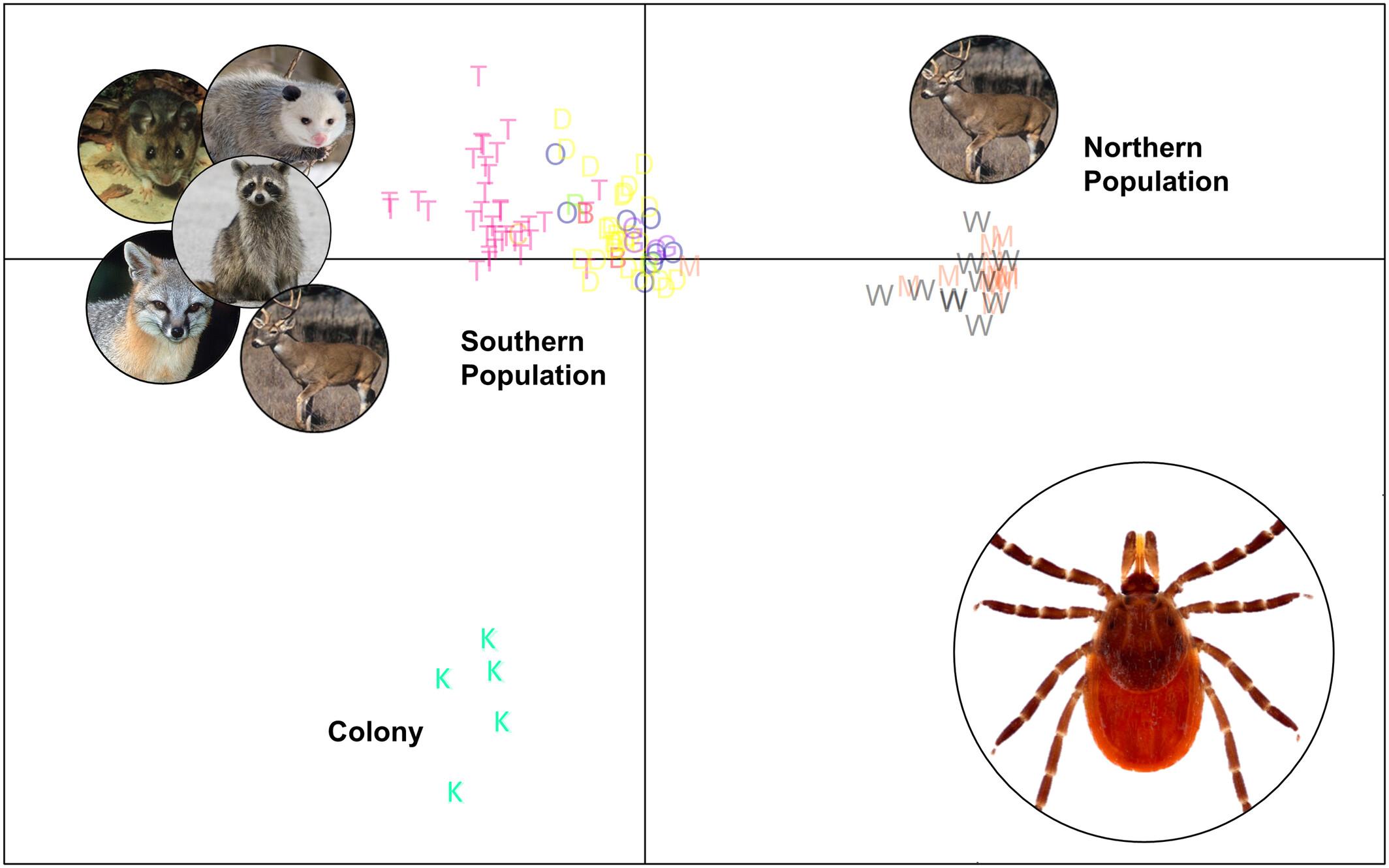
The blacklegged tick, Ixodes scapularis (Say) (Acari: Ixodidae), is a vector of pathogens that cause diseases including anaplasmosis, babesiosis, and Lyme disease. It is a generalist vector feeding on a wide variety of vertebrate hosts. The transmission cycles of these pathogens are affected by the tick's host selection because host species differ in their ability to clear, maintain, or amplify these pathogens. Several generalist parasites exhibit host-associated differentiation (HAD), a process that results in genetically distinct populations associated with different host species. Knowing whether I. scapularis exhibits HAD is important to better understand the ecology of these diseases. To test for HAD in I. scapularis, whole-genome resequencing was performed on ticks collected directly from six hosts in the southern United States (i.e., cotton mice [Cricetidae: Peromyscus gossypinus Le Conte], opossum [Didelphidae: Didelphis virginiana Kerr], raccoon [Procyonidae: Procyon lotor L.], gray fox [Canidae: Urocyon cinereoargenteus Schreber], wild boar or feral hog [Suidae: Sus scrofa L.], and white-tailed deer [Cervidae: Odocoileus virginianus Zimmermann]). For the hosts tested, HAD was not found. However, it could not be ruled out if HAD is occurring for ticks associated with lizards in this study. The results of this study contrast with findings from another host generalist, Dermacentor variabilis (Say), that does exhibit HAD. Our results suggest that these two tick species differ in their propensity for HAD. One explanation could be that I. scapularis can mate off-host, maintaining panmixia, whereas D. variabilis mate only on the host. The lack of HAD in I. scapularis should be confirmed by sampling ticks from lizard and rodent hosts. These results will inform control efforts and the use of area-wide tick control strategies.
期刊介绍:
Entomologia Experimentalis et Applicata publishes top quality original research papers in the fields of experimental biology and ecology of insects and other terrestrial arthropods, with both pure and applied scopes. Mini-reviews, technical notes and media reviews are also published. Although the scope of the journal covers the entire scientific field of entomology, it has established itself as the preferred medium for the communication of results in the areas of the physiological, ecological, and morphological inter-relations between phytophagous arthropods and their food plants, their parasitoids, predators, and pathogens. Examples of specific areas that are covered frequently are:
host-plant selection mechanisms
chemical and sensory ecology and infochemicals
parasitoid-host interactions
behavioural ecology
biosystematics
(co-)evolution
migration and dispersal
population modelling
sampling strategies
developmental and behavioural responses to photoperiod and temperature
nutrition
natural and transgenic plant resistance.




 京公网安备 11010802042870号
京ICP备2023020795号-1
京公网安备 11010802042870号
京ICP备2023020795号-1

 分享
分享
 求助内容:
求助内容: 应助结果提醒方式:
 扫码关注我们
