{"title":"电化学元件用聚合物/锰-氧化镍/碳纳米管共混物的新型核-壳管结构","authors":"Yue Fu, Yangyang Dong, Xiangchao Zhang, Haijun Niu, Chuanli Qin, Xiankai Jiang","doi":"10.1002/pol.20240708","DOIUrl":null,"url":null,"abstract":"<div>\n \n <p>To address the issue of electrochemical performance degradation resulting from redox reactions during the charging and discharging of supercapacitors, we introduced a novel electrode material featuring a core–shell attachment structure (PANI@(MnO<sub>2</sub> + NiO)) with the incorporation of carbon nanotubes (CNTs). The introduction of CNT on top of the core–shell structure by a simple chemical synthesis method helps to improve the double-layer capacitance and Faraday capacitance of the composite. Thus, multiple synergistic effects can be produced to improve charge storage capacity. The morphology structure and electrochemical properties of PANI@(MnO<sub>2</sub> + NiO)@CNT were analyzed. In a three-electrode configuration, the specific capacitance of the composite is 327 F g<sup>−1</sup> at a current density of 0.5 A g<sup>−1</sup>. Remarkably, the capacitance retention rate exceeded 75% after 5000 charge–discharge cycles. Calculations indicate that in a supercapacitor employing a 1 M Na<sub>2</sub>SO<sub>4</sub> electrolyte, the composite demonstrated energy and power densities of 48.1 W h kg<sup>−1</sup> and 999.9 W kg<sup>−1</sup>, respectively. This kind of core–shell structural composites achieved electrochemical properties in line with expectations through a simple chemical synthesis method. As a practical application of supercapacitor electrode materials, PANI@(MnO<sub>2</sub> + NiO)@CNT have better electrical properties than similar materials and have broad application prospects in industrial production.</p>\n </div>","PeriodicalId":16888,"journal":{"name":"Journal of Polymer Science","volume":"63 1","pages":"109-120"},"PeriodicalIF":3.9000,"publicationDate":"2024-10-15","publicationTypes":"Journal Article","fieldsOfStudy":null,"isOpenAccess":false,"openAccessPdf":"","citationCount":"0","resultStr":"{\"title\":\"Innovative Core–Shell Tubular Structure in Polymer/Manganese–Nickel Oxide/Carbon Nanotube Blends for Electrochemical Components\",\"authors\":\"Yue Fu, Yangyang Dong, Xiangchao Zhang, Haijun Niu, Chuanli Qin, Xiankai Jiang\",\"doi\":\"10.1002/pol.20240708\",\"DOIUrl\":null,\"url\":null,\"abstract\":\"<div>\\n \\n <p>To address the issue of electrochemical performance degradation resulting from redox reactions during the charging and discharging of supercapacitors, we introduced a novel electrode material featuring a core–shell attachment structure (PANI@(MnO<sub>2</sub> + NiO)) with the incorporation of carbon nanotubes (CNTs). The introduction of CNT on top of the core–shell structure by a simple chemical synthesis method helps to improve the double-layer capacitance and Faraday capacitance of the composite. Thus, multiple synergistic effects can be produced to improve charge storage capacity. The morphology structure and electrochemical properties of PANI@(MnO<sub>2</sub> + NiO)@CNT were analyzed. In a three-electrode configuration, the specific capacitance of the composite is 327 F g<sup>−1</sup> at a current density of 0.5 A g<sup>−1</sup>. Remarkably, the capacitance retention rate exceeded 75% after 5000 charge–discharge cycles. Calculations indicate that in a supercapacitor employing a 1 M Na<sub>2</sub>SO<sub>4</sub> electrolyte, the composite demonstrated energy and power densities of 48.1 W h kg<sup>−1</sup> and 999.9 W kg<sup>−1</sup>, respectively. This kind of core–shell structural composites achieved electrochemical properties in line with expectations through a simple chemical synthesis method. As a practical application of supercapacitor electrode materials, PANI@(MnO<sub>2</sub> + NiO)@CNT have better electrical properties than similar materials and have broad application prospects in industrial production.</p>\\n </div>\",\"PeriodicalId\":16888,\"journal\":{\"name\":\"Journal of Polymer Science\",\"volume\":\"63 1\",\"pages\":\"109-120\"},\"PeriodicalIF\":3.9000,\"publicationDate\":\"2024-10-15\",\"publicationTypes\":\"Journal Article\",\"fieldsOfStudy\":null,\"isOpenAccess\":false,\"openAccessPdf\":\"\",\"citationCount\":\"0\",\"resultStr\":null,\"platform\":\"Semanticscholar\",\"paperid\":null,\"PeriodicalName\":\"Journal of Polymer Science\",\"FirstCategoryId\":\"92\",\"ListUrlMain\":\"https://onlinelibrary.wiley.com/doi/10.1002/pol.20240708\",\"RegionNum\":3,\"RegionCategory\":\"化学\",\"ArticlePicture\":[],\"TitleCN\":null,\"AbstractTextCN\":null,\"PMCID\":null,\"EPubDate\":\"\",\"PubModel\":\"\",\"JCR\":\"Q2\",\"JCRName\":\"POLYMER SCIENCE\",\"Score\":null,\"Total\":0}","platform":"Semanticscholar","paperid":null,"PeriodicalName":"Journal of Polymer Science","FirstCategoryId":"92","ListUrlMain":"https://onlinelibrary.wiley.com/doi/10.1002/pol.20240708","RegionNum":3,"RegionCategory":"化学","ArticlePicture":[],"TitleCN":null,"AbstractTextCN":null,"PMCID":null,"EPubDate":"","PubModel":"","JCR":"Q2","JCRName":"POLYMER SCIENCE","Score":null,"Total":0}
引用次数: 0
摘要
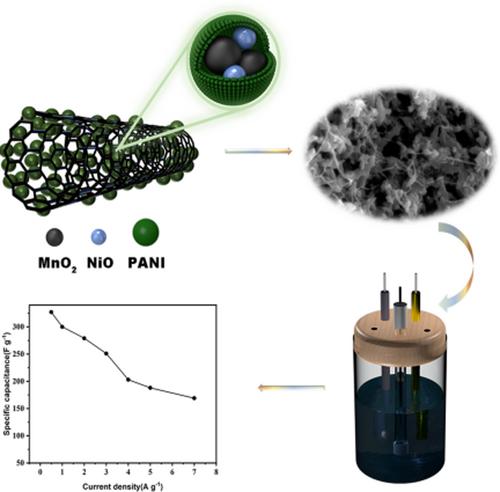
为了解决超级电容器充放电过程中氧化还原反应导致电化学性能下降的问题,我们引入了一种新型电极材料,该材料具有核壳连接结构(PANI@(MnO2 + NiO)),并掺入碳纳米管(CNTs)。通过简单的化学合成方法在核壳结构的顶部引入碳纳米管,有助于提高复合材料的双层电容和法拉第电容。因此,可以产生多种协同效应,以提高电荷存储容量。分析了聚苯胺@(MnO2 + NiO)@碳纳米管的形貌结构和电化学性能。在三电极配置下,复合材料的比电容为327 F g−1,电流密度为0.5 a g−1。值得注意的是,在5000次充放电循环后,电容保持率超过75%。计算表明,在采用1 M Na2SO4电解液的超级电容器中,该复合材料的能量和功率密度分别为48.1 W h kg - 1和999.9 W kg - 1。这种核壳结构复合材料通过简单的化学合成方法获得了符合预期的电化学性能。PANI@(MnO2 + NiO)@CNT作为一种实际应用的超级电容器电极材料,具有比同类材料更好的电学性能,在工业生产中具有广阔的应用前景。
Innovative Core–Shell Tubular Structure in Polymer/Manganese–Nickel Oxide/Carbon Nanotube Blends for Electrochemical Components
To address the issue of electrochemical performance degradation resulting from redox reactions during the charging and discharging of supercapacitors, we introduced a novel electrode material featuring a core–shell attachment structure (PANI@(MnO2 + NiO)) with the incorporation of carbon nanotubes (CNTs). The introduction of CNT on top of the core–shell structure by a simple chemical synthesis method helps to improve the double-layer capacitance and Faraday capacitance of the composite. Thus, multiple synergistic effects can be produced to improve charge storage capacity. The morphology structure and electrochemical properties of PANI@(MnO2 + NiO)@CNT were analyzed. In a three-electrode configuration, the specific capacitance of the composite is 327 F g−1 at a current density of 0.5 A g−1. Remarkably, the capacitance retention rate exceeded 75% after 5000 charge–discharge cycles. Calculations indicate that in a supercapacitor employing a 1 M Na2SO4 electrolyte, the composite demonstrated energy and power densities of 48.1 W h kg−1 and 999.9 W kg−1, respectively. This kind of core–shell structural composites achieved electrochemical properties in line with expectations through a simple chemical synthesis method. As a practical application of supercapacitor electrode materials, PANI@(MnO2 + NiO)@CNT have better electrical properties than similar materials and have broad application prospects in industrial production.
期刊介绍:
Journal of Polymer Research provides a forum for the prompt publication of articles concerning the fundamental and applied research of polymers. Its great feature lies in the diversity of content which it encompasses, drawing together results from all aspects of polymer science and technology.
As polymer research is rapidly growing around the globe, the aim of this journal is to establish itself as a significant information tool not only for the international polymer researchers in academia but also for those working in industry. The scope of the journal covers a wide range of the highly interdisciplinary field of polymer science and technology.




 京公网安备 11010802042870号
京ICP备2023020795号-1
京公网安备 11010802042870号
京ICP备2023020795号-1

 分享
分享
 求助内容:
求助内容: 应助结果提醒方式:
 扫码关注我们
