{"title":"酞菁铜用于设计高选择性、一次性电化学挥发性有机化合物(VOC)传感器","authors":"Mohammad Shakhawat Hossain, Nirmita Roy, Prasanta Kumar Biswas, Manoj Ram, Arash Takshi","doi":"10.1002/anse.202400033","DOIUrl":null,"url":null,"abstract":"<p>Formic acid (FA) is one of the very important organic acids that has been widely used in various industries. The highly corrosive FA can have severe adverse effects on the surrounding environment. Here, we developed an electrochemical sensor that utilizes the material properties of multi-walled carbon nanotubes (MWCNTs), and copper phthalocyanine (CuPc) for the real-time detection of FA gas. The response of FA has been compared with the responses of 9 common volatile organic compounds (VOCs). The chronoamperometry (CA) results revealed a high selectivity towards FA by showing an increase in the sensor current by about 25 %, in contrast to the decrease of the current in response to the other VOCs. The sensitivity of the CuPc device to FA was calculated to be 38.85 mAM<sup>−1</sup>. Material characterization (SEM, EDX, FTIR, Raman, and UV-vis) also strongly suggests a protonation mechanism caused by the carboxylic acid group, which enhances the electrical conductivity.</p>","PeriodicalId":72192,"journal":{"name":"Analysis & sensing","volume":"5 1","pages":""},"PeriodicalIF":2.9000,"publicationDate":"2024-09-17","publicationTypes":"Journal Article","fieldsOfStudy":null,"isOpenAccess":false,"openAccessPdf":"","citationCount":"0","resultStr":"{\"title\":\"Copper Phthalocyanine for Designing a Highly Selective and Disposable Electrochemical Volatile Organic Compound (VOC) Sensor\",\"authors\":\"Mohammad Shakhawat Hossain, Nirmita Roy, Prasanta Kumar Biswas, Manoj Ram, Arash Takshi\",\"doi\":\"10.1002/anse.202400033\",\"DOIUrl\":null,\"url\":null,\"abstract\":\"<p>Formic acid (FA) is one of the very important organic acids that has been widely used in various industries. The highly corrosive FA can have severe adverse effects on the surrounding environment. Here, we developed an electrochemical sensor that utilizes the material properties of multi-walled carbon nanotubes (MWCNTs), and copper phthalocyanine (CuPc) for the real-time detection of FA gas. The response of FA has been compared with the responses of 9 common volatile organic compounds (VOCs). The chronoamperometry (CA) results revealed a high selectivity towards FA by showing an increase in the sensor current by about 25 %, in contrast to the decrease of the current in response to the other VOCs. The sensitivity of the CuPc device to FA was calculated to be 38.85 mAM<sup>−1</sup>. Material characterization (SEM, EDX, FTIR, Raman, and UV-vis) also strongly suggests a protonation mechanism caused by the carboxylic acid group, which enhances the electrical conductivity.</p>\",\"PeriodicalId\":72192,\"journal\":{\"name\":\"Analysis & sensing\",\"volume\":\"5 1\",\"pages\":\"\"},\"PeriodicalIF\":2.9000,\"publicationDate\":\"2024-09-17\",\"publicationTypes\":\"Journal Article\",\"fieldsOfStudy\":null,\"isOpenAccess\":false,\"openAccessPdf\":\"\",\"citationCount\":\"0\",\"resultStr\":null,\"platform\":\"Semanticscholar\",\"paperid\":null,\"PeriodicalName\":\"Analysis & sensing\",\"FirstCategoryId\":\"1085\",\"ListUrlMain\":\"https://chemistry-europe.onlinelibrary.wiley.com/doi/10.1002/anse.202400033\",\"RegionNum\":0,\"RegionCategory\":null,\"ArticlePicture\":[],\"TitleCN\":null,\"AbstractTextCN\":null,\"PMCID\":null,\"EPubDate\":\"\",\"PubModel\":\"\",\"JCR\":\"Q2\",\"JCRName\":\"CHEMISTRY, ANALYTICAL\",\"Score\":null,\"Total\":0}","platform":"Semanticscholar","paperid":null,"PeriodicalName":"Analysis & sensing","FirstCategoryId":"1085","ListUrlMain":"https://chemistry-europe.onlinelibrary.wiley.com/doi/10.1002/anse.202400033","RegionNum":0,"RegionCategory":null,"ArticlePicture":[],"TitleCN":null,"AbstractTextCN":null,"PMCID":null,"EPubDate":"","PubModel":"","JCR":"Q2","JCRName":"CHEMISTRY, ANALYTICAL","Score":null,"Total":0}
Copper Phthalocyanine for Designing a Highly Selective and Disposable Electrochemical Volatile Organic Compound (VOC) Sensor
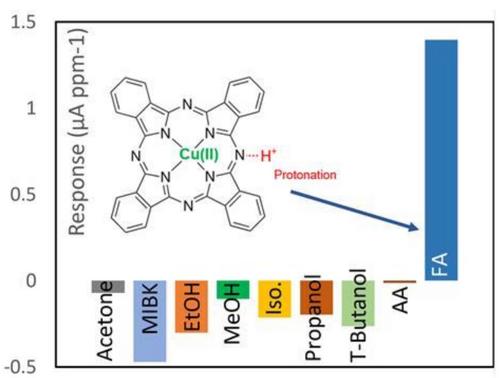
Formic acid (FA) is one of the very important organic acids that has been widely used in various industries. The highly corrosive FA can have severe adverse effects on the surrounding environment. Here, we developed an electrochemical sensor that utilizes the material properties of multi-walled carbon nanotubes (MWCNTs), and copper phthalocyanine (CuPc) for the real-time detection of FA gas. The response of FA has been compared with the responses of 9 common volatile organic compounds (VOCs). The chronoamperometry (CA) results revealed a high selectivity towards FA by showing an increase in the sensor current by about 25 %, in contrast to the decrease of the current in response to the other VOCs. The sensitivity of the CuPc device to FA was calculated to be 38.85 mAM−1. Material characterization (SEM, EDX, FTIR, Raman, and UV-vis) also strongly suggests a protonation mechanism caused by the carboxylic acid group, which enhances the electrical conductivity.






 京公网安备 11010802042870号
京ICP备2023020795号-1
京公网安备 11010802042870号
京ICP备2023020795号-1

 分享
分享

 求助内容:
求助内容: 应助结果提醒方式:
 扫码关注我们
