Eliandreina Cruz-Barrios, Sarah N. Lak, Cameron Taylor, Emily B. Pentzer
{"title":"乳液中聚合物沉淀对液体的封装","authors":"Eliandreina Cruz-Barrios, Sarah N. Lak, Cameron Taylor, Emily B. Pentzer","doi":"10.1002/pol.20240607","DOIUrl":null,"url":null,"abstract":"<div>\n \n <p>Microencapsulation strategies enable the confinement of sensitive active materials in a protective shell, giving capsules with applications across pharmaceuticals, foodstuffs, agriculture, textiles, cosmetics, and energy storage. Among the different approaches, the soft template encapsulation method is a widely used technique that leverages emulsions as templates and forms spherical microcapsules with a liquid core and polymeric shell. Within the emulsion template umbrella, interfacial polymerization, phase internal phase separation, and polymer precipitation can all be used. The main limitation of interfacial polymerization is that the core will inevitably contain impurities such as residual monomers, which can affect the performance of the encapsulated material. This is especially relevant when performance efficiency strongly depends on its pristine composition. In this perspective, we focus on polymer precipitation soft-template strategies for capsule formation, and the complementarity of this approach to the more widely used interfacial polymerization. Polymer precipitation strategies enable the encapsulation of sensitive cores (or payloads) and can include those that are viscous, hygroscopic, and reactive.</p>\n </div>","PeriodicalId":16888,"journal":{"name":"Journal of Polymer Science","volume":"63 1","pages":"146-163"},"PeriodicalIF":3.6000,"publicationDate":"2024-10-21","publicationTypes":"Journal Article","fieldsOfStudy":null,"isOpenAccess":false,"openAccessPdf":"","citationCount":"0","resultStr":"{\"title\":\"Encapsulation of Liquids via Polymer Precipitation in Emulsions\",\"authors\":\"Eliandreina Cruz-Barrios, Sarah N. Lak, Cameron Taylor, Emily B. Pentzer\",\"doi\":\"10.1002/pol.20240607\",\"DOIUrl\":null,\"url\":null,\"abstract\":\"<div>\\n \\n <p>Microencapsulation strategies enable the confinement of sensitive active materials in a protective shell, giving capsules with applications across pharmaceuticals, foodstuffs, agriculture, textiles, cosmetics, and energy storage. Among the different approaches, the soft template encapsulation method is a widely used technique that leverages emulsions as templates and forms spherical microcapsules with a liquid core and polymeric shell. Within the emulsion template umbrella, interfacial polymerization, phase internal phase separation, and polymer precipitation can all be used. The main limitation of interfacial polymerization is that the core will inevitably contain impurities such as residual monomers, which can affect the performance of the encapsulated material. This is especially relevant when performance efficiency strongly depends on its pristine composition. In this perspective, we focus on polymer precipitation soft-template strategies for capsule formation, and the complementarity of this approach to the more widely used interfacial polymerization. Polymer precipitation strategies enable the encapsulation of sensitive cores (or payloads) and can include those that are viscous, hygroscopic, and reactive.</p>\\n </div>\",\"PeriodicalId\":16888,\"journal\":{\"name\":\"Journal of Polymer Science\",\"volume\":\"63 1\",\"pages\":\"146-163\"},\"PeriodicalIF\":3.6000,\"publicationDate\":\"2024-10-21\",\"publicationTypes\":\"Journal Article\",\"fieldsOfStudy\":null,\"isOpenAccess\":false,\"openAccessPdf\":\"\",\"citationCount\":\"0\",\"resultStr\":null,\"platform\":\"Semanticscholar\",\"paperid\":null,\"PeriodicalName\":\"Journal of Polymer Science\",\"FirstCategoryId\":\"92\",\"ListUrlMain\":\"https://onlinelibrary.wiley.com/doi/10.1002/pol.20240607\",\"RegionNum\":3,\"RegionCategory\":\"化学\",\"ArticlePicture\":[],\"TitleCN\":null,\"AbstractTextCN\":null,\"PMCID\":null,\"EPubDate\":\"\",\"PubModel\":\"\",\"JCR\":\"Q2\",\"JCRName\":\"POLYMER SCIENCE\",\"Score\":null,\"Total\":0}","platform":"Semanticscholar","paperid":null,"PeriodicalName":"Journal of Polymer Science","FirstCategoryId":"92","ListUrlMain":"https://onlinelibrary.wiley.com/doi/10.1002/pol.20240607","RegionNum":3,"RegionCategory":"化学","ArticlePicture":[],"TitleCN":null,"AbstractTextCN":null,"PMCID":null,"EPubDate":"","PubModel":"","JCR":"Q2","JCRName":"POLYMER SCIENCE","Score":null,"Total":0}
Encapsulation of Liquids via Polymer Precipitation in Emulsions
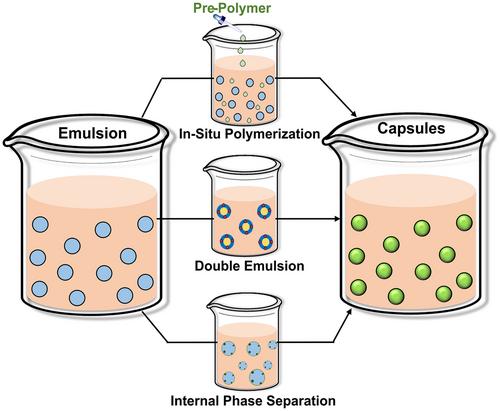
Microencapsulation strategies enable the confinement of sensitive active materials in a protective shell, giving capsules with applications across pharmaceuticals, foodstuffs, agriculture, textiles, cosmetics, and energy storage. Among the different approaches, the soft template encapsulation method is a widely used technique that leverages emulsions as templates and forms spherical microcapsules with a liquid core and polymeric shell. Within the emulsion template umbrella, interfacial polymerization, phase internal phase separation, and polymer precipitation can all be used. The main limitation of interfacial polymerization is that the core will inevitably contain impurities such as residual monomers, which can affect the performance of the encapsulated material. This is especially relevant when performance efficiency strongly depends on its pristine composition. In this perspective, we focus on polymer precipitation soft-template strategies for capsule formation, and the complementarity of this approach to the more widely used interfacial polymerization. Polymer precipitation strategies enable the encapsulation of sensitive cores (or payloads) and can include those that are viscous, hygroscopic, and reactive.
期刊介绍:
Journal of Polymer Research provides a forum for the prompt publication of articles concerning the fundamental and applied research of polymers. Its great feature lies in the diversity of content which it encompasses, drawing together results from all aspects of polymer science and technology.
As polymer research is rapidly growing around the globe, the aim of this journal is to establish itself as a significant information tool not only for the international polymer researchers in academia but also for those working in industry. The scope of the journal covers a wide range of the highly interdisciplinary field of polymer science and technology.




 京公网安备 11010802042870号
京ICP备2023020795号-1
京公网安备 11010802042870号
京ICP备2023020795号-1

 分享
分享
 求助内容:
求助内容: 应助结果提醒方式:
 扫码关注我们
