Brunna F. Henriques, Amanda Neumann, Lucas V. Bertolim, Rafaela C. de Freitas, Luiz R. G. Silva, Jéssica S. Stefano, Bruno C. Janegitz
{"title":"3d打印环丙沙星电化学传感器的研制与应用","authors":"Brunna F. Henriques, Amanda Neumann, Lucas V. Bertolim, Rafaela C. de Freitas, Luiz R. G. Silva, Jéssica S. Stefano, Bruno C. Janegitz","doi":"10.1002/elan.12008","DOIUrl":null,"url":null,"abstract":"<p>The production of electrochemical devices and systems using additive manufacturing technology, particularly three-dimensional (3D) printing, has proven to be highly promising. This work reports the development of 3D-printed electrochemical sensors for the determination of the antibiotic ciprofloxacin (CIP). To achieve this, a lab-made conductive filament composed of carbon black (CB) and polylactic acid (PLA) was produced and utilized in the fabrication of the sensors. Additionally, an electrochemical cell was constructed using a nonconductive filament, resulting in a miniaturized and entirely additively manufactured platform. The characterization of the proposed CB–PLA sensor was carried out using scanning electron microscopy and electrochemical techniques. The proposed sensor has shown a linear range of 1.0–12.5 µmol L<sup>−1</sup>, with a sensitivity of 3.77 µA µmol<sup>−1</sup> L, and limits of detection and quantification of 0.3 and 0.9 µmol L<sup>−1</sup> for CIP, respectively. Regarding the analysis of the samples (tap water and synthetic urine), it was observed recovery values close to 100% for all samples. Thus, the 3D-printed electrochemical device presents itself as a high-potential alternative for CIP drug control, with the possibility of being used in the field and point of care.</p>","PeriodicalId":162,"journal":{"name":"Electroanalysis","volume":"37 1","pages":""},"PeriodicalIF":2.3000,"publicationDate":"2025-01-23","publicationTypes":"Journal Article","fieldsOfStudy":null,"isOpenAccess":false,"openAccessPdf":"","citationCount":"0","resultStr":"{\"title\":\"Development and Application of 3D-Printed Electrochemical Sensors for Ciprofloxacin Detection\",\"authors\":\"Brunna F. Henriques, Amanda Neumann, Lucas V. Bertolim, Rafaela C. de Freitas, Luiz R. G. Silva, Jéssica S. Stefano, Bruno C. Janegitz\",\"doi\":\"10.1002/elan.12008\",\"DOIUrl\":null,\"url\":null,\"abstract\":\"<p>The production of electrochemical devices and systems using additive manufacturing technology, particularly three-dimensional (3D) printing, has proven to be highly promising. This work reports the development of 3D-printed electrochemical sensors for the determination of the antibiotic ciprofloxacin (CIP). To achieve this, a lab-made conductive filament composed of carbon black (CB) and polylactic acid (PLA) was produced and utilized in the fabrication of the sensors. Additionally, an electrochemical cell was constructed using a nonconductive filament, resulting in a miniaturized and entirely additively manufactured platform. The characterization of the proposed CB–PLA sensor was carried out using scanning electron microscopy and electrochemical techniques. The proposed sensor has shown a linear range of 1.0–12.5 µmol L<sup>−1</sup>, with a sensitivity of 3.77 µA µmol<sup>−1</sup> L, and limits of detection and quantification of 0.3 and 0.9 µmol L<sup>−1</sup> for CIP, respectively. Regarding the analysis of the samples (tap water and synthetic urine), it was observed recovery values close to 100% for all samples. Thus, the 3D-printed electrochemical device presents itself as a high-potential alternative for CIP drug control, with the possibility of being used in the field and point of care.</p>\",\"PeriodicalId\":162,\"journal\":{\"name\":\"Electroanalysis\",\"volume\":\"37 1\",\"pages\":\"\"},\"PeriodicalIF\":2.3000,\"publicationDate\":\"2025-01-23\",\"publicationTypes\":\"Journal Article\",\"fieldsOfStudy\":null,\"isOpenAccess\":false,\"openAccessPdf\":\"\",\"citationCount\":\"0\",\"resultStr\":null,\"platform\":\"Semanticscholar\",\"paperid\":null,\"PeriodicalName\":\"Electroanalysis\",\"FirstCategoryId\":\"92\",\"ListUrlMain\":\"https://analyticalsciencejournals.onlinelibrary.wiley.com/doi/10.1002/elan.12008\",\"RegionNum\":3,\"RegionCategory\":\"化学\",\"ArticlePicture\":[],\"TitleCN\":null,\"AbstractTextCN\":null,\"PMCID\":null,\"EPubDate\":\"\",\"PubModel\":\"\",\"JCR\":\"Q2\",\"JCRName\":\"CHEMISTRY, ANALYTICAL\",\"Score\":null,\"Total\":0}","platform":"Semanticscholar","paperid":null,"PeriodicalName":"Electroanalysis","FirstCategoryId":"92","ListUrlMain":"https://analyticalsciencejournals.onlinelibrary.wiley.com/doi/10.1002/elan.12008","RegionNum":3,"RegionCategory":"化学","ArticlePicture":[],"TitleCN":null,"AbstractTextCN":null,"PMCID":null,"EPubDate":"","PubModel":"","JCR":"Q2","JCRName":"CHEMISTRY, ANALYTICAL","Score":null,"Total":0}
Development and Application of 3D-Printed Electrochemical Sensors for Ciprofloxacin Detection
The production of electrochemical devices and systems using additive manufacturing technology, particularly three-dimensional (3D) printing, has proven to be highly promising. This work reports the development of 3D-printed electrochemical sensors for the determination of the antibiotic ciprofloxacin (CIP). To achieve this, a lab-made conductive filament composed of carbon black (CB) and polylactic acid (PLA) was produced and utilized in the fabrication of the sensors. Additionally, an electrochemical cell was constructed using a nonconductive filament, resulting in a miniaturized and entirely additively manufactured platform. The characterization of the proposed CB–PLA sensor was carried out using scanning electron microscopy and electrochemical techniques. The proposed sensor has shown a linear range of 1.0–12.5 µmol L−1, with a sensitivity of 3.77 µA µmol−1 L, and limits of detection and quantification of 0.3 and 0.9 µmol L−1 for CIP, respectively. Regarding the analysis of the samples (tap water and synthetic urine), it was observed recovery values close to 100% for all samples. Thus, the 3D-printed electrochemical device presents itself as a high-potential alternative for CIP drug control, with the possibility of being used in the field and point of care.
期刊介绍:
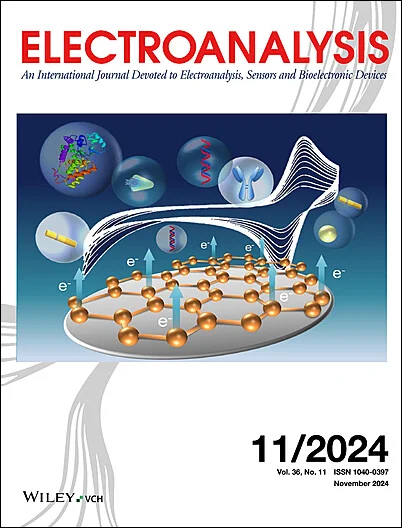
Electroanalysis is an international, peer-reviewed journal covering all branches of electroanalytical chemistry, including both fundamental and application papers as well as reviews dealing with new electrochemical sensors and biosensors, nanobioelectronics devices, analytical voltammetry, potentiometry, new electrochemical detection schemes based on novel nanomaterials, fuel cells and biofuel cells, and important practical applications.
Serving as a vital communication link between the research labs and the field, Electroanalysis helps you to quickly adapt the latest innovations into practical clinical, environmental, food analysis, industrial and energy-related applications. Electroanalysis provides the most comprehensive coverage of the field and is the number one source for information on electroanalytical chemistry, electrochemical sensors and biosensors and fuel/biofuel cells.




 京公网安备 11010802042870号
京ICP备2023020795号-1
京公网安备 11010802042870号
京ICP备2023020795号-1

 分享
分享
 求助内容:
求助内容: 应助结果提醒方式:
 扫码关注我们
