{"title":"聚芦丁膜修饰电化学传感器测定水中氟喹诺酮类抗生素","authors":"Jiao Qiu, Wanglei Gou, Wen Chen, JingFeng Gao","doi":"10.1002/elan.12006","DOIUrl":null,"url":null,"abstract":"<p>This study is aimed at the determination of a new pollutant, fluoroquinolones antibiotics (FQs). Taking ciprofloxacin (CIP) as the research representative, rutin polymer film-modified sensor polyrutin modified glass carbon electrode (PRT/GCE) was prepared by electropolymerization, and a new analytical method for the determination of FQs was established, which is environmentally friendly, simple, efficient, and economical. The topography, elemental composition, and electrochemical behavior of the sensor were investigated using scanning electron microscopy (SEM), X-ray photoelectron spectroscopy (XPS), electrochemical impedance spectroscopy (EIS), and cyclic voltammetry (CV). The results showed that the linear range of the PRT/GCE sensor used for CIP was 0.8–50 μM, the detection limit was 0.050 μM, and the recovery rate was 94.9%–104%. In addition, when it was used to detect norfloxacin (NOR), enrofloxacin (ENR), pefloxacin (PEF), and rofloxacin (FLE) in FQs, the sensor similarly exhibited a broad linear range; its corresponding detection limits were 0.078, 0.16, 0.088, and 0.12 μM, respectively. The PRT/GCE sensor had a high active area, good catalytic performance for FQs, simple preparation, stable performance, and reusability. It has potential application value for routine determination of fluoroquinolones in real water.</p>","PeriodicalId":162,"journal":{"name":"Electroanalysis","volume":"37 1","pages":""},"PeriodicalIF":2.3000,"publicationDate":"2025-01-23","publicationTypes":"Journal Article","fieldsOfStudy":null,"isOpenAccess":false,"openAccessPdf":"","citationCount":"0","resultStr":"{\"title\":\"Determination of Fluoroquinolones Antibiotics in Water by Polyrutin Film-Modified Electrochemical Sensor\",\"authors\":\"Jiao Qiu, Wanglei Gou, Wen Chen, JingFeng Gao\",\"doi\":\"10.1002/elan.12006\",\"DOIUrl\":null,\"url\":null,\"abstract\":\"<p>This study is aimed at the determination of a new pollutant, fluoroquinolones antibiotics (FQs). Taking ciprofloxacin (CIP) as the research representative, rutin polymer film-modified sensor polyrutin modified glass carbon electrode (PRT/GCE) was prepared by electropolymerization, and a new analytical method for the determination of FQs was established, which is environmentally friendly, simple, efficient, and economical. The topography, elemental composition, and electrochemical behavior of the sensor were investigated using scanning electron microscopy (SEM), X-ray photoelectron spectroscopy (XPS), electrochemical impedance spectroscopy (EIS), and cyclic voltammetry (CV). The results showed that the linear range of the PRT/GCE sensor used for CIP was 0.8–50 μM, the detection limit was 0.050 μM, and the recovery rate was 94.9%–104%. In addition, when it was used to detect norfloxacin (NOR), enrofloxacin (ENR), pefloxacin (PEF), and rofloxacin (FLE) in FQs, the sensor similarly exhibited a broad linear range; its corresponding detection limits were 0.078, 0.16, 0.088, and 0.12 μM, respectively. The PRT/GCE sensor had a high active area, good catalytic performance for FQs, simple preparation, stable performance, and reusability. It has potential application value for routine determination of fluoroquinolones in real water.</p>\",\"PeriodicalId\":162,\"journal\":{\"name\":\"Electroanalysis\",\"volume\":\"37 1\",\"pages\":\"\"},\"PeriodicalIF\":2.3000,\"publicationDate\":\"2025-01-23\",\"publicationTypes\":\"Journal Article\",\"fieldsOfStudy\":null,\"isOpenAccess\":false,\"openAccessPdf\":\"\",\"citationCount\":\"0\",\"resultStr\":null,\"platform\":\"Semanticscholar\",\"paperid\":null,\"PeriodicalName\":\"Electroanalysis\",\"FirstCategoryId\":\"92\",\"ListUrlMain\":\"https://analyticalsciencejournals.onlinelibrary.wiley.com/doi/10.1002/elan.12006\",\"RegionNum\":3,\"RegionCategory\":\"化学\",\"ArticlePicture\":[],\"TitleCN\":null,\"AbstractTextCN\":null,\"PMCID\":null,\"EPubDate\":\"\",\"PubModel\":\"\",\"JCR\":\"Q2\",\"JCRName\":\"CHEMISTRY, ANALYTICAL\",\"Score\":null,\"Total\":0}","platform":"Semanticscholar","paperid":null,"PeriodicalName":"Electroanalysis","FirstCategoryId":"92","ListUrlMain":"https://analyticalsciencejournals.onlinelibrary.wiley.com/doi/10.1002/elan.12006","RegionNum":3,"RegionCategory":"化学","ArticlePicture":[],"TitleCN":null,"AbstractTextCN":null,"PMCID":null,"EPubDate":"","PubModel":"","JCR":"Q2","JCRName":"CHEMISTRY, ANALYTICAL","Score":null,"Total":0}
Determination of Fluoroquinolones Antibiotics in Water by Polyrutin Film-Modified Electrochemical Sensor
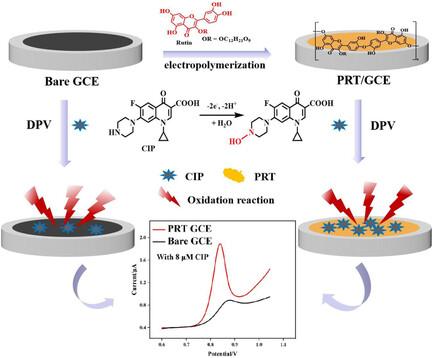
This study is aimed at the determination of a new pollutant, fluoroquinolones antibiotics (FQs). Taking ciprofloxacin (CIP) as the research representative, rutin polymer film-modified sensor polyrutin modified glass carbon electrode (PRT/GCE) was prepared by electropolymerization, and a new analytical method for the determination of FQs was established, which is environmentally friendly, simple, efficient, and economical. The topography, elemental composition, and electrochemical behavior of the sensor were investigated using scanning electron microscopy (SEM), X-ray photoelectron spectroscopy (XPS), electrochemical impedance spectroscopy (EIS), and cyclic voltammetry (CV). The results showed that the linear range of the PRT/GCE sensor used for CIP was 0.8–50 μM, the detection limit was 0.050 μM, and the recovery rate was 94.9%–104%. In addition, when it was used to detect norfloxacin (NOR), enrofloxacin (ENR), pefloxacin (PEF), and rofloxacin (FLE) in FQs, the sensor similarly exhibited a broad linear range; its corresponding detection limits were 0.078, 0.16, 0.088, and 0.12 μM, respectively. The PRT/GCE sensor had a high active area, good catalytic performance for FQs, simple preparation, stable performance, and reusability. It has potential application value for routine determination of fluoroquinolones in real water.
期刊介绍:
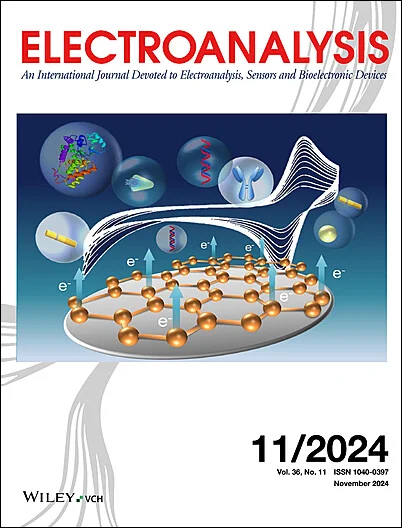
Electroanalysis is an international, peer-reviewed journal covering all branches of electroanalytical chemistry, including both fundamental and application papers as well as reviews dealing with new electrochemical sensors and biosensors, nanobioelectronics devices, analytical voltammetry, potentiometry, new electrochemical detection schemes based on novel nanomaterials, fuel cells and biofuel cells, and important practical applications.
Serving as a vital communication link between the research labs and the field, Electroanalysis helps you to quickly adapt the latest innovations into practical clinical, environmental, food analysis, industrial and energy-related applications. Electroanalysis provides the most comprehensive coverage of the field and is the number one source for information on electroanalytical chemistry, electrochemical sensors and biosensors and fuel/biofuel cells.





 京公网安备 11010802042870号
京ICP备2023020795号-1
京公网安备 11010802042870号
京ICP备2023020795号-1

 分享
分享
 求助内容:
求助内容: 应助结果提醒方式:
 扫码关注我们
