{"title":"基于模糊的物联网节能路由:交通延迟优化","authors":"P. Roy Sudha Reetha, N. Pandeeswari","doi":"10.1002/dac.6055","DOIUrl":null,"url":null,"abstract":"<div>\n \n <p>Energy conservation and optimized traffic delay are crucial challenges in Internet of Things (IoT) systems, particularly in wireless sensor networks (WSNs). This study presents a novel approach to address these issues through a fuzzy-based routing protocol. Traditional methods often struggle to effectively enhance routing protocols with optimized packet size control. Researchers have proposed a combination of machine learning and evolutionary techniques to overcome this limitation and enhance energy efficiency in WSNs. The new approach called MOSPFNN (Multi-Objective Spider Prey-localized Fuzzy Neural Network) leverages fuzzy logic control (FLC) to select optimal paths for traffic-aware multipath routing. Additionally, a new meta-heuristic algorithm of SP optimizer is employed to develop an energy-efficient spatial routing protocol with superior convergence and minimal local optima. The proposed protocol incorporates optimal FNN for congestion monitoring and traffic-aware routing. Simulation results validate that new protocol outperforms existing methods in terms of average end-to-end delay and packet delivery ratio (PDR). Using MOSPFNN, traffic with different priority levels can achieve a successful PDR rate of over 92% and network lifetime of above 2% than previous network within a reasonable timeframe. This research contributes to advancing energy-efficient and traffic delay-aware routing protocols in IoT systems.</p>\n </div>","PeriodicalId":13946,"journal":{"name":"International Journal of Communication Systems","volume":"38 2","pages":""},"PeriodicalIF":1.8000,"publicationDate":"2024-12-25","publicationTypes":"Journal Article","fieldsOfStudy":null,"isOpenAccess":false,"openAccessPdf":"","citationCount":"0","resultStr":"{\"title\":\"Fuzzy Based Energy Efficient Routing for IoT: Traffic Delay Optimization\",\"authors\":\"P. Roy Sudha Reetha, N. Pandeeswari\",\"doi\":\"10.1002/dac.6055\",\"DOIUrl\":null,\"url\":null,\"abstract\":\"<div>\\n \\n <p>Energy conservation and optimized traffic delay are crucial challenges in Internet of Things (IoT) systems, particularly in wireless sensor networks (WSNs). This study presents a novel approach to address these issues through a fuzzy-based routing protocol. Traditional methods often struggle to effectively enhance routing protocols with optimized packet size control. Researchers have proposed a combination of machine learning and evolutionary techniques to overcome this limitation and enhance energy efficiency in WSNs. The new approach called MOSPFNN (Multi-Objective Spider Prey-localized Fuzzy Neural Network) leverages fuzzy logic control (FLC) to select optimal paths for traffic-aware multipath routing. Additionally, a new meta-heuristic algorithm of SP optimizer is employed to develop an energy-efficient spatial routing protocol with superior convergence and minimal local optima. The proposed protocol incorporates optimal FNN for congestion monitoring and traffic-aware routing. Simulation results validate that new protocol outperforms existing methods in terms of average end-to-end delay and packet delivery ratio (PDR). Using MOSPFNN, traffic with different priority levels can achieve a successful PDR rate of over 92% and network lifetime of above 2% than previous network within a reasonable timeframe. This research contributes to advancing energy-efficient and traffic delay-aware routing protocols in IoT systems.</p>\\n </div>\",\"PeriodicalId\":13946,\"journal\":{\"name\":\"International Journal of Communication Systems\",\"volume\":\"38 2\",\"pages\":\"\"},\"PeriodicalIF\":1.8000,\"publicationDate\":\"2024-12-25\",\"publicationTypes\":\"Journal Article\",\"fieldsOfStudy\":null,\"isOpenAccess\":false,\"openAccessPdf\":\"\",\"citationCount\":\"0\",\"resultStr\":null,\"platform\":\"Semanticscholar\",\"paperid\":null,\"PeriodicalName\":\"International Journal of Communication Systems\",\"FirstCategoryId\":\"94\",\"ListUrlMain\":\"https://onlinelibrary.wiley.com/doi/10.1002/dac.6055\",\"RegionNum\":4,\"RegionCategory\":\"计算机科学\",\"ArticlePicture\":[],\"TitleCN\":null,\"AbstractTextCN\":null,\"PMCID\":null,\"EPubDate\":\"\",\"PubModel\":\"\",\"JCR\":\"Q3\",\"JCRName\":\"ENGINEERING, ELECTRICAL & ELECTRONIC\",\"Score\":null,\"Total\":0}","platform":"Semanticscholar","paperid":null,"PeriodicalName":"International Journal of Communication Systems","FirstCategoryId":"94","ListUrlMain":"https://onlinelibrary.wiley.com/doi/10.1002/dac.6055","RegionNum":4,"RegionCategory":"计算机科学","ArticlePicture":[],"TitleCN":null,"AbstractTextCN":null,"PMCID":null,"EPubDate":"","PubModel":"","JCR":"Q3","JCRName":"ENGINEERING, ELECTRICAL & ELECTRONIC","Score":null,"Total":0}
Fuzzy Based Energy Efficient Routing for IoT: Traffic Delay Optimization
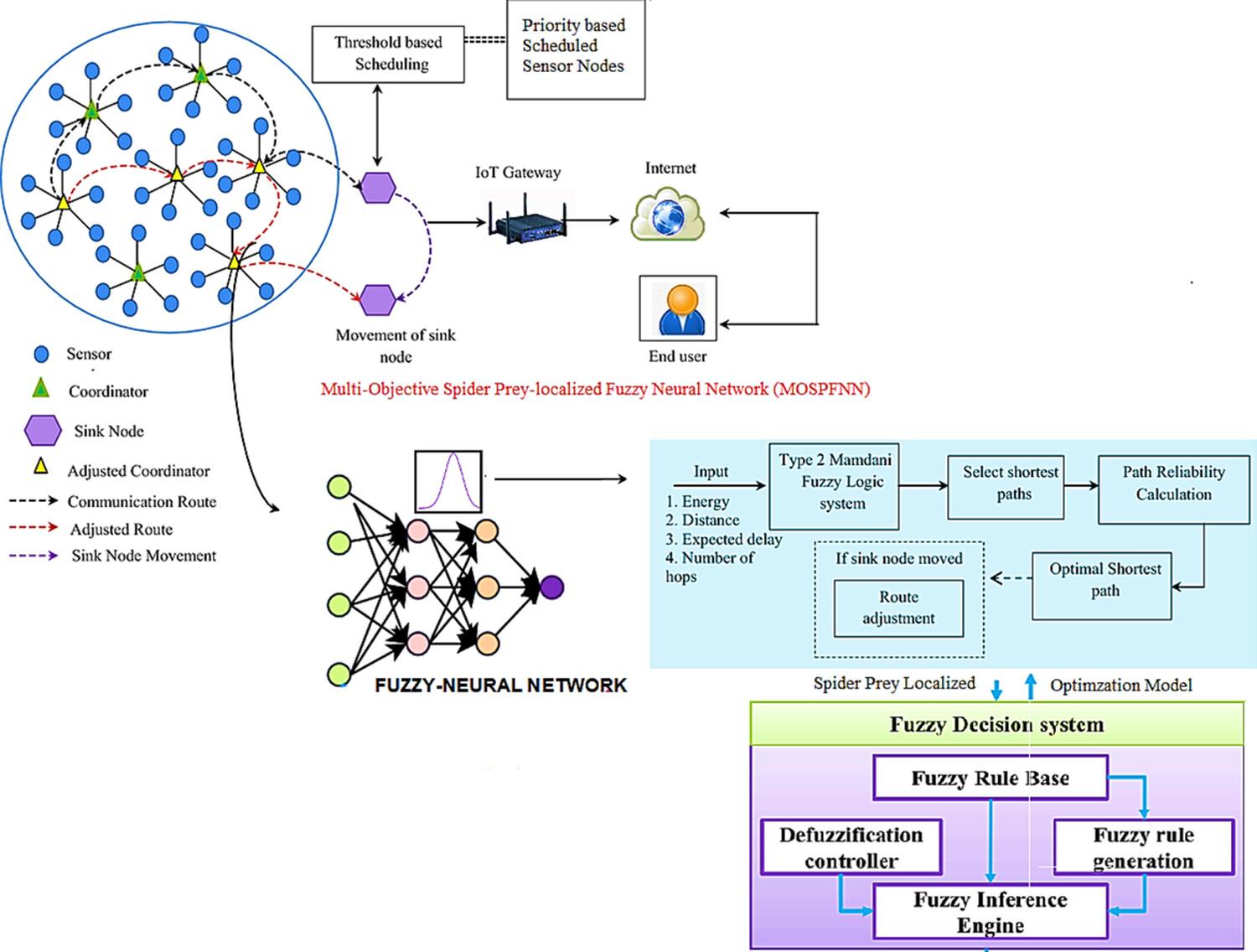
Energy conservation and optimized traffic delay are crucial challenges in Internet of Things (IoT) systems, particularly in wireless sensor networks (WSNs). This study presents a novel approach to address these issues through a fuzzy-based routing protocol. Traditional methods often struggle to effectively enhance routing protocols with optimized packet size control. Researchers have proposed a combination of machine learning and evolutionary techniques to overcome this limitation and enhance energy efficiency in WSNs. The new approach called MOSPFNN (Multi-Objective Spider Prey-localized Fuzzy Neural Network) leverages fuzzy logic control (FLC) to select optimal paths for traffic-aware multipath routing. Additionally, a new meta-heuristic algorithm of SP optimizer is employed to develop an energy-efficient spatial routing protocol with superior convergence and minimal local optima. The proposed protocol incorporates optimal FNN for congestion monitoring and traffic-aware routing. Simulation results validate that new protocol outperforms existing methods in terms of average end-to-end delay and packet delivery ratio (PDR). Using MOSPFNN, traffic with different priority levels can achieve a successful PDR rate of over 92% and network lifetime of above 2% than previous network within a reasonable timeframe. This research contributes to advancing energy-efficient and traffic delay-aware routing protocols in IoT systems.
期刊介绍:
The International Journal of Communication Systems provides a forum for R&D, open to researchers from all types of institutions and organisations worldwide, aimed at the increasingly important area of communication technology. The Journal''s emphasis is particularly on the issues impacting behaviour at the system, service and management levels. Published twelve times a year, it provides coverage of advances that have a significant potential to impact the immense technical and commercial opportunities in the communications sector. The International Journal of Communication Systems strives to select a balance of contributions that promotes technical innovation allied to practical relevance across the range of system types and issues.
The Journal addresses both public communication systems (Telecommunication, mobile, Internet, and Cable TV) and private systems (Intranets, enterprise networks, LANs, MANs, WANs). The following key areas and issues are regularly covered:
-Transmission/Switching/Distribution technologies (ATM, SDH, TCP/IP, routers, DSL, cable modems, VoD, VoIP, WDM, etc.)
-System control, network/service management
-Network and Internet protocols and standards
-Client-server, distributed and Web-based communication systems
-Broadband and multimedia systems and applications, with a focus on increased service variety and interactivity
-Trials of advanced systems and services; their implementation and evaluation
-Novel concepts and improvements in technique; their theoretical basis and performance analysis using measurement/testing, modelling and simulation
-Performance evaluation issues and methods.




 京公网安备 11010802042870号
京ICP备2023020795号-1
京公网安备 11010802042870号
京ICP备2023020795号-1

 分享
分享
 求助内容:
求助内容: 应助结果提醒方式:
 扫码关注我们
