Karina Dueñas-Parro, Oscar Gulias, Montserrat Agut, Felipe de la Cruz-Martínez, Agustín Lara-Sánchez, José A. Castro-Osma, Juan F. García-Reyes, Antonio Sánchez-Ruiz, Cristina Martín, Santi Nonell, Roger Bresolí-Obach
{"title":"聚簇与杀伤:聚簇触发发射材料在抗菌光动力治疗中单线态氧光敏化的应用","authors":"Karina Dueñas-Parro, Oscar Gulias, Montserrat Agut, Felipe de la Cruz-Martínez, Agustín Lara-Sánchez, José A. Castro-Osma, Juan F. García-Reyes, Antonio Sánchez-Ruiz, Cristina Martín, Santi Nonell, Roger Bresolí-Obach","doi":"10.1002/adom.202402179","DOIUrl":null,"url":null,"abstract":"<p>The emergence of light-based technologies is revolutionizing modern medicine and healthcare by enabling precise disease diagnosis and treatment through various luminescent agents and imaging techniques. Despite challenges like biocompatibility, spectral tuning, and synthesis complexity, the primary issue is the aggregation-caused quenching of emission on high concentrations or physiological conditions. In light of these problems, Clustering-Triggered Emission (CTE), which involves the formation of atomic clusters to induce light absorption and the luminescence of unconventional chromophores, represents an all-in-one solution to the challenges identified. Given the potential for CTE materials to behave in ways previously only associated with conventional chromophores, it seems reasonable that highly oxidative reactive oxygen species can be formed from CTE excited states. The results demonstrate that it is possible to transfer the excess energy from the CTE long-lived excited states to molecular oxygen, thereby producing singlet oxygen. It is also noteworthy that over 99.9% of <i>Staphylococcus aureus</i> cells can be eradicated using fluences comparable to those used in traditional systems under violet light irradiation. Uncovering these photophysical properties of CTE opens the door to a revolutionary breakthrough that can disrupt conventional photodynamic therapy and usher in a new era of CTE-based photosensitizers.</p>","PeriodicalId":116,"journal":{"name":"Advanced Optical Materials","volume":"13 3","pages":""},"PeriodicalIF":7.2000,"publicationDate":"2024-12-25","publicationTypes":"Journal Article","fieldsOfStudy":null,"isOpenAccess":false,"openAccessPdf":"https://onlinelibrary.wiley.com/doi/epdf/10.1002/adom.202402179","citationCount":"0","resultStr":"{\"title\":\"Cluster and Kill: the Use of Clustering-Triggered Emission Materials for Singlet Oxygen Photosensitization in Antimicrobial Photodynamic Therapy\",\"authors\":\"Karina Dueñas-Parro, Oscar Gulias, Montserrat Agut, Felipe de la Cruz-Martínez, Agustín Lara-Sánchez, José A. Castro-Osma, Juan F. García-Reyes, Antonio Sánchez-Ruiz, Cristina Martín, Santi Nonell, Roger Bresolí-Obach\",\"doi\":\"10.1002/adom.202402179\",\"DOIUrl\":null,\"url\":null,\"abstract\":\"<p>The emergence of light-based technologies is revolutionizing modern medicine and healthcare by enabling precise disease diagnosis and treatment through various luminescent agents and imaging techniques. Despite challenges like biocompatibility, spectral tuning, and synthesis complexity, the primary issue is the aggregation-caused quenching of emission on high concentrations or physiological conditions. In light of these problems, Clustering-Triggered Emission (CTE), which involves the formation of atomic clusters to induce light absorption and the luminescence of unconventional chromophores, represents an all-in-one solution to the challenges identified. Given the potential for CTE materials to behave in ways previously only associated with conventional chromophores, it seems reasonable that highly oxidative reactive oxygen species can be formed from CTE excited states. The results demonstrate that it is possible to transfer the excess energy from the CTE long-lived excited states to molecular oxygen, thereby producing singlet oxygen. It is also noteworthy that over 99.9% of <i>Staphylococcus aureus</i> cells can be eradicated using fluences comparable to those used in traditional systems under violet light irradiation. Uncovering these photophysical properties of CTE opens the door to a revolutionary breakthrough that can disrupt conventional photodynamic therapy and usher in a new era of CTE-based photosensitizers.</p>\",\"PeriodicalId\":116,\"journal\":{\"name\":\"Advanced Optical Materials\",\"volume\":\"13 3\",\"pages\":\"\"},\"PeriodicalIF\":7.2000,\"publicationDate\":\"2024-12-25\",\"publicationTypes\":\"Journal Article\",\"fieldsOfStudy\":null,\"isOpenAccess\":false,\"openAccessPdf\":\"https://onlinelibrary.wiley.com/doi/epdf/10.1002/adom.202402179\",\"citationCount\":\"0\",\"resultStr\":null,\"platform\":\"Semanticscholar\",\"paperid\":null,\"PeriodicalName\":\"Advanced Optical Materials\",\"FirstCategoryId\":\"88\",\"ListUrlMain\":\"https://advanced.onlinelibrary.wiley.com/doi/10.1002/adom.202402179\",\"RegionNum\":2,\"RegionCategory\":\"材料科学\",\"ArticlePicture\":[],\"TitleCN\":null,\"AbstractTextCN\":null,\"PMCID\":null,\"EPubDate\":\"\",\"PubModel\":\"\",\"JCR\":\"Q1\",\"JCRName\":\"MATERIALS SCIENCE, MULTIDISCIPLINARY\",\"Score\":null,\"Total\":0}","platform":"Semanticscholar","paperid":null,"PeriodicalName":"Advanced Optical Materials","FirstCategoryId":"88","ListUrlMain":"https://advanced.onlinelibrary.wiley.com/doi/10.1002/adom.202402179","RegionNum":2,"RegionCategory":"材料科学","ArticlePicture":[],"TitleCN":null,"AbstractTextCN":null,"PMCID":null,"EPubDate":"","PubModel":"","JCR":"Q1","JCRName":"MATERIALS SCIENCE, MULTIDISCIPLINARY","Score":null,"Total":0}
Cluster and Kill: the Use of Clustering-Triggered Emission Materials for Singlet Oxygen Photosensitization in Antimicrobial Photodynamic Therapy
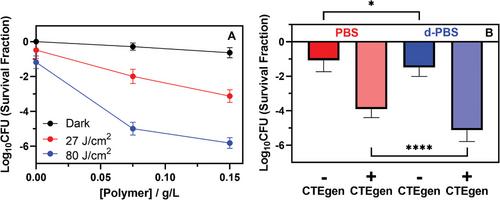
The emergence of light-based technologies is revolutionizing modern medicine and healthcare by enabling precise disease diagnosis and treatment through various luminescent agents and imaging techniques. Despite challenges like biocompatibility, spectral tuning, and synthesis complexity, the primary issue is the aggregation-caused quenching of emission on high concentrations or physiological conditions. In light of these problems, Clustering-Triggered Emission (CTE), which involves the formation of atomic clusters to induce light absorption and the luminescence of unconventional chromophores, represents an all-in-one solution to the challenges identified. Given the potential for CTE materials to behave in ways previously only associated with conventional chromophores, it seems reasonable that highly oxidative reactive oxygen species can be formed from CTE excited states. The results demonstrate that it is possible to transfer the excess energy from the CTE long-lived excited states to molecular oxygen, thereby producing singlet oxygen. It is also noteworthy that over 99.9% of Staphylococcus aureus cells can be eradicated using fluences comparable to those used in traditional systems under violet light irradiation. Uncovering these photophysical properties of CTE opens the door to a revolutionary breakthrough that can disrupt conventional photodynamic therapy and usher in a new era of CTE-based photosensitizers.
期刊介绍:
Advanced Optical Materials, part of the esteemed Advanced portfolio, is a unique materials science journal concentrating on all facets of light-matter interactions. For over a decade, it has been the preferred optical materials journal for significant discoveries in photonics, plasmonics, metamaterials, and more. The Advanced portfolio from Wiley is a collection of globally respected, high-impact journals that disseminate the best science from established and emerging researchers, aiding them in fulfilling their mission and amplifying the reach of their scientific discoveries.






 京公网安备 11010802042870号
京ICP备2023020795号-1
京公网安备 11010802042870号
京ICP备2023020795号-1

 分享
分享
 求助内容:
求助内容: 应助结果提醒方式:
 扫码关注我们
