M. F. de Jong, K. E. Fogaren, I. Le Bras, L. McRaven, H. I. Palevsky
{"title":"大气强迫主导伊明格海对流强度的年际变化","authors":"M. F. de Jong, K. E. Fogaren, I. Le Bras, L. McRaven, H. I. Palevsky","doi":"10.1029/2023JC020799","DOIUrl":null,"url":null,"abstract":"<p>Transformation of light to dense waters by atmospheric cooling is key to the Atlantic Meridional Overturning Circulation in the Subpolar Gyre. Convection in the center of the Irminger Gyre contributes to the formation of the densest waters east of Greenland. We present a 19-year (2002–2020) weekly time series of hydrography and convection in the central Irminger Sea based on (bi-)daily mooring profiles supplemented with Argo profiles. A 70-year annual time series of shipboard hydrography shows that this mooring period is representative of longer-term variability. The depth of convection varies strongly from winter to winter (288–1,500 dbar), with a mean March mixed layer depth (MLD) of 470 dbar and a mean maximum density reached of 27.70 ± 0.05 kg m<sup>−3</sup>. The densification of the water column by local convection directly impacts the sea surface height in the center of the Irminger Gyre and thus large-scale circulation patterns. Both the observations and a Price-Weller-Pinkel mixed layer model analysis show that the main cause of interannual variability in MLD is the strength of the winter atmospheric surface forcing. Its role is three times as important as that of the strength of the maximum stratification in the preceding summer. Strong stratification as a result of a fresh surface anomaly similar to the one observed in 2010 can weaken convection by approximately 170 m on average, but changes in surface forcing will need to be taken into account as well when considering the evolution of Irminger Sea convection under climate change.</p>","PeriodicalId":54340,"journal":{"name":"Journal of Geophysical Research-Oceans","volume":"130 2","pages":""},"PeriodicalIF":3.4000,"publicationDate":"2025-01-28","publicationTypes":"Journal Article","fieldsOfStudy":null,"isOpenAccess":false,"openAccessPdf":"https://onlinelibrary.wiley.com/doi/epdf/10.1029/2023JC020799","citationCount":"0","resultStr":"{\"title\":\"Atmospheric Forcing Dominates the Interannual Variability of Convection Strength in the Irminger Sea\",\"authors\":\"M. F. de Jong, K. E. Fogaren, I. Le Bras, L. McRaven, H. I. Palevsky\",\"doi\":\"10.1029/2023JC020799\",\"DOIUrl\":null,\"url\":null,\"abstract\":\"<p>Transformation of light to dense waters by atmospheric cooling is key to the Atlantic Meridional Overturning Circulation in the Subpolar Gyre. Convection in the center of the Irminger Gyre contributes to the formation of the densest waters east of Greenland. We present a 19-year (2002–2020) weekly time series of hydrography and convection in the central Irminger Sea based on (bi-)daily mooring profiles supplemented with Argo profiles. A 70-year annual time series of shipboard hydrography shows that this mooring period is representative of longer-term variability. The depth of convection varies strongly from winter to winter (288–1,500 dbar), with a mean March mixed layer depth (MLD) of 470 dbar and a mean maximum density reached of 27.70 ± 0.05 kg m<sup>−3</sup>. The densification of the water column by local convection directly impacts the sea surface height in the center of the Irminger Gyre and thus large-scale circulation patterns. Both the observations and a Price-Weller-Pinkel mixed layer model analysis show that the main cause of interannual variability in MLD is the strength of the winter atmospheric surface forcing. Its role is three times as important as that of the strength of the maximum stratification in the preceding summer. Strong stratification as a result of a fresh surface anomaly similar to the one observed in 2010 can weaken convection by approximately 170 m on average, but changes in surface forcing will need to be taken into account as well when considering the evolution of Irminger Sea convection under climate change.</p>\",\"PeriodicalId\":54340,\"journal\":{\"name\":\"Journal of Geophysical Research-Oceans\",\"volume\":\"130 2\",\"pages\":\"\"},\"PeriodicalIF\":3.4000,\"publicationDate\":\"2025-01-28\",\"publicationTypes\":\"Journal Article\",\"fieldsOfStudy\":null,\"isOpenAccess\":false,\"openAccessPdf\":\"https://onlinelibrary.wiley.com/doi/epdf/10.1029/2023JC020799\",\"citationCount\":\"0\",\"resultStr\":null,\"platform\":\"Semanticscholar\",\"paperid\":null,\"PeriodicalName\":\"Journal of Geophysical Research-Oceans\",\"FirstCategoryId\":\"89\",\"ListUrlMain\":\"https://agupubs.onlinelibrary.wiley.com/doi/10.1029/2023JC020799\",\"RegionNum\":2,\"RegionCategory\":\"地球科学\",\"ArticlePicture\":[],\"TitleCN\":null,\"AbstractTextCN\":null,\"PMCID\":null,\"EPubDate\":\"\",\"PubModel\":\"\",\"JCR\":\"Q1\",\"JCRName\":\"OCEANOGRAPHY\",\"Score\":null,\"Total\":0}","platform":"Semanticscholar","paperid":null,"PeriodicalName":"Journal of Geophysical Research-Oceans","FirstCategoryId":"89","ListUrlMain":"https://agupubs.onlinelibrary.wiley.com/doi/10.1029/2023JC020799","RegionNum":2,"RegionCategory":"地球科学","ArticlePicture":[],"TitleCN":null,"AbstractTextCN":null,"PMCID":null,"EPubDate":"","PubModel":"","JCR":"Q1","JCRName":"OCEANOGRAPHY","Score":null,"Total":0}
引用次数: 0
摘要
大气冷却将轻水转化为浓水是次极环流中大西洋经向翻转环流的关键。伊明格环流中心的对流促成了格陵兰岛以东最密集水域的形成。基于(双)日系泊剖面和Argo剖面的补充,我们提出了19年(2002-2020)每周Irminger海中部水文和对流的时间序列。70年的年度船舶水文时间序列表明,这一系泊期代表了较长期的变化。冬季对流深度变化较大(288 ~ 1500 dbar), 3月平均混合层深度(MLD)为470 dbar,平均最大密度为27.70±0.05 kg m−3。局地对流使水柱致密化,直接影响伊明格环流中心海面高度,从而影响大尺度环流型。观测结果和Price-Weller-Pinkel混合层模式分析都表明,MLD年际变化的主要原因是冬季大气表面强迫的强度。它的作用是前一个夏季最大分层强度的三倍。与2010年观测到的类似的新鲜地表异常导致的强分层可使对流平均减弱约170米,但在考虑气候变化下伊尔明格海对流的演变时,也需要考虑地表强迫的变化。
Atmospheric Forcing Dominates the Interannual Variability of Convection Strength in the Irminger Sea
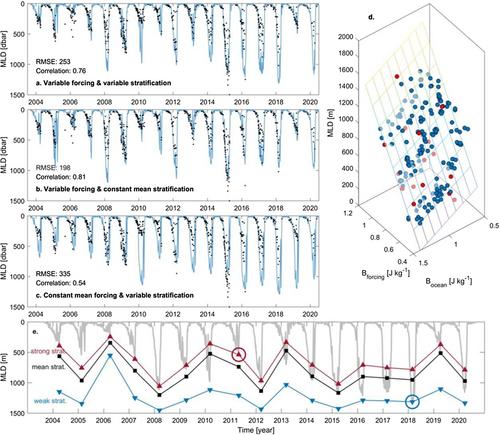
Transformation of light to dense waters by atmospheric cooling is key to the Atlantic Meridional Overturning Circulation in the Subpolar Gyre. Convection in the center of the Irminger Gyre contributes to the formation of the densest waters east of Greenland. We present a 19-year (2002–2020) weekly time series of hydrography and convection in the central Irminger Sea based on (bi-)daily mooring profiles supplemented with Argo profiles. A 70-year annual time series of shipboard hydrography shows that this mooring period is representative of longer-term variability. The depth of convection varies strongly from winter to winter (288–1,500 dbar), with a mean March mixed layer depth (MLD) of 470 dbar and a mean maximum density reached of 27.70 ± 0.05 kg m−3. The densification of the water column by local convection directly impacts the sea surface height in the center of the Irminger Gyre and thus large-scale circulation patterns. Both the observations and a Price-Weller-Pinkel mixed layer model analysis show that the main cause of interannual variability in MLD is the strength of the winter atmospheric surface forcing. Its role is three times as important as that of the strength of the maximum stratification in the preceding summer. Strong stratification as a result of a fresh surface anomaly similar to the one observed in 2010 can weaken convection by approximately 170 m on average, but changes in surface forcing will need to be taken into account as well when considering the evolution of Irminger Sea convection under climate change.







 京公网安备 11010802042870号
京ICP备2023020795号-1
京公网安备 11010802042870号
京ICP备2023020795号-1

 分享
分享
 求助内容:
求助内容: 应助结果提醒方式:
 扫码关注我们
