Melissa Lamar, Konstantinos Arfanakis, Ana W. Capuano, Shengwei Zhang, Debra A. Fleischman, S. Duke Han, Victoria N. Poole, Sue E. Leurgans, David A. Bennett, Lisa L. Barnes
{"title":"老年非裔美国人横向松弛率(R2)的变化和认知的变化","authors":"Melissa Lamar, Konstantinos Arfanakis, Ana W. Capuano, Shengwei Zhang, Debra A. Fleischman, S. Duke Han, Victoria N. Poole, Sue E. Leurgans, David A. Bennett, Lisa L. Barnes","doi":"10.1002/hbm.26794","DOIUrl":null,"url":null,"abstract":"<p>Despite transverse relaxation rate (R<sub>2</sub>) being one of the fundamental contrasts in MRI, most investigations of brain R<sub>2</sub> and cognition have been cross-sectional and conducted in predominantly non-Latino White adults. We investigated the profile of R<sub>2</sub> as related to cognition in 212 older African Americans (~75 years of age) with longitudinal 3T MRI scans and cognitive test data to determine how changes in R<sub>2</sub> are associated with changes in cognition. For each participant, the slopes of global cognitive and five cognitive domain scores were each separately combined with voxel-specific slopes of R<sub>2</sub> in whole brain voxelwise analyses. Participants with less negative rates of R<sub>2</sub> change within left basal ganglia and centrum semiovale, bilateral hippocampal complex and temporal gyri, parietooccipital white matter, as well as posterior cingulate displayed less negative slopes in global cognition. Similar associations were seen for regional R<sub>2</sub> change and episodic memory (most robustly within bilateral hippocampi) as well as semantic memory (left greater than right hemisphere involvement). Results suggest a relatively wide distribution of regional associations between rates of changes in R<sub>2</sub> and changes in global cognition for older African Americans; a profile that became more regionally specific when considering individual cognitive domains. Relative preservation of tissue integrity across grey and white matter, and in key regions associated with specific cognitive domains, is associated with slower cognitive decline for older African Americans. These results may lay the foundation for more directed work to support healthy brain aging in older African Americans.</p>","PeriodicalId":13019,"journal":{"name":"Human Brain Mapping","volume":"46 1","pages":""},"PeriodicalIF":3.3000,"publicationDate":"2024-12-29","publicationTypes":"Journal Article","fieldsOfStudy":null,"isOpenAccess":false,"openAccessPdf":"https://onlinelibrary.wiley.com/doi/epdf/10.1002/hbm.26794","citationCount":"0","resultStr":"{\"title\":\"Change in transverse relaxation rates (R2) and change in cognition for older African Americans\",\"authors\":\"Melissa Lamar, Konstantinos Arfanakis, Ana W. Capuano, Shengwei Zhang, Debra A. Fleischman, S. Duke Han, Victoria N. Poole, Sue E. Leurgans, David A. Bennett, Lisa L. Barnes\",\"doi\":\"10.1002/hbm.26794\",\"DOIUrl\":null,\"url\":null,\"abstract\":\"<p>Despite transverse relaxation rate (R<sub>2</sub>) being one of the fundamental contrasts in MRI, most investigations of brain R<sub>2</sub> and cognition have been cross-sectional and conducted in predominantly non-Latino White adults. We investigated the profile of R<sub>2</sub> as related to cognition in 212 older African Americans (~75 years of age) with longitudinal 3T MRI scans and cognitive test data to determine how changes in R<sub>2</sub> are associated with changes in cognition. For each participant, the slopes of global cognitive and five cognitive domain scores were each separately combined with voxel-specific slopes of R<sub>2</sub> in whole brain voxelwise analyses. Participants with less negative rates of R<sub>2</sub> change within left basal ganglia and centrum semiovale, bilateral hippocampal complex and temporal gyri, parietooccipital white matter, as well as posterior cingulate displayed less negative slopes in global cognition. Similar associations were seen for regional R<sub>2</sub> change and episodic memory (most robustly within bilateral hippocampi) as well as semantic memory (left greater than right hemisphere involvement). Results suggest a relatively wide distribution of regional associations between rates of changes in R<sub>2</sub> and changes in global cognition for older African Americans; a profile that became more regionally specific when considering individual cognitive domains. Relative preservation of tissue integrity across grey and white matter, and in key regions associated with specific cognitive domains, is associated with slower cognitive decline for older African Americans. These results may lay the foundation for more directed work to support healthy brain aging in older African Americans.</p>\",\"PeriodicalId\":13019,\"journal\":{\"name\":\"Human Brain Mapping\",\"volume\":\"46 1\",\"pages\":\"\"},\"PeriodicalIF\":3.3000,\"publicationDate\":\"2024-12-29\",\"publicationTypes\":\"Journal Article\",\"fieldsOfStudy\":null,\"isOpenAccess\":false,\"openAccessPdf\":\"https://onlinelibrary.wiley.com/doi/epdf/10.1002/hbm.26794\",\"citationCount\":\"0\",\"resultStr\":null,\"platform\":\"Semanticscholar\",\"paperid\":null,\"PeriodicalName\":\"Human Brain Mapping\",\"FirstCategoryId\":\"3\",\"ListUrlMain\":\"https://onlinelibrary.wiley.com/doi/10.1002/hbm.26794\",\"RegionNum\":2,\"RegionCategory\":\"医学\",\"ArticlePicture\":[],\"TitleCN\":null,\"AbstractTextCN\":null,\"PMCID\":null,\"EPubDate\":\"\",\"PubModel\":\"\",\"JCR\":\"Q1\",\"JCRName\":\"NEUROIMAGING\",\"Score\":null,\"Total\":0}","platform":"Semanticscholar","paperid":null,"PeriodicalName":"Human Brain Mapping","FirstCategoryId":"3","ListUrlMain":"https://onlinelibrary.wiley.com/doi/10.1002/hbm.26794","RegionNum":2,"RegionCategory":"医学","ArticlePicture":[],"TitleCN":null,"AbstractTextCN":null,"PMCID":null,"EPubDate":"","PubModel":"","JCR":"Q1","JCRName":"NEUROIMAGING","Score":null,"Total":0}
Change in transverse relaxation rates (R2) and change in cognition for older African Americans
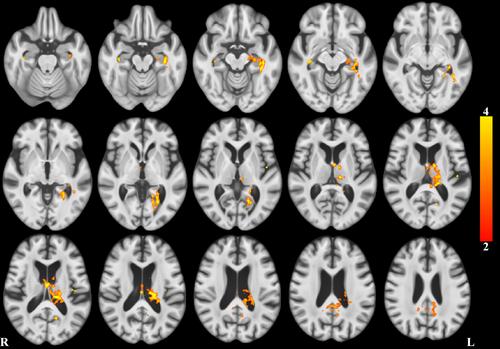
Despite transverse relaxation rate (R2) being one of the fundamental contrasts in MRI, most investigations of brain R2 and cognition have been cross-sectional and conducted in predominantly non-Latino White adults. We investigated the profile of R2 as related to cognition in 212 older African Americans (~75 years of age) with longitudinal 3T MRI scans and cognitive test data to determine how changes in R2 are associated with changes in cognition. For each participant, the slopes of global cognitive and five cognitive domain scores were each separately combined with voxel-specific slopes of R2 in whole brain voxelwise analyses. Participants with less negative rates of R2 change within left basal ganglia and centrum semiovale, bilateral hippocampal complex and temporal gyri, parietooccipital white matter, as well as posterior cingulate displayed less negative slopes in global cognition. Similar associations were seen for regional R2 change and episodic memory (most robustly within bilateral hippocampi) as well as semantic memory (left greater than right hemisphere involvement). Results suggest a relatively wide distribution of regional associations between rates of changes in R2 and changes in global cognition for older African Americans; a profile that became more regionally specific when considering individual cognitive domains. Relative preservation of tissue integrity across grey and white matter, and in key regions associated with specific cognitive domains, is associated with slower cognitive decline for older African Americans. These results may lay the foundation for more directed work to support healthy brain aging in older African Americans.
期刊介绍:
Human Brain Mapping publishes peer-reviewed basic, clinical, technical, and theoretical research in the interdisciplinary and rapidly expanding field of human brain mapping. The journal features research derived from non-invasive brain imaging modalities used to explore the spatial and temporal organization of the neural systems supporting human behavior. Imaging modalities of interest include positron emission tomography, event-related potentials, electro-and magnetoencephalography, magnetic resonance imaging, and single-photon emission tomography. Brain mapping research in both normal and clinical populations is encouraged.
Article formats include Research Articles, Review Articles, Clinical Case Studies, and Technique, as well as Technological Developments, Theoretical Articles, and Synthetic Reviews. Technical advances, such as novel brain imaging methods, analyses for detecting or localizing neural activity, synergistic uses of multiple imaging modalities, and strategies for the design of behavioral paradigms and neural-systems modeling are of particular interest. The journal endorses the propagation of methodological standards and encourages database development in the field of human brain mapping.




 京公网安备 11010802042870号
京ICP备2023020795号-1
京公网安备 11010802042870号
京ICP备2023020795号-1

 分享
分享
 求助内容:
求助内容: 应助结果提醒方式:
 扫码关注我们
