Yijun Liu, Rou Yu, Yifan Fu, Yunxia Zuo, Yanhua Qiu, Jin Liu
{"title":"开发和验证一种新的通用的患者报告的结果测量-成人术后恢复量表(PRSA):一项前瞻性观察研究。","authors":"Yijun Liu, Rou Yu, Yifan Fu, Yunxia Zuo, Yanhua Qiu, Jin Liu","doi":"10.2147/PPA.S485263","DOIUrl":null,"url":null,"abstract":"<p><strong>Background: </strong>Quality of postoperative recovery is an important perioperative patient-reported outcome. However, there are limitations in the development process and content of existing scales.</p><p><strong>Purpose: </strong>To develop and validate a universal patient-reported outcome measure, the postoperative recovery scale for adult (PRSA), to assess early and long-term postoperative recovery.</p><p><strong>Patients and methods: </strong>The PRSA was developed through a new conceptual framework, systematic literature review, patient interview, and Delphi consultation. Then, the PRSA and the 15-item quality of recovery scale (QoR-15) were employed to evaluate the measurement properties of PRSA in 180 adult patients undergoing abdominal surgery.</p><p><strong>Results: </strong>A 10-item PRSA scale was developed through a systematic review of 1602 literature, interviews with 138 patients, and two rounds of Delphi consultation. The correlation coefficient between the PRSA and QoR-15 ranged from 0.780 to 0.904 (<i>P</i> < 0.001), and the PRSA indicated great validity in distinguishing patients with complications. The internal consistency and test-retest reliability of the PRSA were satisfactory. Besides, the time to complete the PRSA was 27.5s (95% CI: 24.5-30.0 s) shorter than QoR-15, and more patients thought that completing the PRSA was easy compared to QoR-15 (65.7% vs 57.2%, <i>P</i> < 0.001).</p><p><strong>Conclusion: </strong>The PRSA scale is a universal patient-reported outcome measure that can be utilized for evaluating postoperative recovery. It shows great measurement properties in patients undergoing abdominal surgery.</p>","PeriodicalId":19972,"journal":{"name":"Patient preference and adherence","volume":"19 ","pages":"243-253"},"PeriodicalIF":2.0000,"publicationDate":"2025-01-30","publicationTypes":"Journal Article","fieldsOfStudy":null,"isOpenAccess":false,"openAccessPdf":"https://www.ncbi.nlm.nih.gov/pmc/articles/PMC11789672/pdf/","citationCount":"0","resultStr":"{\"title\":\"Developing and Validating a Novel Generic Patient-Reported Outcome Measure - Postoperative Recovery Scale for Adult (PRSA): A Prospective Observational Study.\",\"authors\":\"Yijun Liu, Rou Yu, Yifan Fu, Yunxia Zuo, Yanhua Qiu, Jin Liu\",\"doi\":\"10.2147/PPA.S485263\",\"DOIUrl\":null,\"url\":null,\"abstract\":\"<p><strong>Background: </strong>Quality of postoperative recovery is an important perioperative patient-reported outcome. However, there are limitations in the development process and content of existing scales.</p><p><strong>Purpose: </strong>To develop and validate a universal patient-reported outcome measure, the postoperative recovery scale for adult (PRSA), to assess early and long-term postoperative recovery.</p><p><strong>Patients and methods: </strong>The PRSA was developed through a new conceptual framework, systematic literature review, patient interview, and Delphi consultation. Then, the PRSA and the 15-item quality of recovery scale (QoR-15) were employed to evaluate the measurement properties of PRSA in 180 adult patients undergoing abdominal surgery.</p><p><strong>Results: </strong>A 10-item PRSA scale was developed through a systematic review of 1602 literature, interviews with 138 patients, and two rounds of Delphi consultation. The correlation coefficient between the PRSA and QoR-15 ranged from 0.780 to 0.904 (<i>P</i> < 0.001), and the PRSA indicated great validity in distinguishing patients with complications. The internal consistency and test-retest reliability of the PRSA were satisfactory. Besides, the time to complete the PRSA was 27.5s (95% CI: 24.5-30.0 s) shorter than QoR-15, and more patients thought that completing the PRSA was easy compared to QoR-15 (65.7% vs 57.2%, <i>P</i> < 0.001).</p><p><strong>Conclusion: </strong>The PRSA scale is a universal patient-reported outcome measure that can be utilized for evaluating postoperative recovery. It shows great measurement properties in patients undergoing abdominal surgery.</p>\",\"PeriodicalId\":19972,\"journal\":{\"name\":\"Patient preference and adherence\",\"volume\":\"19 \",\"pages\":\"243-253\"},\"PeriodicalIF\":2.0000,\"publicationDate\":\"2025-01-30\",\"publicationTypes\":\"Journal Article\",\"fieldsOfStudy\":null,\"isOpenAccess\":false,\"openAccessPdf\":\"https://www.ncbi.nlm.nih.gov/pmc/articles/PMC11789672/pdf/\",\"citationCount\":\"0\",\"resultStr\":null,\"platform\":\"Semanticscholar\",\"paperid\":null,\"PeriodicalName\":\"Patient preference and adherence\",\"FirstCategoryId\":\"3\",\"ListUrlMain\":\"https://doi.org/10.2147/PPA.S485263\",\"RegionNum\":3,\"RegionCategory\":\"医学\",\"ArticlePicture\":[],\"TitleCN\":null,\"AbstractTextCN\":null,\"PMCID\":null,\"EPubDate\":\"2025/1/1 0:00:00\",\"PubModel\":\"eCollection\",\"JCR\":\"Q2\",\"JCRName\":\"MEDICINE, GENERAL & INTERNAL\",\"Score\":null,\"Total\":0}","platform":"Semanticscholar","paperid":null,"PeriodicalName":"Patient preference and adherence","FirstCategoryId":"3","ListUrlMain":"https://doi.org/10.2147/PPA.S485263","RegionNum":3,"RegionCategory":"医学","ArticlePicture":[],"TitleCN":null,"AbstractTextCN":null,"PMCID":null,"EPubDate":"2025/1/1 0:00:00","PubModel":"eCollection","JCR":"Q2","JCRName":"MEDICINE, GENERAL & INTERNAL","Score":null,"Total":0}
引用次数: 0
摘要
背景:术后恢复质量是围手术期患者报告的重要结果。但是,现有的量表在开发过程和内容上都存在一定的局限性。目的:开发和验证一种通用的患者报告的结果测量,成人术后恢复量表(PRSA),以评估早期和长期术后恢复。患者和方法:PRSA是通过一个新的概念框架、系统的文献回顾、患者访谈和德尔菲咨询而发展起来的。然后,采用PRSA和15项恢复质量量表(QoR-15)对180例腹部手术成人患者的PRSA测量特性进行评价。结果:通过对1602篇文献的系统回顾,对138名患者的访谈,以及两轮德尔菲咨询,制定了10项PRSA量表。PRSA与QoR-15的相关系数在0.780 ~ 0.904之间(P < 0.001), PRSA在鉴别并发症患者方面具有较高的有效性。PRSA的内部一致性和重测信度令人满意。此外,完成PRSA的时间比QoR-15短27.5s (95% CI: 24.5-30.0 s),更多的患者认为完成PRSA比QoR-15容易(65.7% vs 57.2%, P < 0.001)。结论:PRSA量表是一种通用的患者报告的结局指标,可用于评估术后恢复。它在腹部手术患者中显示出良好的测量特性。
Developing and Validating a Novel Generic Patient-Reported Outcome Measure - Postoperative Recovery Scale for Adult (PRSA): A Prospective Observational Study.
Background: Quality of postoperative recovery is an important perioperative patient-reported outcome. However, there are limitations in the development process and content of existing scales.
Purpose: To develop and validate a universal patient-reported outcome measure, the postoperative recovery scale for adult (PRSA), to assess early and long-term postoperative recovery.
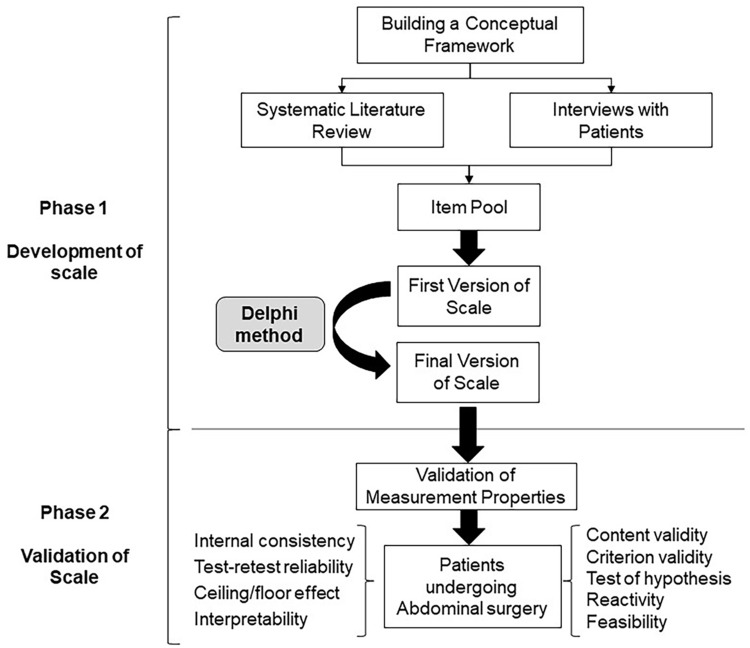
Patients and methods: The PRSA was developed through a new conceptual framework, systematic literature review, patient interview, and Delphi consultation. Then, the PRSA and the 15-item quality of recovery scale (QoR-15) were employed to evaluate the measurement properties of PRSA in 180 adult patients undergoing abdominal surgery.
Results: A 10-item PRSA scale was developed through a systematic review of 1602 literature, interviews with 138 patients, and two rounds of Delphi consultation. The correlation coefficient between the PRSA and QoR-15 ranged from 0.780 to 0.904 (P < 0.001), and the PRSA indicated great validity in distinguishing patients with complications. The internal consistency and test-retest reliability of the PRSA were satisfactory. Besides, the time to complete the PRSA was 27.5s (95% CI: 24.5-30.0 s) shorter than QoR-15, and more patients thought that completing the PRSA was easy compared to QoR-15 (65.7% vs 57.2%, P < 0.001).
Conclusion: The PRSA scale is a universal patient-reported outcome measure that can be utilized for evaluating postoperative recovery. It shows great measurement properties in patients undergoing abdominal surgery.
期刊介绍:
Patient Preference and Adherence is an international, peer reviewed, open access journal that focuses on the growing importance of patient preference and adherence throughout the therapeutic continuum. The journal is characterized by the rapid reporting of reviews, original research, modeling and clinical studies across all therapeutic areas. Patient satisfaction, acceptability, quality of life, compliance, persistence and their role in developing new therapeutic modalities and compounds to optimize clinical outcomes for existing disease states are major areas of interest for the journal.
As of 1st April 2019, Patient Preference and Adherence will no longer consider meta-analyses for publication.





 京公网安备 11010802042870号
京ICP备2023020795号-1
京公网安备 11010802042870号
京ICP备2023020795号-1

 分享
分享
 求助内容:
求助内容: 应助结果提醒方式:
 扫码关注我们
